. 2018 Sep 21;13(9):e0204283.
doi: 10.1371/journal.pone.0204283. eCollection 2018.

Role of altered proteostasis network in chronic hypobaric hypoxia induced skeletal muscle atrophy

Affiliations

Role of altered proteostasis network in chronic hypobaric hypoxia induced skeletal muscle atrophy

Akanksha Agrawal et al. PLoS One. .

Abstract

Background: High altitude associated hypobaric hypoxia is one of the cellular and environmental perturbation that alters proteostasis network and push the healthy cell towards loss of muscle mass. The present study has elucidated the robust proteostasis network and signaling mechanism for skeletal muscle atrophy under chronic hypobaric hypoxia (CHH).

Methods: Male Sprague Dawley rats were exposed to simulated hypoxia equivalent to a pressure of 282 torr for different durations (1, 3, 7 and 14 days). After CHH exposure, skeletal muscle tissue was excised from the hind limb of rats for biochemical analysis.

Results: Chronic hypobaric hypoxia caused a substantial increase in protein oxidation and exhibited a greater activation of ER chaperones, glucose-regulated protein-78 (GRP-78) and protein disulphide isomerase (PDI) till 14d of CHH. Presence of oxidized proteins triggered the proteolytic systems, 20S proteasome and calpain pathway which were accompanied by a marked increase in [Ca2+]. Upregulated Akt pathway was observed upto 07d of CHH which was also linked with enhanced glycogen synthase kinase-3β (GSk-3β) expression, a negative regulator of Akt. Muscle-derived cytokines, tumor necrosis factor-α (TNF-α), interferon-ϒ (IFN-©) and interleukin-1β (IL-1β) levels significantly increased from 07d onwards. CHH exposure also upregulated the expression of nuclear factor kappa-B (NF-κB) and E3 ligase, muscle atrophy F-box-1 (Mafbx-1/Atrogin-1) and MuRF-1 (muscle ring finger-1) on 07d and 14d. Further, severe hypoxia also lead to increase expression of ER-associated degradation (ERAD) CHOP/ GADD153, Ub-proteasome and apoptosis pathway.

Conclusions: The disrupted proteostasis network was tightly coupled to degradative pathways, altered anabolic signaling, inflammation, and apoptosis under chronic hypoxia. Severe and prolonged hypoxia exposure affected the protein homeostasis which overwhelms the muscular system and tends towards skeletal muscle atrophy.


Conflict of interest statement

The authors have declared that no competing interests exist.

Figures

Fig 1
Fig 1. Effect of chronic hypoxia on appendicular body parameters.
(A) Ratio of skeletal muscle weight & tibial length of rats (B) Creatine phosphokinase (CPK) *p<0.05 Vs. Control; **p<0.01 Vs. Control; ***p<0.001 Vs. Control.
Fig 2
Fig 2. Presence of oxidized/misfolded proteins activates protein degradative pathways.
(A) Protein Carbonylation (B) Advanced Oxidized protein product (AOPP) (C) Chymotrypsin-like 20 proteasome activity (D) Calpain activity (E) Intracellular Calcium ion (F) Representative western blots for expression of ER chaperones of skeletal muscle cytoplasmic extracts. (n = 3) and (G-H) Semiquantitative analysis of the expression of GRP-78 and PDI. GAPDH considered as the loading control. The densitometric analysis is shown as mean with standard error (bars) performed in n = 3 independent experiments. *p<0.05 Vs. Control; **p<0.01 Vs. Control; ***p<0.001 Vs. Control.
Fig 3
Fig 3. Anabolic signalling / protein translational machinery response under chronic hypoxia insult.
(A) Representative western blots for expression of protein synthesis cascade, in skeletal muscles tissues cytoplasmic extracts. GAPDH considered as the loading control and (B-E) Semiquantitative analysis of the expression of total-Akt, p-Akt, p70S6kinase and GSK-3β respectively is presented in the graphs. The densitometric analysis is shown as mean with standard error (bars) performed in n = 3 independent experiments. *p<0.05 Vs. Control; **p<0.01 Vs. Control; ***p<0.001 Vs. Control.
Fig 4
Fig 4. Effect of chronic hypoxia on inflammatory signaling.
(A) IFN-ϒ (B) IL-1β, and (C) TNF-α. All values presented as mean ± SEM. *p<0.05 Vs. Control; **p<0.01 Vs. Control; ***p<0.001 Vs.Control.
Fig 5
Fig 5. Upregulated NF-κB and E3 ligase mediated protein degradation in response to chronic hypoxia.
(A) Representative western blots for expression of NF-κB and Mafbx-1 in skeletal muscles and (BD) Semiquantitative analysis of the expression of NF-κB, MAFbx-1and MuRF-1 is presented in the graph. The densitometric analysis is shown as mean ± SEM performed in n = 3 independent experiments. *p<0.05 Vs. Control; **p<0.01 Vs. Control; ***p<0.001 Vs. Control.
Fig 6
Fig 6. Chronic hypoxia led to the activation of apoptotic signaling cascade.
(A) Representative western blots for expression of CHOP/GADD153 from the cytoplasmic extracts of skeletal muscle. (B) Semiquantitative analysis of the expression of ER associated degradation, CHOP/GADD153. GAPDH considered as the loading control. The densitometric analysis is shown as mean with standard error (bars) performed in n = 3 independent experiments. Specific colorimetric peptide substrate has been used for particular caspases in cellular fuction. Activity of caspase-3 and caspase-9 was measured using colorimetric substrate Ac-Asp-Glu-Val-Asp p-Nitroaniline and Ac-Leu-Glu-His-Asp-pNA. The cysteine protease activity of (C) Caspase-3 and (D) Caspase-9 cleaves the substrate and releases pNA, the absorbance of which can be measured at 405 nm, and the (E) Annexin-V was measured by ELISA kit. All values presented as mean ± SEM. *p<0.05 Vs. Control; **p<0.01 Vs. Control; ***p<0.001 Vs. Control.
Fig 7
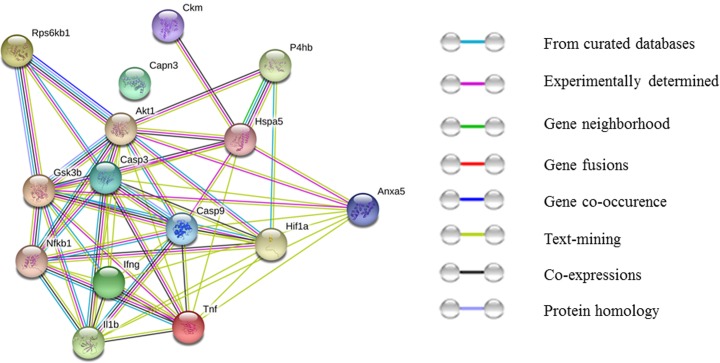
Fig 7. The network analysis of proteins differentiated expressed in chronic hypobaric hypoxia exposed groups using STRING 10.0.
Fig 8
Fig 8. Diagrammatic representation of mechanism approach to elucidate the chronic hypobaric hypoxia induced muscle atrophy.

References

    1. Hoppeler H, Klossner S, Vogt M. Training in hypoxia and its effects on skeletal muscle tissue. Scand J Med Sci Sports. 2008; 18: 38–49. 10.1111/j.1600-0838.2008.00831.x - DOI - PubMed
    1. Agrawal A, Rathor R, Suryakumar G. Oxidative protein modification alters proteostasis under acute hypobaric hypoxia in skeletal muscles: a comprehensive in vivo study. Cell Stress and Chaperones. 2017; 22: 429–443. 10.1007/s12192-017-0795-8 - DOI - PMC - PubMed
    1. Costello MO. Muscle adaptation to altitude: tissue capillarity and capacity for aerobic metabolism. High Alt Med Biol. 2001; 3: 413–25. - PubMed
    1. Bharadwaj H, Prasad J, Pramanik SN, Kishnani S, Zachariah T, Chaudhary KL et al. Effect of prolonged exposure to high altitude on skeletal muscles of Indian soldiers. Def Sci J. 2000; 50:167–176.
    1. Hoppeler H, Vogt M. Muscle tissue adaptations to hypoxia. J Exp Biol. 2000; 204:3133–3139 - PubMed

Publication types