


Survival and years of life lost in various aetiologies of dementia, mild cognitive impairment (MCI) and subjective cognitive decline (SCD) in Norway
- PMID: 30240425
- PMCID: PMC6150521
- DOI: 10.1371/journal.pone.0204436
Survival and years of life lost in various aetiologies of dementia, mild cognitive impairment (MCI) and subjective cognitive decline (SCD) in Norway
Abstract
Introduction: Alzheimer's disease patients are reported to have higher survival rate compared to patients with vascular dementia or dementia with Lewy bodies. There is a paucity of studies investigating survival including persons with cognitive decline and dementia of various aetiologies.
Objectives: We aimed to compare survival for patients with subjective cognitive decline, mild cognitive impairment, Alzheimer's disease, vascular dementia, mixed Alzheimer's/vascular dementia, dementia with Lewy bodies/Parkinson's disease, and other dementias compared to the general Norwegian population, taking into account the role of gender, cognitive function, function in everyday activities, comorbidity and education.
Methods: Patients (N = 4682), ≥65 years, in the The Norwegian register of persons assessed for cognitive symptoms (NorCog) during 2009-2017 were followed for mortality in the National Registry until January 2018. Flexible parametric survival models were applied to estimate relative survival, life expectancy and years of life lost for diagnostic groups compared with the general population.
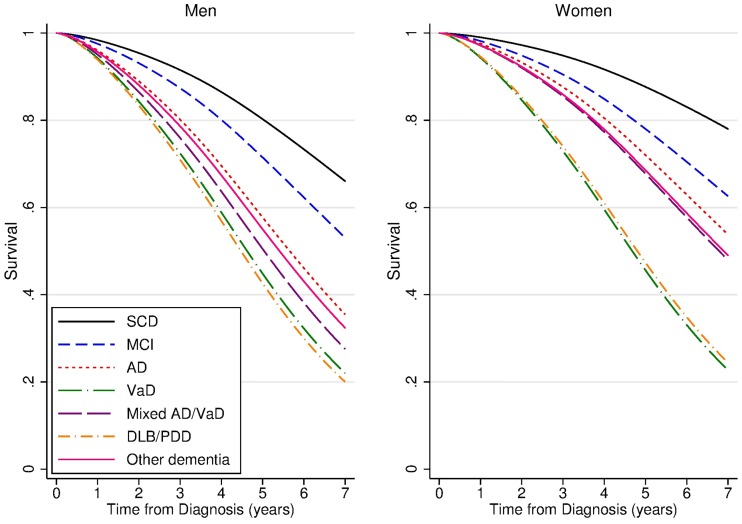
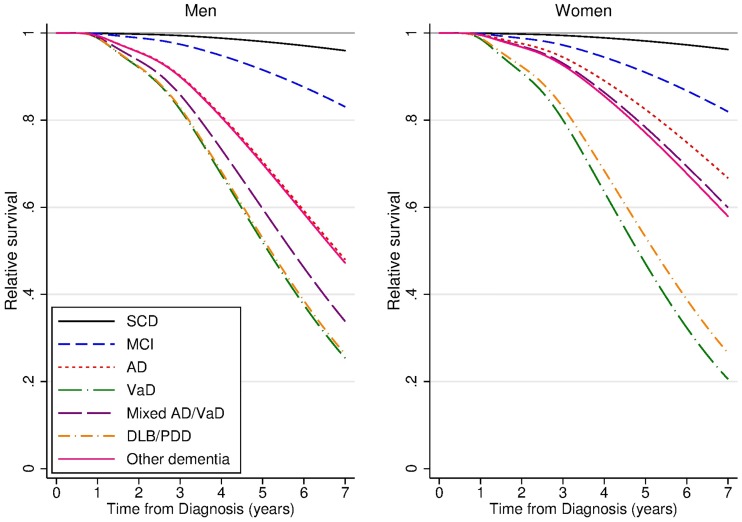
Results: Patients with vascular dementia or dementia with Lewy bodies/Parkinson's had the shortest survival, followed by mixed dementia, Alzheimer's disease, unspecified dementia, mild cognitive impairment and subjective cognitive decline. At age 70 years, men with vascular dementia or dementia with Lewy bodies/Parkinson's had life expectancy of 4.7 years, which corresponded to 10.3 years of life lost compared to the general population. Years of life lost for other diagnoses were 10.0 years for mixed dementia, 9.2 years for Alzheimer's disease, 9.3 years for other dementias, 5.2 years for mild cognitive impairment and 2.2 years for subjective cognitive decline. Corresponding years of life lost in women were: 12.7 years, 10.5 years, 9.8 years, 10.6 years, 7.8 years, and 2.6 years. Poor relative survival among dementia patients was associated with male gender, comorbidity, low cognitive function, and low function in activities of daily living.
Conclusions: Compared with the general population, patients with subjective cognitive decline had no significant loss in life expectancy, while patients with mild cognitive impairment and all dementia subtypes had large losses, especially those with a diagnosis of vascular dementia or dementia with Lewy bodies/Parkinson's.
Conflict of interest statement
The authors declare no conflicts of interest. Dr. Edwin reports personal fees and other from Roche BN29553, personal fees and other from Boehringer-Ingelheim 1346.0023, outside the submitted work; Dr. Persson reports other from Roche, outside the submitted work; Dr. Knapskog reports other from Roche, from Boehringer-Ingelheim, outside the submitted work. This does not alter our adherence to PLOS ONE policies on sharing data and materials.
Figures
References
-
- Garcia-Ptacek S, Farahmand B, Kareholt I, Religa D, Cuadrado ML, Eriksdotter M. Mortality risk after dementia diagnosis by dementia type and underlying factors: A cohort of 15,209 patients based on the Swedish Dementia Registry. Journal of Alzheimer’s Disease. 2014;41(2):467–77. 10.3233/JAD-131856 - DOI - PubMed
Publication types
MeSH terms
LinkOut - more resources
Full Text Sources
Other Literature Sources
Medical
