Global Survey of Clinical Oncology Workforce
- PMID: 30241241
- PMCID: PMC6223442
- DOI: 10.1200/JGO.17.00188
Global Survey of Clinical Oncology Workforce
Abstract
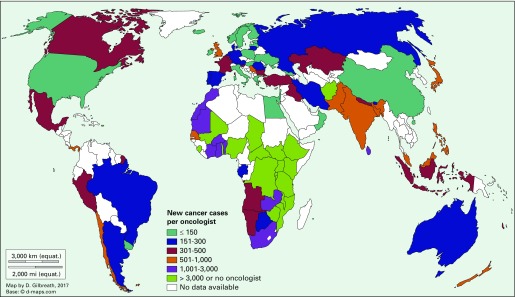
A lack of well-trained clinical oncologists can result in significant cancer health disparities. The magnitude of this problem around the world is poorly described in the literature. A comprehensive global survey of the clinical oncology workforce was conducted. Data on the number of clinical oncologists in 93 countries were obtained from 30 references. The mortality-to-incidence ratio was estimated by using data on incidence and mortality rates from the GLOBOCAN 2012 database; the ratio was > 70% in 26 countries (28%), which included 21 countries in Africa (66%) and five countries in Asia (26%). Eight countries had no clinical oncologist available to provide care for patients with cancer. In 22 countries (24%), a clinical oncologist would provide care for < 150 patients with a new diagnosis of cancer. In 39 countries (42%), a clinical oncologist would provide care for > 500 patients with cancer. In 27 countries (29%), a clinical oncologist would provide care for > 1,000 incident cancers, of which 25 were in Africa, two were in Asia, and none were in Europe or the Americas. The economic and social development status of a country correlates closely with the burden of cancer and the shortage of human resources. Addressing the shortage of clinical oncologists in regions with a critical need will help these countries meet the sustainable development goals for noncommunicable diseases by 2030.
Figures
References
-
- Siegel RL, Miller KD, Jemal A. Cancer statistics, 2017. CA Cancer J Clin. 2017;67:7–30. - PubMed
-
- Fitzmaurice C, Allen C, Barber RM, et al. Global, regional, and national cancer incidence, mortality, years of life lost, years lived with disability, and disability-adjusted life-years for 32 cancer groups, 1990 to 2015: A systematic analysis for the Global Burden of Disease Study. JAMA Oncol. 2017;3:524–548. - PMC - PubMed
-
- Yang W, Williams JH, Hogan PF, et al. Projected supply of and demand for oncologists and radiation oncologists through 2025: An aging, better-insured population will result in shortage. J Oncol Pract. 2014;10:39–45. - PubMed
-
- International Agency for Research on Cancer GLOBOCAN: 2012. http://globocan.iarc.fr
MeSH terms
LinkOut - more resources
Full Text Sources
Other Literature Sources