


Leveraging EUnetHTA's conceptual framework to compare HTA decision drivers in France, Italy, and Germany from a manufacturer's point of view
- PMID: 30242522
- PMCID: PMC6755607
- DOI: 10.1186/s13561-018-0201-y
Leveraging EUnetHTA's conceptual framework to compare HTA decision drivers in France, Italy, and Germany from a manufacturer's point of view
Abstract
Background: Health Technology Assessments (HTA) procedures differ substantially across the various European countries. We reviewed recent appraisals of a pharmaceutical manufacturer in three major European markets (France; Italy; Germany) and identified and categorized related decision drivers.
Methods: New marketing authorisation between January 2011 and August 2017, and Roche being the Marketing Authorization Holder, were included. Outcome of HTA appraisals by the Haute Autorité de Santé (HAS), Agenzia Italiana del Farmaco (AIFA), and Federal Joint Committee (Gemeinsamer Bundesausschuss, G-BA) were reviewed. Respective decision drivers were identified and commonalities and differences across the three countries were determined leveraging the EUnetHTA conceptual taxonomy (i.e. the 9 domains of the EUnetHTA core model).
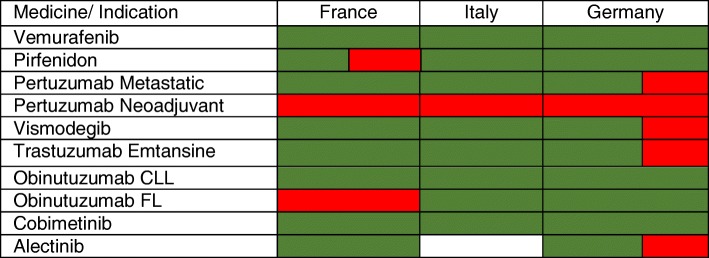
Results: Within that time period Roche received European marketing authorization for eight new molecular entities (10 indications, respectively). Outcome of HTA appraisals was heterogeneous across the three countries. However, the four clinical domains of the EUnetHTA core model were driving the national HTA appraisals, with the clinical effectiveness domain being of most importance. Important drivers related to the other three clinical domains included the target patient population (subgroups, Germany), the current management of the condition (unmet need, Italy), the regulatory status (Orphan Designation, Germany), as well as safety considerations (all three countries). Average time between EMA approval and full commercial availability of new medicines was 63 (Germany), 459 (Italy), and 557 days (France).
Conclusions: The clinical domains of the EUnetHTA framework are mainly driven by national HTA appraisals, providing a suitable starting point for further developing a joint European view on value and evidence. Underlying topics and issues still reveal considerable differences.
Keywords: AIFA; Appraisal; EUnetHTA Core model; G-BA; HAS; Health technology assessment; Innovation.
Conflict of interest statement
GG, FC, DT, MG, AH, PR are Roche Employees.
JR received funding by Roche for preparing the manuscript.
Figures
References
-
- Gazzetta Ufficiale; 2004; Anno 145o, Numero 228. http://www.agenziafarmaco.gov.it/sites/default/files/DM_2004_245.pdf. (Access 20 Dec 2017).
-
- République Française. Le Service Public De La Diffusion du Droit. Loi no 2004–810 du 13 août 204 page 14598 texte no 2 https://www.legifrance.gouv.fr/affichTexte.do?cidTexte=JORFTEXT000000625.... (Access 20 Dec 2017).
-
- Gemeinsamer Bundesausschuss http://www.english.g-ba.de/benefitassessment/information/#2. (Access 20 Dec 2017).
-
- European Commission: Strengthening of the EU cooperation on Health Technology Assessment (HTA). Online pubic consultation report. https://ec.europa.eu/health/sites/health/files/technology_assessment/doc.... (Access 20 Feb 2018).
-
- Berntgen M, Gourvil A, Pavlovic M, et al. Improving the contribution of regulatory assessment reports to health technology assessments – a collaboration between the European medicines agency and the European network for HealthTechnology assessment. Value Health. 2014;17:634–641. doi: 10.1016/j.jval.2014.04.006. - DOI - PubMed
LinkOut - more resources
Full Text Sources
Other Literature Sources
Research Materials
