Review
. 2018 Jan 1:17:1533033818801809.
doi: 10.1177/1533033818801809.

Liquid Biopsy Promotes Non-Small Cell Lung Cancer Precision Therapy

Affiliations
Review

Liquid Biopsy Promotes Non-Small Cell Lung Cancer Precision Therapy

Jun Lu et al. Technol Cancer Res Treat. .

Abstract

The range of potential applications of liquid biopsies for non-small cell lung cancer management is expanded by the use of circulating tumor deoxyribonucleic acid and circulating tumor cells. Principal studies have demonstrated the predictive accuracy of droplet digital polymerase chain reaction detection, next-generation sequencing, and circulating tumor cells detection in patients with non-small cell lung cancer. The translational potential of these liquid biopsy technologies promotes the improvement of sensitivity and specificity in genomic and molecular methods. Here, we highlight the realities and challenges associated with the use of liquid biopsies for the detection of non-small cell lung cancer in patients. However, liquid biopsy technologies including circulating tumor cells detection, droplet digital polymerase chain reaction detection, and next-generation sequencing detection for precision therapy in non-small cell lung cancer will show substantive clinical applications in the future.

Keywords: circulating tumor DNA; circulating tumor cells; liquid biopsy; non-small cell lung cancer; precision therapy.


Conflict of interest statement

Declaration of Conflicting Interests: The author(s) declared no potential conflicts of interest with respect to the research, authorship, and/or publication of this article.

Figures

Figure 1.
Figure 1.
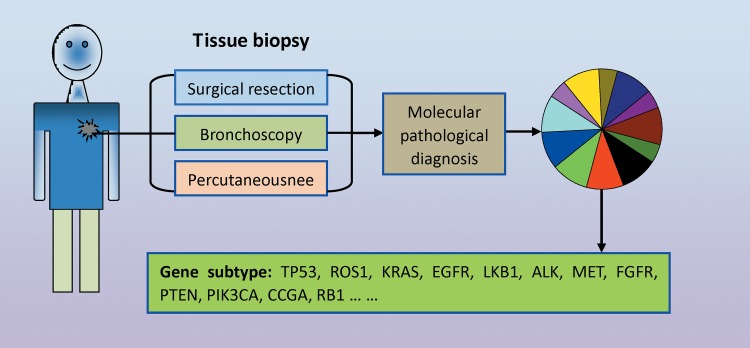
Gene subtype detection in lung cancer tissue biopsy. Cancer tissue in situ is taken out via invasive technologies including surgical resection, bronchoscopy, and percutaneous needle. Molecular pathological diagnosis technologies are performed to test alterations in the lung cancer driver gene including gene mutation, copy number variations, and fusion genes.
Figure 2.
Figure 2.
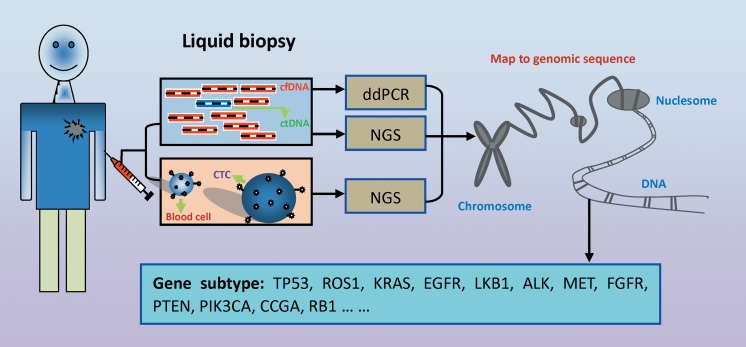
Gene subtype detection in circulating tumor DNA (ctDNA). Cell-free DNA (cfDNA) is isolated from blood collected from patients with lung cancer. Circulating tumor DNA accounts for a small ratio of cfDNA fragments. Droplet digital PCR (ddPCR) and next-generation sequencing (NGS) are performed to test alterations in the lung cancer driver gene including gene mutation, copy number variations, and fusion genes.
Figure 3.
Figure 3.
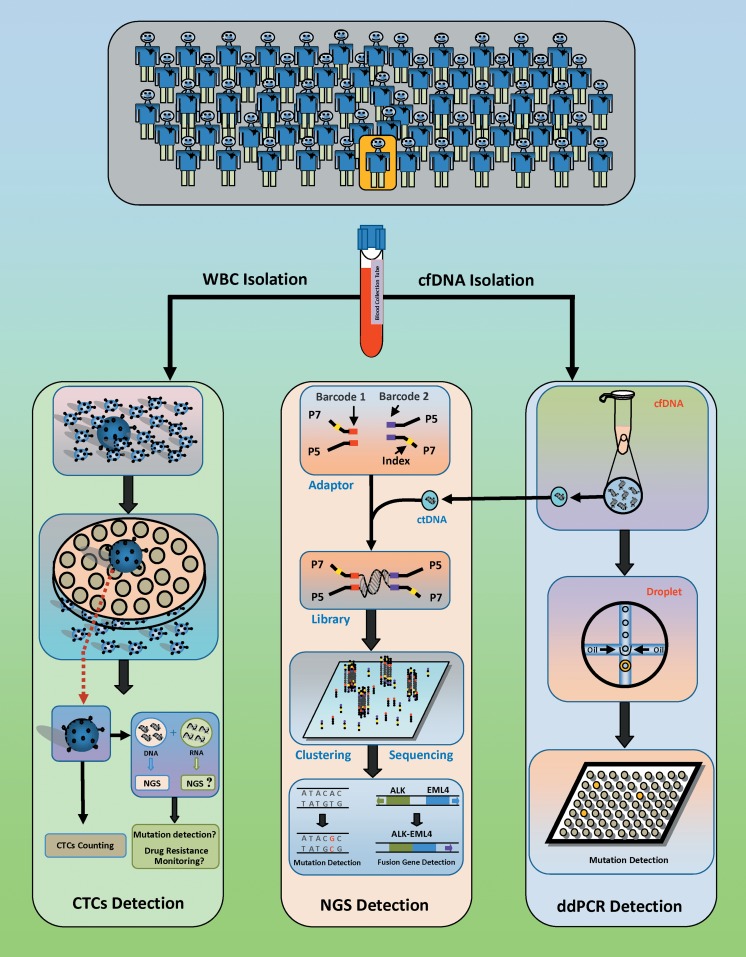
Circulating tumor cell detection and ctDNA detection used for lung cancer diagnosis. Circulating tumor cell capture is performed to isolate cells with large sizes. The number of CTCs is used as a reference for predicting the prognosis and survival time of patients with lung cancer. Circulating tumor DNA (ctDNA) is isolated from the blood of patients with lung cancer. Digital PCR (ddPCR) detection, a fluorescent probe-based PCR assay, is partitioned into highly uniform 1-nL reverse micelles (water-in-oil). After PCR amplification, the fluorescence of each droplet is individually measured and defined as positive (presence of PCR product) or negative (absence of PCR product). For NGS detection, a pair of index-based adaptors are ligated at the ends of the cfDNA fragment. During high-throughput sequencing, adaptor-ligated DNA fragments undergo amplification, clustering, and sequencing. Data are used for analysis of ctDNA point mutations, copy number variations, and chromosomal rearrangements. NGS indicates next-generation sequencing; PCR, polymerase chain reaction.

References

    1. Wan JC, Massie C, Garcia-Corbacho J, et al. Liquid biopsies come of age: towards implementation of circulating tumour DNA. Nat Rev Cancer. 2017;17(4):223–238. - PubMed
    1. Bennett CW, Berchem G, Kim YJ, El-Khoury V. Cell-free DNA and next-generation sequencing in the service of personalized medicine for lung cancer. Oncotarget. 2016;7(43):71013–71035. - PMC - PubMed
    1. Diaz LA, Jr, Bardelli A. Liquid biopsies: genotyping circulating tumor DNA. J Clin Oncol. 2014;32(6):579–586. - PMC - PubMed
    1. Lebofsky R, Decraene C, Bernard V, et al. Circulating tumor DNA as a non-invasive substitute to metastasis biopsy for tumor genotyping and personalized medicine in a prospective trial across all tumor types. Mol Oncol. 2015;9(4):783–790. - PMC - PubMed
    1. Esposito A, Criscitiello C, Locatelli M, Milano M, Curigliano G. Liquid biopsies for solid tumors: understanding tumor heterogeneity and real time monitoring of early resistance to targeted therapies. Pharmacol Ther. 2016;157:120–124. - PubMed

Publication types

MeSH terms

Substances

LinkOut - more resources