. 2019 Apr;21(4):948-954.
doi: 10.1038/s41436-018-0285-0. Epub 2018 Sep 24.

Splice-altering variant in COL11A1 as a cause of nonsyndromic hearing loss DFNA37

Affiliations

Splice-altering variant in COL11A1 as a cause of nonsyndromic hearing loss DFNA37

Kevin T Booth et al. Genet Med. 2019 Apr.

Abstract

Purpose: The aim of this study was to determine the genetic cause of autosomal dominant nonsyndromic hearing loss segregating in a multigenerational family.

Methods: Clinical examination, genome-wide linkage analysis, and exome sequencing were carried out on the family.

Results: Affected individuals presented with early-onset progressive mild hearing impairment with a fairly flat, gently downsloping or U-shaped audiogram configuration. Detailed clinical examination excluded any additional symptoms. Linkage analysis detected an interval on chromosome 1p21 with a logarithm of the odds (LOD) score of 8.29: designated locus DFNA37. Exome sequencing identified a novel canonical acceptor splice-site variant c.652-2A>C in the COL11A1 gene within the DFNA37 locus. Genotyping of all 48 family members confirmed segregation of this variant with the deafness phenotype in the extended family. The c.652-2A>C variant is novel, highly conserved, and confirmed in vitro to alter RNA splicing.

Conclusion: We have identified COL11A1 as the gene responsible for deafness at the DFNA37 locus. Previously, COL11A1 was solely associated with Marshall and Stickler syndromes. This study expands its phenotypic spectrum to include nonsyndromic deafness. The implications of this discovery are valuable in the clinical diagnosis, prognosis, and treatment of patients with COL11A1 pathogenic variants.

Keywords: COL11A1; DFNA37; exome sequencing; nonsyndromic hearing loss; splice-site variant.


Conflict of interest statement

The authors declare no conflicts of interest.

Figures
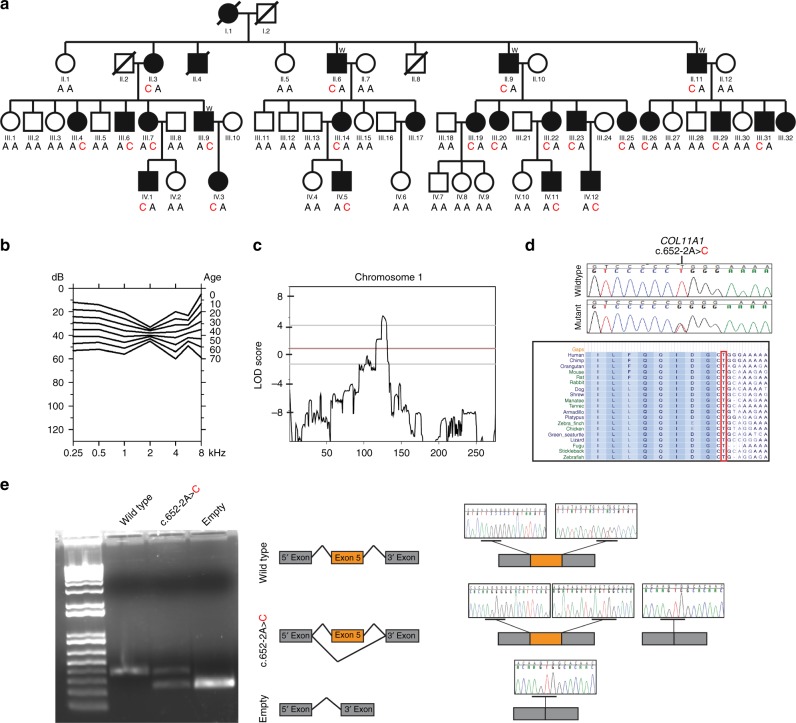
Fig. 1
Fig. 1. Genetic Analysis of c.652A>C variant in COL11A1.
a Family pedigree showing the segregation of the c.652-2A>C variant in COL11A1. Red and bold indicates the mutant allele. Circles and squares represent females and males, respectively. Filled symbols denote individuals with nonsyndromic hearing loss (NSHL) and nonfilled symbols show individuals with normal hearing. b Age-related typical audiograms (ARTA). Binaural mean air conduction thresholds (dB HL) are presented for the ages 10–60 years. c Parametric linkage analysis plot of chromosome 1. d Representative chromatograms from wild-type and mutant sequences. e Gel electrophoresis of wild-type COL11A1 exon 5, c.652-2A>C pathogenic variant, and the empty pET01 vector. The inclusion of exon 5 results in a 372-bp product and its exclusion results in a 234-bp band. Sequence chromatograms show read through at each exon junction. Results shown from COS7 experiments. LOD logarithm of the odds.
Fig. 2
Fig. 2
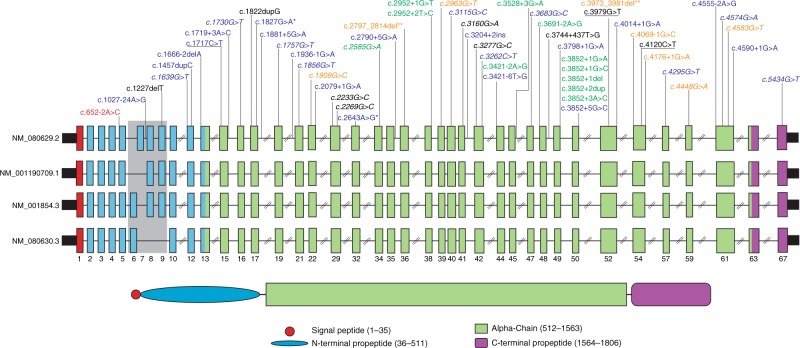
COL11A1 gene and protein schematic denoting reported pathogenic variants and their associated phenotypes. All variants were collected from the Deafness Variation Database (DVD; http://deafnessvariationdatabase.org/). The gray box shows the alternatively spliced exons. Text colored blue, black, green, and orange indicates the phenotypes associated with pathogenic variants in COL11A1: STL2, FBCG1, MRSHS, and STL2/MRSHS, respectively. Missense variants are in italics and nonsense variants are underlined. An asterisk (*) denotes a synonymous change, while a double asterisk (**) represents in-frame indels. The position of the c.652-2A>C pathogenic variant is shown in red and bold. Nucleotide numbering: the A of the ATG translation initiation site is noted as +1 using transcript NM_001854.3.

References

    1. Bork JM, Peters LM, Riazuddin S, Bernstein SL, Ahmed ZM, Ness SL, et al. Usher syndrome 1D and nonsyndromic autosomal recessive deafness DFNB12 are caused by allelic mutations of the novel cadherin-like gene CDH23. Am J Hum Genet. 2001;68:26–37. doi: 10.1086/316954. - DOI - PMC - PubMed
    1. Azaiez H, Booth KT, Bu F, Huygen P, Shibata SB, Shearer AE, et al. TBC1D24 mutation causes autosomal-dominant nonsyndromic hearing loss. Hum Mutat. 2014;35:819–823. doi: 10.1002/humu.22557. - DOI - PMC - PubMed
    1. Cryns K, Sivakumaran TA, Van den Ouweland JMW, Pennings RJE, Cremers CWRJ, et al. Mutational spectrum of the WFS1 gene in Wolfram syndrome, nonsyndromic hearing impairment, diabetes mellitus, and psychiatric disease. Hum Mutat. 2003;22:275–287. doi: 10.1002/humu.10258. - DOI - PubMed
    1. Rigoli L, Lombardo F, Di Bella C. Wolfram syndrome and WFS1 gene. Clin Genet. 2011;79:103–117. doi: 10.1111/j.1399-0004.2010.01522.x. - DOI - PubMed
    1. Richardson GP, de Monvel JB, Petit C. How the genetics of deafness illuminates auditory physiology. Annu Rev Physiol. 2011;73:311–334. doi: 10.1146/annurev-physiol-012110-142228. - DOI - PubMed

Publication types

Supplementary concepts