


Long-range haplotype analysis of the malaria parasite receptor gene ACKR1 in an East-African population
- PMID: 30245840
- PMCID: PMC6138691
- DOI: 10.1038/s41439-018-0024-8
Long-range haplotype analysis of the malaria parasite receptor gene ACKR1 in an East-African population
Abstract
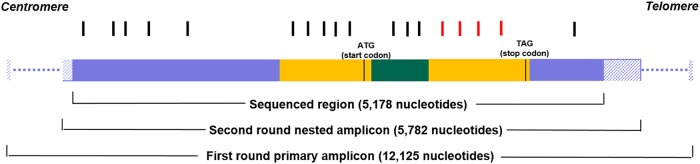
The human ACKR1 gene encodes a glycoprotein expressing the Duffy blood group antigens (Fy). The Duffy protein acts as a receptor for distinct pro-inflammatory cytokines and malaria parasites. We determined the haplotypes of the ACKR1 gene in a population inhabiting a malaria-endemic area. We collected blood samples from 60 healthy volunteers in Ethiopia's southwestern low-altitude tropical region. An assay was devised to amplify the ACKR1 gene as a single amplicon and determine its genomic sequence. All haplotypes were resolved at 5178 nucleotides each, covering the coding sequence (CDS) of the ACKR1 gene and including the 5'- and 3'-untranslated regions (UTR), intron 1, and the 5'- and 3'-flanking regions. When necessary, allele-specific PCR with nucleotide sequencing or length polymorphism analysis was applied. Among the 120 chromosomes analyzed, 18 ACKR1 alleles were confirmed without ambiguity. We found 18 single-nucleotide polymorphisms (SNPs); only one SNP was novel. The non-coding sequences harbored 14 SNPs. No SNP, other than c.-67T>C, indicative of a non-functional allele, was detected. We described haplotypes of the ACKR1 gene in an autochthonous East-African population and found 18 distinct ACKR1 alleles. These long-range alleles are useful as templates to phase and analyze next-generation sequencing data, thus enhancing the reliability of clinical diagnostics.
Conflict of interest statement
The authors declare that they have no conflict of interest.
Figures
References
-
- Hadley TJ, Peiper SC. From malaria to chemokine receptor: the emerging physiologic role of the Duffy blood group antigen. Blood. 1997;89:3077–3091. - PubMed
Grants and funding
LinkOut - more resources
Full Text Sources
Other Literature Sources
