Nursing attitudes towards continuous capnographic monitoring of floor patients
- PMID: 30246157
- PMCID: PMC6144903
- DOI: 10.1136/bmjoq-2018-000416
Nursing attitudes towards continuous capnographic monitoring of floor patients
Abstract
Introduction: Nurses' perceptions of the utility of capnography monitoring are inconsistent in previous studies. We sought to outline the limitations of a uniform education effort in bringing about consistent views of capnography among nurses.
Methods: A survey was administered to 22 nurses in three subacute care floors participating in a pragmatic clinical trial employing capnography monitoring in a large, urban tertiary care hospital. A 5-point Likert scale was used to assess the value and acceptance nurses ascribed to the practice. Means and SD were calculated for each response.
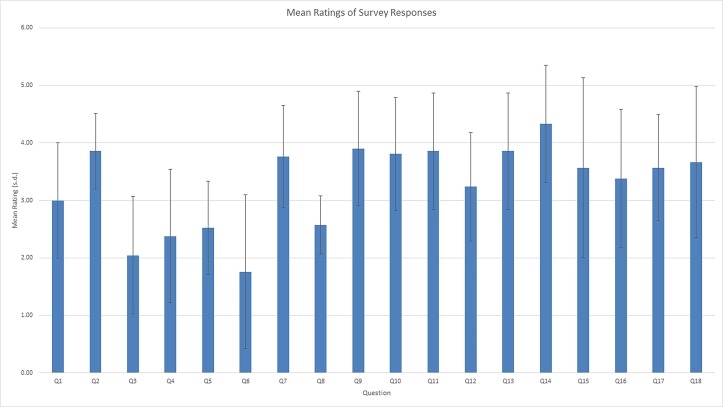
Results: Survey results indicated inconsistency in the valuation of capnography, coupled with varying degrees of acceptance of its use. The mean for the level of perceived impact of capnography use on patient safety was 3.86, yet the perceived risk of removing capnography was represented by a mean of 2.57. The levels of urgency attached to apnoea alarms (mean 3.57, SD 1.57) were lower than those for alarms for oxygen saturation violations (mean 3.67, SD 1.32). The necessity for pulse oximetry monitoring was perceived as much higher than that for capnography monitoring (mean 1.76, SD 1.34), where '1' represented pulse oximetry as more necessary and '5' represented capnography as more necessary.
Conclusions: Nursing acceptance of capnography monitoring is a difficult endpoint to achieve. There is a need for better accounting for the external and internal influences on nurse perceptions and values to have greater success with the implementation of similar monitoring.
Keywords: adverse events, epidemiology and detection; attitudes; cognitive biases; continuing education, continuing professional development; hospital medicine.
Conflict of interest statement
Competing interests: None declared.
Figures
References
Grants and funding
LinkOut - more resources
Full Text Sources
Other Literature Sources