


Peripherally Inserted Central Catheters in the ICU: A Retrospective Study of Adult Medical Patients in 52 Hospitals
- PMID: 30247241
- PMCID: PMC6317857
- DOI: 10.1097/CCM.0000000000003423
Peripherally Inserted Central Catheters in the ICU: A Retrospective Study of Adult Medical Patients in 52 Hospitals
Abstract
Objectives: To quantify variation in use and complications from peripherally inserted central catheters placed in the ICU versus peripherally inserted central catheters placed on the general ward.
Design: Retrospective cohort study.
Setting: Fifty-two hospital Michigan quality collaborative.
Patients: Twenty-seven-thousand two-hundred eighty-nine patients with peripherally inserted central catheters placed during hospitalization.
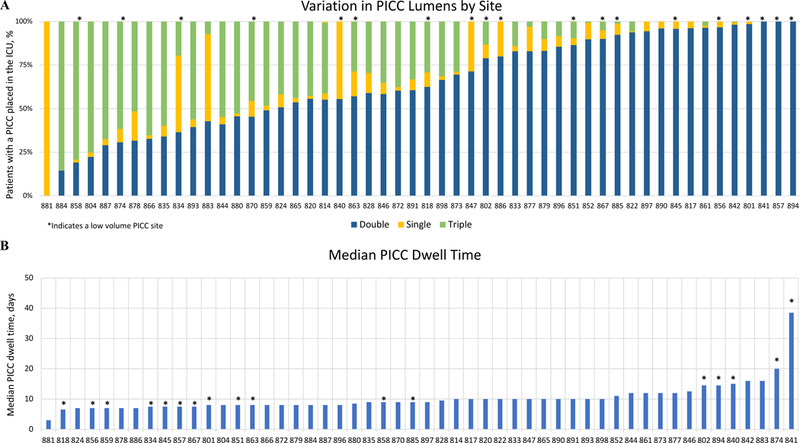
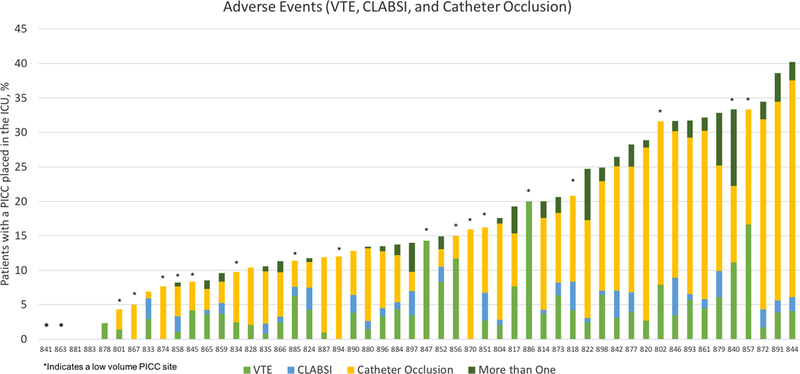
Measurements and main results: Descriptive statistics were used to summarize patient, provider, and device characteristics. Bivariate tests were used to assess differences between peripherally inserted central catheters placed in the ICU versus peripherally inserted central catheters placed on the ward. Multilevel mixed-effects generalized linear models adjusting for patient and device factors with a logit link clustered by hospital were used to examine the association between peripherally inserted central catheter complications and location of peripherally inserted central catheter placement. Variation in ICU peripherally inserted central catheter use, rates of complications, and appropriateness of use across hospitals was also examined. Eight-thousand two-hundred eighty patients (30.3%) received peripherally inserted central catheters in the ICU versus 19,009 (69.7%) on the general ward. The commonest indication for peripherally inserted central catheter use in the ICU was difficult IV access (35.1%) versus antibiotic therapy (53.3%) on wards. Compared with peripherally inserted central catheters placed in wards, peripherally inserted central catheters placed in the ICU were more often multilumen (59.5% vs 39.3; p < 0.001) and more often associated with a complication (odds ratio, 1.30; 95% CI, 1.18-1.43; p < 0.001). Substantial variation in ICU peripherally inserted central catheter use and outcomes across hospitals was observed, with median peripherally inserted central catheter dwell time ranging from 3 to 38.5 days (p < 0.001) and complications from 0% to 40.2% (p < 0.001). Importantly, 87% (n = 45) of ICUs reported median peripherally inserted central catheter dwell times less than or equal to 14 days, a duration where traditional central venous catheters, not peripherally inserted central catheters, are considered appropriate by published criteria.
Conclusions: Peripherally inserted central catheter use in the ICU is highly variable, associated with complications and often not appropriate. Further study of vascular access decision-making in the ICU appears necessary.
Conflict of interest statement
Conflicts of Interests: The authors have no conflicts of interests to disclose.
The remaining authors have disclosed that they do not have any potential conflicts of interest.
Figures
References
-
- Climo M, Diekema D, Warren DK, et al.: Prevalence of the use of central venous access devices within and outside of the intensive care unit: results of a survey among hospitals in the prevention epicenter program of the Centers for Disease Control and Prevention. Infect Control Hosp Epidemiol 2003; 24: 942–945. - PubMed
-
- Lindgren S, Pikwer A, Ricksten SE, et al.: Survey of central venous catheterisation practice in Sweden. Acta Anaesthesiol Scand 2013; 57: 1237–1244. - PubMed
-
- McGee DC, Gould MK. Preventing complications of central venous catheterization. N Engl J Med 2003; 348: 1123–1133. - PubMed
-
- Taylor RW, Palagiri AV. Central venous catheterization. Crit Care Med 2007; 35: 1390–1396. - PubMed
-
- Raad I Intravascular-catheter-related infections. Lancet 1998; 351: 893–898. - PubMed
Publication types
MeSH terms
Grants and funding
LinkOut - more resources
Full Text Sources
Other Literature Sources
