


Estimating the False Positive Rate of Absent Somatosensory Evoked Potentials in Cardiac Arrest Prognostication
- PMID: 30247243
- PMCID: PMC6424571
- DOI: 10.1097/CCM.0000000000003436
Estimating the False Positive Rate of Absent Somatosensory Evoked Potentials in Cardiac Arrest Prognostication
Abstract
Objectives: Absence of somatosensory evoked potentials is considered a nearly perfect predictor of poor outcome after cardiac arrest. However, reports of good outcomes despite absent somatosensory evoked potentials and high rates of withdrawal of life-sustaining therapies have raised concerns that estimates of the prognostic value of absent somatosensory evoked potentials may be biased by self-fulfilling prophecies. We aimed to develop an unbiased estimate of the false positive rate of absent somatosensory evoked potentials as a predictor of poor outcome after cardiac arrest.
Data sources: PubMed.
Study selection: We selected 35 studies in cardiac arrest prognostication that reported somatosensory evoked potentials.
Data extraction: In each study, we identified rates of withdrawal of life-sustaining therapies and good outcomes despite absent somatosensory evoked potentials. We appraised studies for potential biases using the Quality in Prognosis Studies tool. Using these data, we developed a statistical model to estimate the false positive rate of absent somatosensory evoked potentials adjusted for withdrawal of life-sustaining therapies rate.
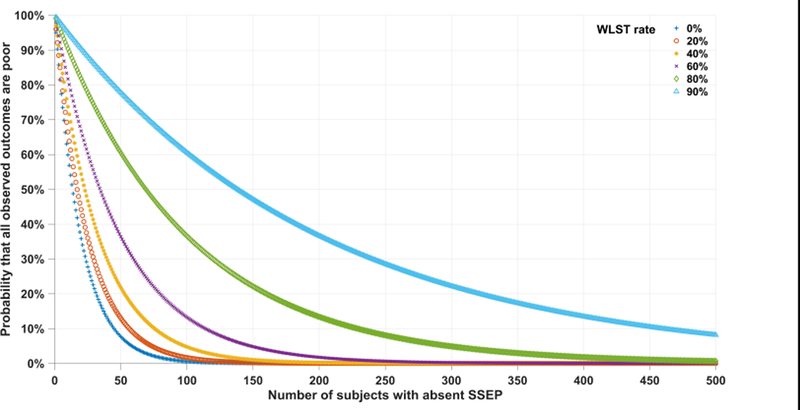
Data synthesis: Two-thousand one-hundred thirty-three subjects underwent somatosensory evoked potential testing. Five-hundred ninety-four had absent somatosensory evoked potentials; of these, 14 had good functional outcomes. The rate of withdrawal of life-sustaining therapies for subjects with absent somatosensory evoked potential could be estimated in 14 of the 35 studies (mean 80%, median 100%). The false positive rate for absent somatosensory evoked potential in predicting poor neurologic outcome, adjusted for a withdrawal of life-sustaining therapies rate of 80%, is 7.7% (95% CI, 4-13%).
Conclusions: Absent cortical somatosensory evoked potentials do not infallibly predict poor outcome in patients with coma following cardiac arrest. The chances of survival in subjects with absent somatosensory evoked potentials, though low, may be substantially higher than generally believed.
Figures


References
-
- Nielsen N, Wetterslev J, Cronberg T, et al. Targeted temperature management at 33 degrees C versus 36 degrees C after cardiac arrest. The New England journal of medicine 2013;369(23):2197–2206. - PubMed
-
- Wijdicks EF, Hijdra A, Young GB, et al. Practice parameter: prediction of outcome in comatose survivors after cardiopulmonary resuscitation (an evidence-based review): report of the Quality Standards Subcommittee of the American Academy of Neurology. Neurology 2006;67(2):203–210. - PubMed
-
- Sandroni C, Cariou A, Cavallaro F, et al. Prognostication in comatose survivors of cardiac arrest: an advisory statement from the European Resuscitation Council and the European Society of Intensive Care Medicine. Resuscitation 2014;85(12):1779–1789. - PubMed
-
- Leithner C, Ploner CJ, Hasper D, et al. Does hypothermia influence the predictive value of bilateral absent N20 after cardiac arrest? Neurology 2010;74(12):965–969. - PubMed
Publication types
MeSH terms
Grants and funding
LinkOut - more resources
Full Text Sources
Other Literature Sources
Medical
