


Children and adolescents with sickle cell disease have worse cold and mechanical hypersensitivity during acute painful events
- PMID: 30247266
- PMCID: PMC6768435
- DOI: 10.1097/j.pain.0000000000001407
Children and adolescents with sickle cell disease have worse cold and mechanical hypersensitivity during acute painful events
Abstract
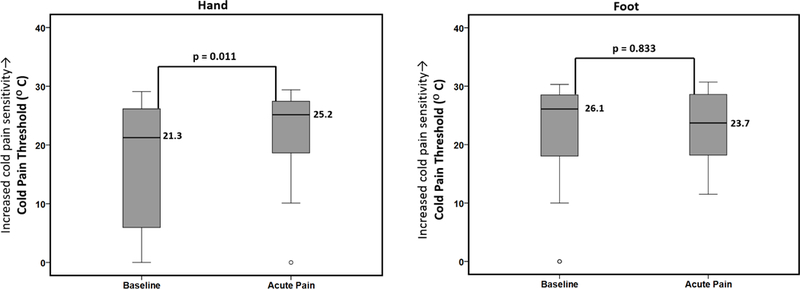
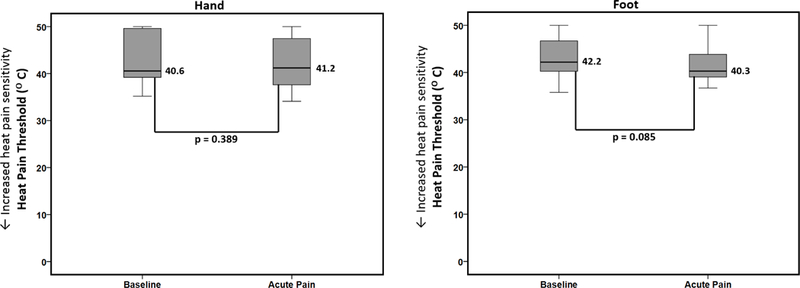
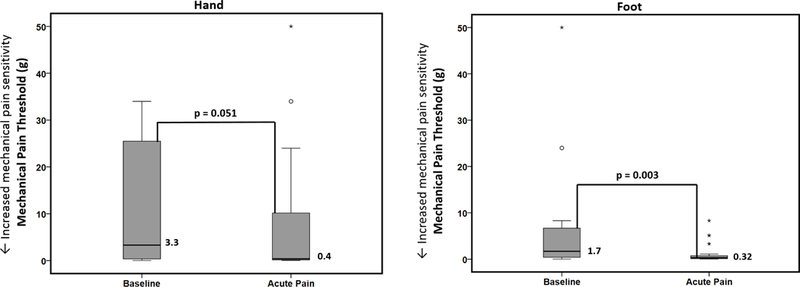
Sickle cell disease (SCD) pain associates with cold temperature and touch. Patients and murine models with SCD have baseline thermal and mechanical pain. In SCD mice, the baseline hypersensitivity is exacerbated by experimental vaso-occlusive crises. We hypothesized that patients with SCD will similarly experience increased hypersensitivity to thermal and mechanical stimuli during acute painful events compared with baseline health. We conducted a prospective study of 24 patients with SCD aged 7 to 19 years. Patients underwent quantitative sensory testing to thermal (cold/heat) and mechanical stimuli on the thenar eminence of the nondominant hand (glabrous skin) and the lateral dorsum of the foot (hairy skin) during baseline health and within 48 hours of hospitalization for acute pain. Primary outcomes were changes in: (1) cold pain threshold (°C), (2) heat pain threshold (°C), and (3) mechanical pain threshold (g). Median age was 10.5 (interquartile range [IQR] 9-14.8) years, 67% were females, and 92% were on hydroxyurea. Patients with SCD had increased cold pain sensitivity in the hand during hospitalization compared with baseline (25.2°C [IQR 18.4-27.5°C] vs 21.3°C [IQR 4.9-26.2°C]; P = 0.011) and increased mechanical pain sensitivity in the foot during hospitalization (0.32 g [IQR 0.09-1.1 g] vs 1.7 g [IQR 0.4-8.3 g]; P = 0.003). There were no differences in heat pain sensitivity. The increased cold (P = 0.02) and mechanical (P = 0.0016) pain sensitivity during hospitalization persisted after adjusting for age, sex, hydroxyurea use, opioid consumption, and numeric pain score. Thus, cold and mechanical pain is significantly worse during an acute SCD painful event as compared to baseline health in patients with SCD.
Conflict of interest statement
Conflict of interest statement
The authors declare no financial arrangements that represent a conflict of interest.
Figures
References
-
- Medoc TSA-II NeuroSensory Analyzer, Vol. 2011. pp. http://www.medoc-web.com/medoc_en_tsaII_analyzer.aspx.
-
- Arendt-Nielsen L, Curatolo M, Drewes A. Human experimental pain models in drug development: translational pain research. Curr Opin Investig Drugs 2007;8(1):41–53. - PubMed
-
- Backonja MM, Walk D, Edwards RR, Sehgal N, Moeller-Bertram T, Wasan A, Irving G, Argoff C, Wallace M. Quantitative sensory testing in measurement of neuropathic pain phenomena and other sensory abnormalities. Clin J Pain 2009;25(7):641–647. - PubMed
MeSH terms
Grants and funding
LinkOut - more resources
Full Text Sources
Other Literature Sources
Medical
