. 2018 Dec;36(11):1062-1066.
doi: 10.1038/nbt.4245. Epub 2018 Sep 24.

A CRISPR-Cas9 gene drive targeting doublesex causes complete population suppression in caged Anopheles gambiae mosquitoes

Affiliations

A CRISPR-Cas9 gene drive targeting doublesex causes complete population suppression in caged Anopheles gambiae mosquitoes

Kyros Kyrou et al. Nat Biotechnol. 2018 Dec.

Abstract

In the human malaria vector Anopheles gambiae, the gene doublesex (Agdsx) encodes two alternatively spliced transcripts, dsx-female (AgdsxF) and dsx-male (AgdsxM), that control differentiation of the two sexes. The female transcript, unlike the male, contains an exon (exon 5) whose sequence is highly conserved in all Anopheles mosquitoes so far analyzed. We found that CRISPR-Cas9-targeted disruption of the intron 4-exon 5 boundary aimed at blocking the formation of functional AgdsxF did not affect male development or fertility, whereas females homozygous for the disrupted allele showed an intersex phenotype and complete sterility. A CRISPR-Cas9 gene drive construct targeting this same sequence spread rapidly in caged mosquitoes, reaching 100% prevalence within 7-11 generations while progressively reducing egg production to the point of total population collapse. Owing to functional constraint of the target sequence, no selection of alleles resistant to the gene drive occurred in these laboratory experiments. Cas9-resistant variants arose in each generation at the target site but did not block the spread of the drive.


Conflict of interest statement

The authors declare no competing financial interests.

Figures
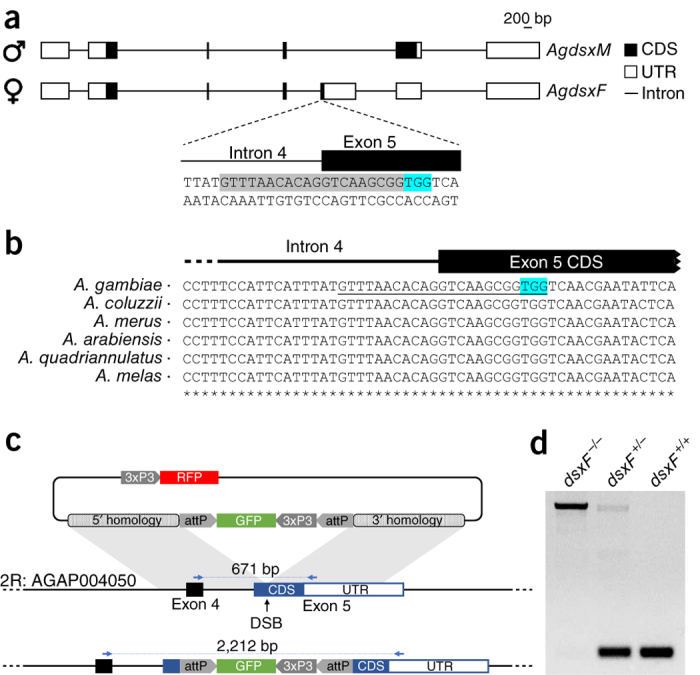
Figure 1
Figure 1. Targeting the female-specific isoform of doublesex.
(a) Schematic representation of the male- and female-specific dsx transcripts and the gRNA sequence used to target the gene (shaded in gray). The gRNA spans the intron 4–exon 5 boundary. The protospacer-adjacent motif (PAM) of the gRNA is highlighted in blue. Scale bar, 200 bp. Coding regions of exons (CDS) are shaded in black, noncoding regions in white. Introns are not drawn to scale. UTR, untranslated region. (b) Sequence alignment of the dsx intron 4–exon 5 boundary in six of the species from the A. gambiae complex. The sequence is highly conserved within the complex suggesting tight functional constraint at this region of the dsx gene. The gRNA used to target the gene is underlined and the protospacer-adjacent motif is highlighted in blue. (c) Schematic representation of the HDR knockout construct specifically recognizing exon 5 and the corresponding target locus. DSB, double-strand break. (d) Diagnostic PCR using a primer set (blue arrows in c) to discriminate between the wild-type and dsxF allele in homozygous (dsxF−/−), heterozygous (dsxF+/−) and wild-type (dsxF+/+) individuals.
Figure 2
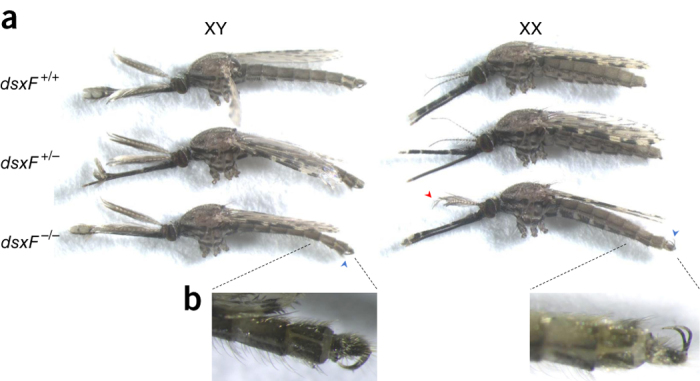
Figure 2. Morphological analysis of homozygous dsxF−/− mutants.
(a) Morphological appearance of genetic males and females heterozygous (dsxF+/−) or homozygous (dsxF−/−) for the exon 5 null allele. This assay was performed in a strain containing a dominant RFP marker linked to the Y chromosome, whose presence permits unambiguous determination of male or female genotype. Anomalies in sexual morphology were observed only in dsxF−/− genetic female mosquitoes. This group of XX individuals showed male-specific traits, including a plumose antenna (red arrowhead) and claspers (blue arrowheads). This group also showed anomalies in the proboscis and accordingly they could not bite and feed on blood. Representative samples of each genotype are shown. (b) Magnification of the external genitalia. All dsxF−/− females carried claspers, a male-specific characteristic. The claspers were dorsally rotated rather than in the normal ventral position.
Figure 3
Figure 3. Reproductive phenotype of dsxF mutants.
Male and female dsxF−/− and dsxF+/− individuals were mated with the corresponding wild-type sexes. Females were given access to a blood meal and subsequently allowed to lay individually. Fecundity was investigated by counting the number of larval progeny per lay (n ≥ 43). Using wild type (wt) as a comparator, we saw no significant differences ('ns') in any genotype other than dsxF−/− females, which were unable to feed on blood and therefore failed to produce a single egg (****P < 0.0001; Kruskal–Wallis test). Vertical bars indicate the mean and the s.e.m. Blue and red indicate the crosses of male or female dsxF mutants, respectively, to wild type, whereas the gray dots represent wild-type-only crosses.
Figure 4
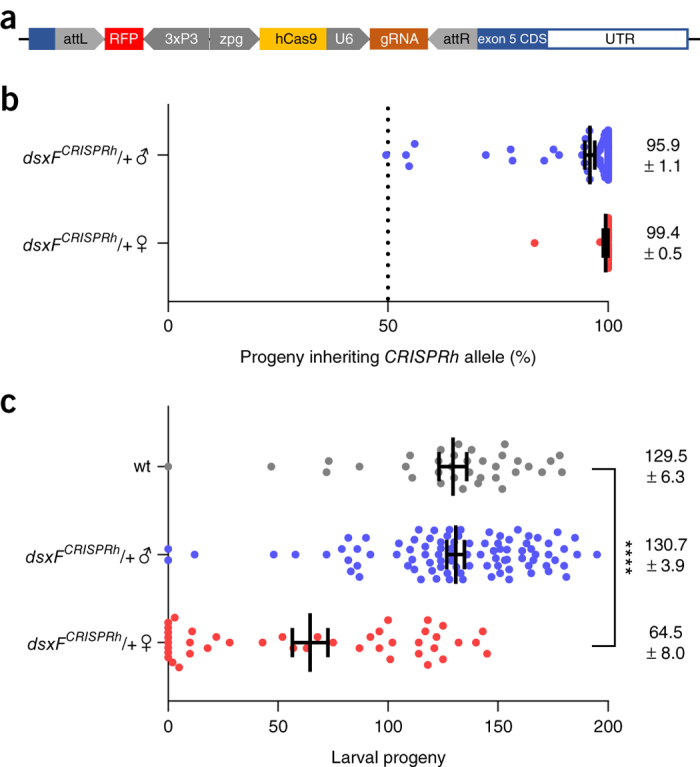
Figure 4. Transmission rate of the dsxFCRISPRh driving allele and fecundity analysis of heterozygous male and female mosquitoes.
(ac) Male and female mosquitoes heterozygous for the dsxFCRISPRh allele (a) were analyzed in crosses with wild-type mosquitoes to assess the inheritance bias of the dsxFCRISPRh drive construct (b) and for the effect of the construct on their reproductive phenotype (c). (b) Scatter plot of the transgenic rate observed in the progeny of dsxFCRISPRh/+ female or male mosquitoes that gave progeny when crossed to wild-type individuals (n ≥ 33). Each dot represents the progeny derived from a single female. Both male and female dsxFCRISPRh/+ showed a high transmission rate of up to 100% of the dsxFCRISPRh allele to the progeny. The transmission rate was determined by visually scoring offspring for the RFP marker that is linked to the dsxFCRISPRh allele. The dotted line indicates the expected Mendelian inheritance. Mean transmission rate (± s.e.m.) is shown. (c) Scatter plot showing the number of larvae produced by single females (n ≥ 35) from crosses of dsxFCRISPRh/+ mosquitoes with wild-type individuals after one blood meal. Mean progeny count (± s.e.m.) is shown (****P < 0.0001; Kruskal–Wallis test).
Figure 5
Figure 5. Dynamics of the spread of the dsxFCRISPRh allele and effect on population reproductive capacity.
Two cages were set up with a starting population of 300 wild-type females, 150 wild-type males and 150 dsxFCRISPRh/+ males, seeding each cage with a dsxFCRISPRh allele frequency of 12.5%. (a) The frequency of dsxFCRISPRh mosquitoes was scored for each generation. The drive allele reached 100% prevalence in both cage 2 (blue) and cage 1 (red) at generation 7 and 11, respectively, in agreement with a deterministic model (black line) that takes into account the parameter values retrieved from the fecundity assays. Twenty stochastic simulations were run (gray lines) assuming a maximum population size of 650 individuals. (b) Total egg output deriving from each generation of the cage was measured and normalized relative to the output from the starting generation. Suppression of the reproductive output of each cage led the population to collapse completely (black arrows) by generation 8 (cage 2) or generation 12 (cage 1). Parameter estimates included in the model are provided in Supplementary Table 5.

References

    1. Gantz VM, et al. Highly efficient Cas9-mediated gene drive for population modification of the malaria vector mosquito Anopheles stephensi. Proc. Natl. Acad. Sci. USA. 2015;112:E6736–E6743. doi: 10.1073/pnas.1521077112. - DOI - PMC - PubMed
    1. Hammond A, et al. A CRISPR-Cas9 gene drive system targeting female reproduction in the malaria mosquito vector Anopheles gambiae. Nat. Biotechnol. 2016;34:78–83. doi: 10.1038/nbt.3439. - DOI - PMC - PubMed
    1. Burt A. Site-specific selfish genes as tools for the control and genetic engineering of natural populations. Proc. Biol. Sci. 2003;270:921–928. doi: 10.1098/rspb.2002.2319. - DOI - PMC - PubMed
    1. Deredec A, Godfray HC, Burt A. Requirements for effective malaria control with homing endonuclease genes. Proc. Natl. Acad. Sci. USA. 2011;108:E874–E880. doi: 10.1073/pnas.1110717108. - DOI - PMC - PubMed
    1. Hamilton WD. Extraordinary sex ratios. A sex-ratio theory for sex linkage and inbreeding has new implications in cytogenetics and entomology. Science. 1967;156:477–488. doi: 10.1126/science.156.3774.477. - DOI - PubMed

Publication types