


Left ventricular global function index predicts incident heart failure and cardiovascular disease in young adults: the coronary artery risk development in young adults (CARDIA) study
- PMID: 30247530
- PMCID: PMC6477648
- DOI: 10.1093/ehjci/jey123
Left ventricular global function index predicts incident heart failure and cardiovascular disease in young adults: the coronary artery risk development in young adults (CARDIA) study
Abstract
Aims: Left ventricular (LV) ejection fraction (LVEF) is an extensively utilized marker of LV function that is often interpreted without recourse to alterations in LV geometry and hypertrophy. LV global function index (LVGFI) is a novel marker that incorporates LV structure in the assessment of LV cardiac performance. We evaluated the prognostic utility of LVGFI from young adulthood into middle age for incident heart failure (HF) and cardiovascular disease (CVD) in comparison to LVEF.
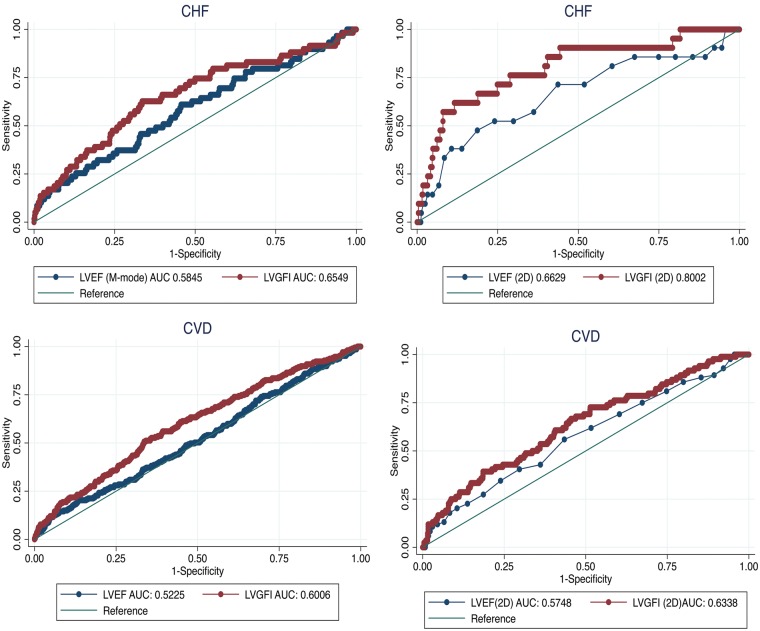
Methods and results: Included were 4107 CARDIA participants with echocardiograms in Year-5 (1990-1991). LVGFI was defined as LV stroke volume/LV global volume*100, where LV global volume was the sum of the LV mean cavity volume ((LV end-diastolic volume + LV end-systolic volume)/2) and myocardial volume (LV mass/density). Adjusted Cox proportional hazard models were utilized to predict incident HF and CVD outcomes. Mean age of participants was 29.8 ± 3.7 years, 55% female, and 48.7% black. Higher body mass index [beta coefficient (B) = -0.11 standard error (SE) = 0.02, P < 0.001], higher blood pressure (B = -0.04, SE = 0.01, P < 0.01), smoking (B = -0.82, SE = 0.22, P < 0.001), male sex (P < 0.001), and black race (P < 0.001) were associated with worse LVGFI. A total of 207 incident CVD events were observed over the course of 98 035 person-years at risk. Higher LVGFI was associated with HF, hazard ratio (HR) = 0.70, 95% confidence interval (CI) (0.54-0.91), hard CVD HR = 0.83, 95% CI (0.71-0.96), and all CVD HR = 0.83, 95% CI (0.72-0.96). For HF outcomes, Harrell's C-statistic for LVGFI (0.80) was greater than LVEF (0.66).
Conclusion: LVGFI is a strong, independent predictor of incident HF and CVD that provides incremental prognostic value compared with LVEF. Male sex, black race, obesity, hypertension, and smoking are associated with worse LVGFI in the early adult lifespan.
Keywords: cardiac function; cardiac structure; early adulthood; heart failure; left ventricular ejection fraction; left ventricular systolic function.
Published on behalf of the European Society of Cardiology. All rights reserved. © The Author(s) 2018. For permissions, please email: journals.permissions@oup.com.
Figures
References
-
- Kramer DG, Trikalinos TA, Kent DM, Antonopoulos GV, Konstam MA, Udelson JE.. Quantitative evaluation of drug or device effects on ventricular remodeling as predictors of therapeutic effects on mortality in patients with heart failure and reduced ejection fraction: a meta-analytic approach. J Am Coll Cardiol 2010;56:392–406. - PMC - PubMed
-
- Packer M. Heart failure with a mid-range ejection fraction: a disorder that a psychiatrist would love. JACC Heart Fail 2017;5:805–7. - PubMed
MeSH terms
LinkOut - more resources
Full Text Sources
Other Literature Sources
Medical
Research Materials
Miscellaneous
