. 2019 Jan 8;47(D1):D948-D954.
doi: 10.1093/nar/gky868.

The Comparative Toxicogenomics Database: update 2019

Affiliations

The Comparative Toxicogenomics Database: update 2019

Allan Peter Davis et al. Nucleic Acids Res. .

Abstract

The Comparative Toxicogenomics Database (CTD; http://ctdbase.org/) is a premier public resource for literature-based, manually curated associations between chemicals, gene products, phenotypes, diseases, and environmental exposures. In this biennial update, we present our new chemical-phenotype module that codes chemical-induced effects on phenotypes, curated using controlled vocabularies for chemicals, phenotypes, taxa, and anatomical descriptors; this module provides unique opportunities to explore cellular and system-level phenotypes of the pre-disease state and allows users to construct predictive adverse outcome pathways (linking chemical-gene molecular initiating events with phenotypic key events, diseases, and population-level health outcomes). We also report a 46% increase in CTD manually curated content, which when integrated with other datasets yields more than 38 million toxicogenomic relationships. We describe new querying and display features for our enhanced chemical-exposure science module, providing greater scope of content and utility. As well, we discuss an updated MEDIC disease vocabulary with over 1700 new terms and accession identifiers. To accommodate these increases in data content and functionality, CTD has upgraded its computational infrastructure. These updates continue to improve CTD and help inform new testable hypotheses about the etiology and mechanisms underlying environmentally influenced diseases.


Figures
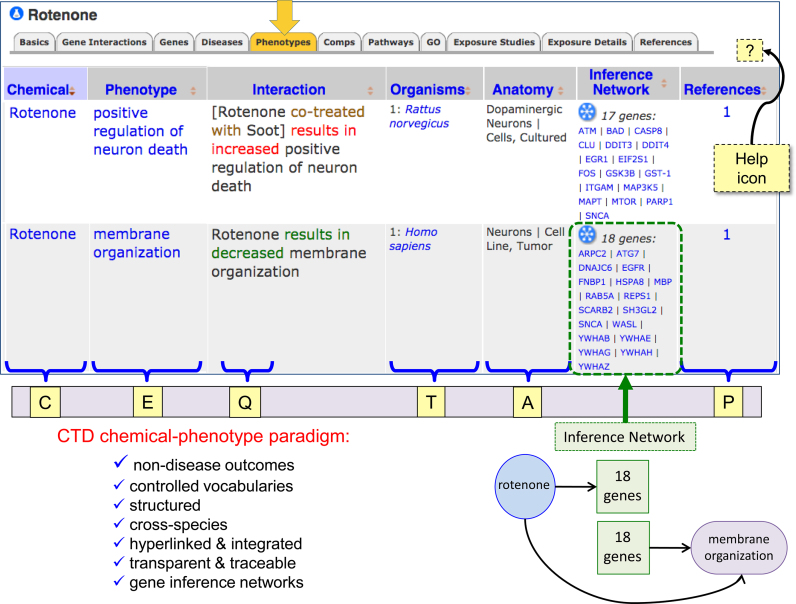
Figure 1.
Figure 1.
CTD’s new phenotype module. CTD’s chemical–phenotype curation paradigm collects novel information for chemically induced non-disease outcomes across species, with hyperlinked terms to allow seamless navigation across CTD. chemical–phenotype interactions are displayed under the new ‘Phenotypes’ data-tab on chemical pages (and vice versa under the new ‘Chemical Interactions’ data-tab on GO/Phenotype pages). Interactions are curated in a structured format using controlled vocabularies for chemicals (C), phenotype entities (E), action qualifiers (Q, ‘increased’, ‘decreased’, or ‘affects’), organisms (T) and anatomy (A), and are directly traceable to the source article (P). Additionally, Inference Networks list a set of genes that provide a putative molecular framework to connect the chemical to the phenotype. Here, the insecticide rotenone affects several phenotypes, including ‘membrane organization’ in a human neural tumor cell line; as well, rotenone directly interacts with 18 genes in CTD that are also independently annotated to the same GO term, forming an inference network. The Help icon (‘?’) provides users with a link to a concise guide about the phenotype module. For simplicity, an edited screenshot is shown.
Figure 2.
Figure 2.
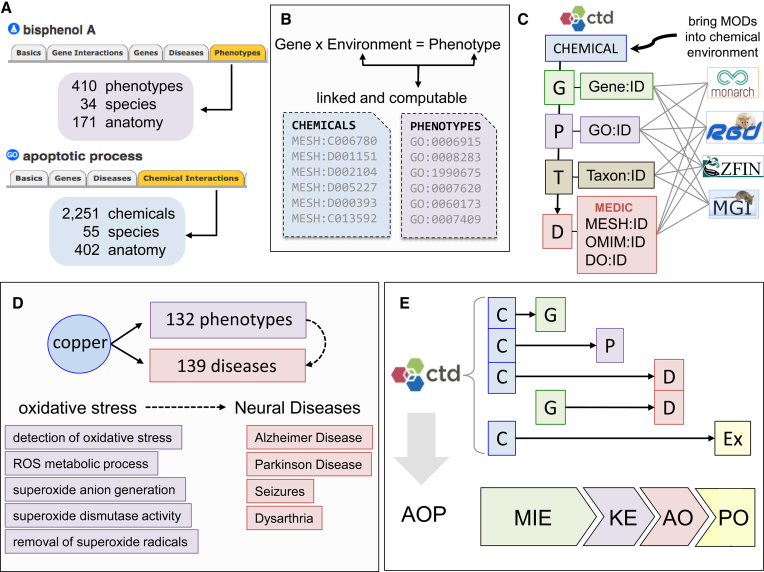
Using chemical–phenotype data for discovery. (A) Users can explore phenotypes from a chemical perspective (e.g. bisphenol A influences 410 phenotypes in 171 anatomical sites from 34 species) as well as discover chemicals that affect a specific phenotype (e.g. apoptotic process is modulated by 2,251 chemicals in 55 species). (B) Use of hierarchical controlled vocabularies (with accession identifiers) for both chemicals (MESH:ID) and phenotypes (GO:ID) provides data files that allow environmental factors and phenotypes to be linked and computable for meta-analyses. (C) Use of interoperable accession identifiers for genes (G), phenotypes (P), taxa (T), and diseases (D) shared by model organism databases (MODs) and other resources enable their content to be integrated with and brought into the chemical environment of CTD. (D) Non-disease phenotypes can be inferred to diseases (based on shared interacting chemicals) to help inform the pre-disease state. The heavy metal copper modulates 132 phenotypes and, independently, is associated with 139 diseases in CTD, providing a view of the potential biological processes in the presymptomatic condition, such as the numerous oxidative stress phenotypes that might precede the onset of neurological diseases. This knowledge can be leveraged to find novel commonalities between sets of phenotypes and diverse diseases, with the potential of re-purposing or discovering new therapeutic drugs. (E) Integrating data from all four CTD modules helps generate predictive adverse outcome pathways (AOP). CTD’s toxicogenomic core reports chemical–gene (C–G) interactions that parallel the molecular initiating event (MIE) of an AOP, CTD’s new phenotype module links chemical–non-disease phenotype (C–P) key events (KE), disease core curates chemical–disease (C–D) and gene–disease (G–D) adverse outcomes (AO), and CTD’s exposure module relates chemical exposures (C-Ex) for population-level health outcomes (PO).

References

    1. Davis A.P., Murphy C.G., Saraceni-Richards C.A., Rosenstein M.C., Wiegers T.C., Mattingly C.J.. Comparative Toxicogenomics Database: a knowledgebase and discovery tool for chemical–gene–disease networks. Nucleic Acids Res. 2009; 37:D786–D792. - PMC - PubMed
    1. Davis A.P., King B.L., Mockus S., Murphy C.G., Saraceni-Richards C., Rosenstein M., Wiegers T., Mattingly C.J.. The Comparative Toxicogenomics Database: update 2011. Nucleic Acids Res. 2011; 39:D1067–D1072. - PMC - PubMed
    1. Davis A.P., Murphy C.G., Johnson R., Lay J.M., Lennon-Hopkins K., Saraceni-Richards C., Sciaky D., King B.L., Rosenstein M.C., Wiegers T.C. et al. The Comparative Toxicogenomics Database: update 2013. Nucleic Acids Res. 2013; 41:D1104–D1114. - PMC - PubMed
    1. Davis A.P., Grondin C.J., Lennon-Hopkins K., Saraceni-Richards C., Sciaky D., King B.L., Wiegers T.C., Mattingly C.J.. The Comparative Toxicogenomics Database's 10th year anniversary: update 2015. Nucleic Acids Res. 2015; 43:D914–D920. - PMC - PubMed
    1. Davis A.P., Grondin C.J., Johnson R.J., Sciaky D., King B.L., McMorran R., Wiegers J., Wiegers T.C., Mattingly C.J.. The Comparative Toxicogenomics Database: update 2017. Nucleic Acids Res. 2017; 45:D972–D978. - PMC - PubMed

Publication types