


The social buffering of pain by affective touch: a laser-evoked potential study in romantic couples
- PMID: 30247679
- PMCID: PMC6234321
- DOI: 10.1093/scan/nsy085
The social buffering of pain by affective touch: a laser-evoked potential study in romantic couples
Abstract
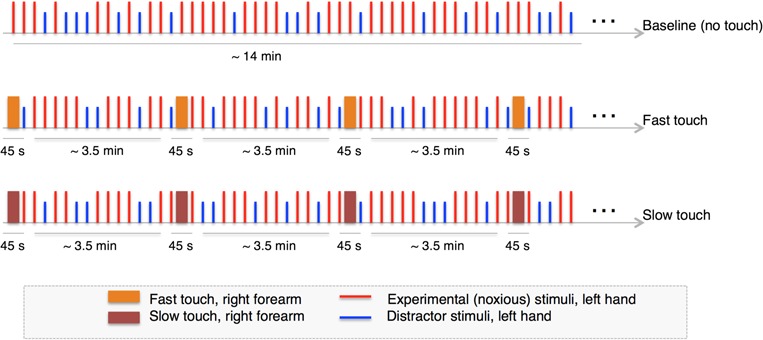
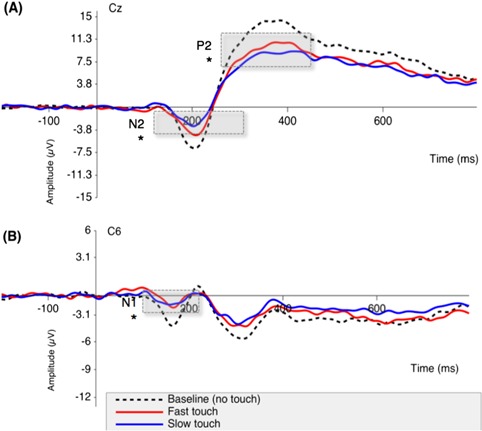
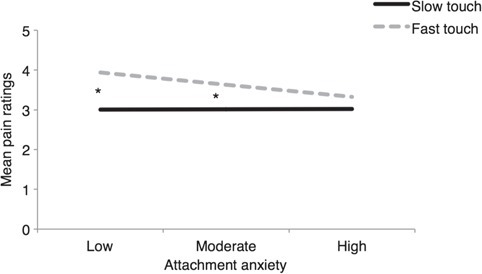
Pain is modulated by social context. Recent neuroimaging studies have shown that romantic partners can provide a potent form of social support during pain. However, such studies have only focused on passive support, finding a relatively late-onset modulation of pain-related neural processing. In this study, we examined for the first time dynamic touch by one's romantic partner as an active form of social support. Specifically, 32 couples provided social, active, affective (vs active but neutral) touch according to the properties of a specific C-tactile afferent pathway to their romantic partners, who then received laser-induced pain. We measured subjective pain ratings and early N1 and later N2-P2 laser-evoked potentials (LEPs) to noxious stimulation, as well as individual differences in adult attachment style. We found that affective touch from one's partner reduces subjective pain ratings and similarly attenuates LEPs both at earlier (N1) and later (N2-P2) stages of cortical processing. Adult attachment style did not affect LEPs, but attachment anxiety had a moderating role on pain ratings. This is the first study to show early neural modulation of pain by active, partner touch, and we discuss these findings in relation to the affective and social modulation of sensory salience.
Figures
References
-
- Aiken L.S., West S.G. (1991). Multiple Regression: Testing and Interpreting Interactions, Newbury Park: Sage.
-
- Atlas L.Y., Wager T.D. (2012). How expectations shape pain. Neuroscience Letters, 520(2), 140–8. - PubMed
-
- Atzil S., Barrett L.F. (2017). Social regulation of allostasis: commentary on “Mentalizing homeostasis: the social origins of interoceptive inference” by Fotopoulou and Tsakiris. Neuropsychoanalysis: An Interdisciplinary Journal for Psychoanalysis and the Neurosciences, 19(1), 29–33. 10.1080/15294145.2017.1295218. - DOI
-
- Beckes L., Coan J.A. (2011). Social Baseline Theory: the role of social proximity in emotion and economy of action. Social and Personality Psychology Compass, 5(12), 976–88. 10.1111/j.1751-9004.2011.00400.x. - DOI
-
- Berscheid E. (2003). The human’s greatest strength: other humans. In L. G. Aspinwall & U. M. Staudinger (Eds.)A Psychology of Human Strengths: Fundamental Questions and Future Directions for a Positive Psychology, pp. (37–47). Washington, DC, US: American Psychological Association; 10.1037/10566-003. - DOI
Publication types
MeSH terms
LinkOut - more resources
Full Text Sources
Other Literature Sources
Medical
Molecular Biology Databases
