


Pregnancy risk factors associated with birthweight of infants born to Australian Aboriginal women in an urban setting - a retrospective cohort study
- PMID: 30249202
- PMCID: PMC6154947
- DOI: 10.1186/s12884-018-1946-3
Pregnancy risk factors associated with birthweight of infants born to Australian Aboriginal women in an urban setting - a retrospective cohort study
Abstract
Background: A key focus of the Closing the Gap campaign is to reduce low birthweight in Aboriginal babies. Limited research exists on factors affecting Aboriginal birthweight in urban areas.
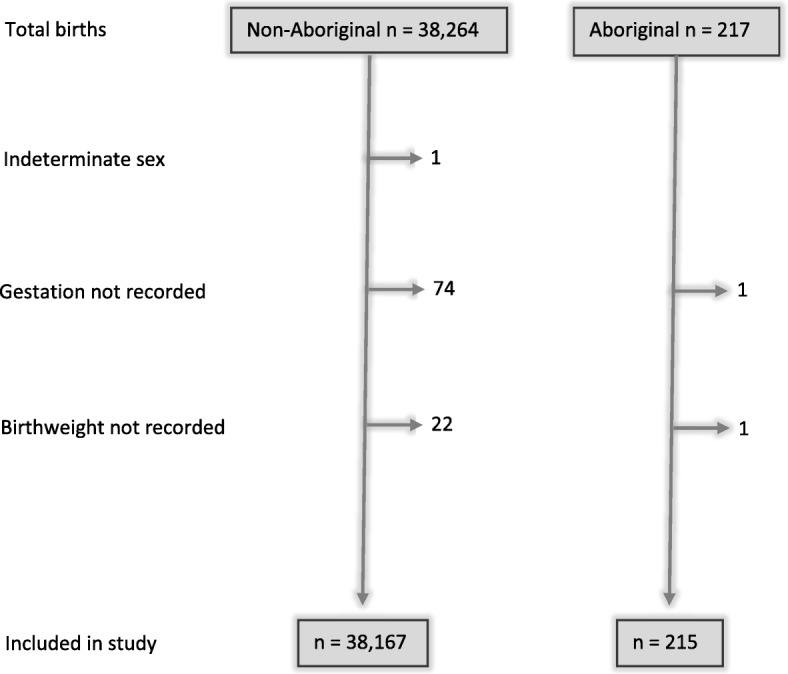
Methods: Retrospective cohort analysis of 38,382 births (38,167 non-Aboriginal, 215 Aboriginal) at the Royal Women's Hospital in Melbourne from January 2010 to December 2015. Aboriginal status was defined by mothers who identified themselves and their baby as Aboriginal or Torres Strait Islander. The aim was to examine the association of maternal health risk behaviours and obstetric complications with birthweight of infants born to Australian Aboriginal women birthing in an urban setting.
Results: Aboriginal babies had a lower mean birthweight than non-Aboriginal babies (mean difference -290 g; 95% confidence interval [CI] -413, - 166 g), but when accounting for gestational age and sex there was little difference (mean difference 5 g; 95% CI -53, 6 g). Aboriginal babies were significantly more likely to be delivered preterm < 37 weeks (23.3% vs 7.9%, odds ratio [OR] 3.58; 95% CI 2.58, 4.95) and be of low birthweight < 2500 g (22.3% vs 6.7%, OR 4.03; 95% CI 2.90, 5.60) or very low birthweight < 1500 g (9.8% vs 1.8%, OR 5.81; 95% CI 3.67, 9.16). Aboriginal mothers were significantly more likely to be teenage mothers (9.8% vs 1.6%, OR 5.72; 95% CI 3.54, 9.24), smoke cigarettes throughout the pregnancy (53.8% vs 5.6%, OR 17.2; 95% CI 12.8, 23.0), and use drugs (26.5% vs 2.4%, OR 14.3; 95% CI 10.4, 19.6) during pregnancy, all of which were associated with lower birthweight. Aboriginal mothers were also more likely to have a mental health diagnosis (49.5% vs 18.8%, OR 3.77; 95% CI 2.86, 4.97), be overweight (59.9% vs 42.6%, OR 1.88; 95% CI 1.39, 2.56) and have diabetes (15.3% vs 7.3%, OR 2.31; 95% CI 1.59, 3.35) which were all associated with higher birthweight.
Conclusions: Aboriginal babies born in metropolitan Melbourne are more likely to be of low birthweight compared with non-Aboriginal babies, which in turn was related to higher rates of prematurity and not to being small for gestational age.
Keywords: Australian Aboriginal; Birthweight; Health; Pregnancy; Urban.
Conflict of interest statement
Ethics approval and consent to participate
The project was approved as an audit by The Royal Women’s Hospital’s Human Research Ethics Committee.
Consent for publication
Not applicable.
Competing interests
The authors declare that they have no competing interests.
Publisher’s Note
Springer Nature remains neutral with regard to jurisdictional claims in published maps and institutional affiliations.
Figures
References
-
- Commonwealth of Australia, Department of the Prime Minister and Cabinet. Closing the Gap Prime Minister’s Report 2017. https://www.pmc.gov.au/sites/default/files/publications/ctg-report-2017.pdf. Accessed 7 Feb 2018.
-
- Gogna NK, Smiley M, Walker AC, Fullerton P. Low birthweight and mortality in Australian aboriginal babies at the Royal Darwin Hospital: a 15 year study. Aust Paediatr J. 1986;22:281–284. - PubMed
-
- Diouf I, Gubhaju L, Chamberlain C, McNamara B, Joshy G, Oats J, Stanley F, Eades S. Trends in maternal and newborn health characteristics and obstetric interventions among aboriginal and Torres Strait islander mothers in Western Australia from 1986 to 2009. Aust N Z J Obstet Gynaecol. 2016;56:245–251. doi: 10.1111/ajo.12416. - DOI - PubMed
MeSH terms
LinkOut - more resources
Full Text Sources
Other Literature Sources
Medical
Miscellaneous
