. 2018 Oct 9;115(41):10369-10374.
doi: 10.1073/pnas.1804726115. Epub 2018 Sep 24.

Nebulin stiffens the thin filament and augments cross-bridge interaction in skeletal muscle

Affiliations

Nebulin stiffens the thin filament and augments cross-bridge interaction in skeletal muscle

Balázs Kiss et al. Proc Natl Acad Sci U S A. .

Abstract

Nebulin is a giant sarcomeric protein that spans along the actin filament in skeletal muscle, from the Z-disk to near the thin filament pointed end. Mutations in nebulin cause muscle weakness in nemaline myopathy patients, suggesting that nebulin plays important roles in force generation, yet little is known about nebulin's influence on thin filament structure and function. Here, we used small-angle X-ray diffraction and compared intact muscle deficient in nebulin (using a conditional nebulin-knockout, Neb cKO) with control (Ctrl) muscle. When muscles were activated, the spacing of the actin subunit repeat (27 Å) increased in both genotypes; when converted to thin filament stiffness, the obtained value was 30 pN/nm in Ctrl muscle and 10 pN/nm in Neb cKO muscle; that is, the thin filament was approximately threefold stiffer when nebulin was present. In contrast, the thick filament stiffness was not different between the genotypes. A significantly shorter left-handed (59 Å) thin filament helical pitch was found in passive and contracting Neb cKO muscles, as well as impaired tropomyosin and troponin movement. Additionally, a reduced myosin mass transfer toward the thin filament in contracting Neb cKO muscle was found, suggesting reduced cross-bridge interaction. We conclude that nebulin is critically important for physiological force levels, as it greatly stiffens the skeletal muscle thin filament and contributes to thin filament activation and cross-bridge recruitment.

Keywords: X-ray diffraction; muscle biology; physiology; skeletal myopathy.


Conflict of interest statement

The authors declare no conflict of interest.

Figures
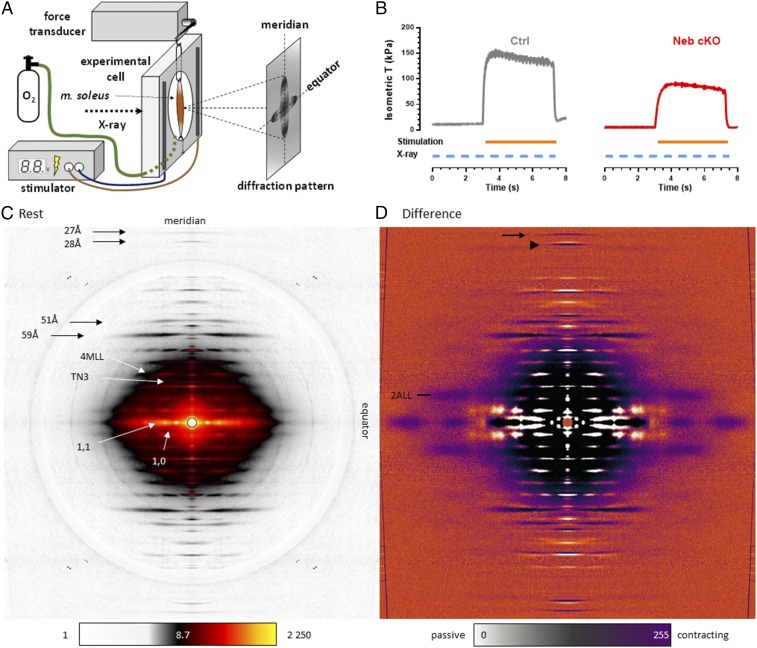
Fig. 1.
Fig. 1.
X-ray diffraction of intact mouse soleus muscle (m. soleus). (A) Experimental setup showing the alignment of the muscle. (B) Isometric activation of Ctrl and Neb cKO soleus showing reduced active tension in Neb cKO. X-ray diffraction data were collected during resting and tetanic phases. (C) X-ray diffraction image of m. soleus at rest. The diffraction peaks of interest are indicated. Nonlinear scale bar indicates intensity. (D) Difference X-ray diffraction (contracting minus resting) from the same muscle. Purple areas represent high intensity during isometric contraction, whereas white pixels indicate high intensity at rest. Arrow indicates 27 Å reflection; arrowhead indicates 28 Å reflection; and linear scale bar indicates intensity difference.
Fig. 2.
Fig. 2.
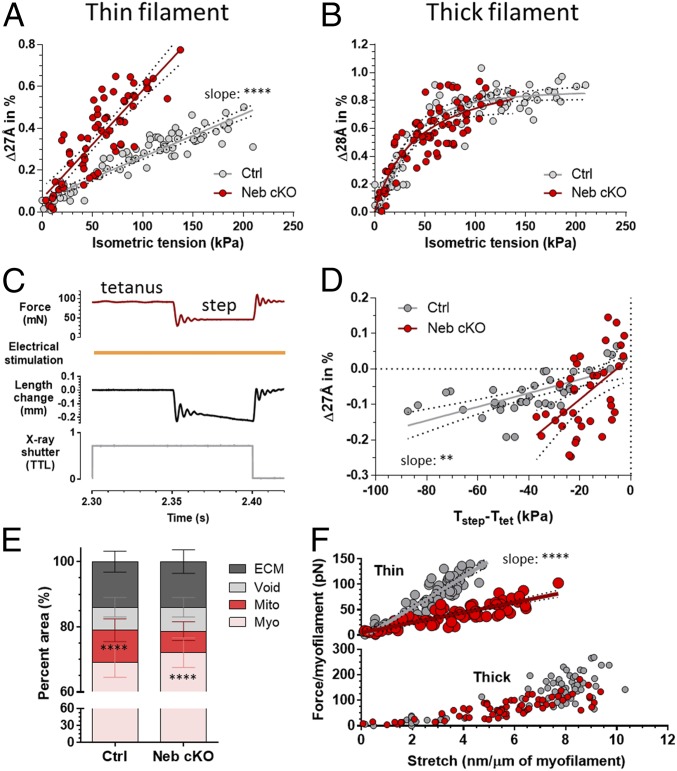
Effect of nebulin on myofilament compliance. (A) The 27 Å relative spacing change as a function of isometric contraction. (B) Tension dependence of the 28 Å reflection. (C) Force step protocol on activated muscle. Tetanic force was reduced and held constant by controlling the muscle length. TTL, logic voltage level. (D) The 27 Å relative spacing change during the force step protocol in Ctrl and Neb cKO. T, tension. (E) Cross-sectional ultrastructural analysis of Ctrl and Neb cKO soleus showing the percent area of myofibrils (Myo), mitochondria (Mito), void regions (Void), and extracellular matrix (ECM). (F) Average force per single thin (Top) and thick (Bottom) filament as a function of longitudinal stretch. Stretch was calculated from the 27 Å and 28 Å relative spacing change extrapolated to a 1-μm-long thin and thick filament, respectively. **P < 0.01; ****P < 0.0001.
Fig. 3.
Fig. 3.
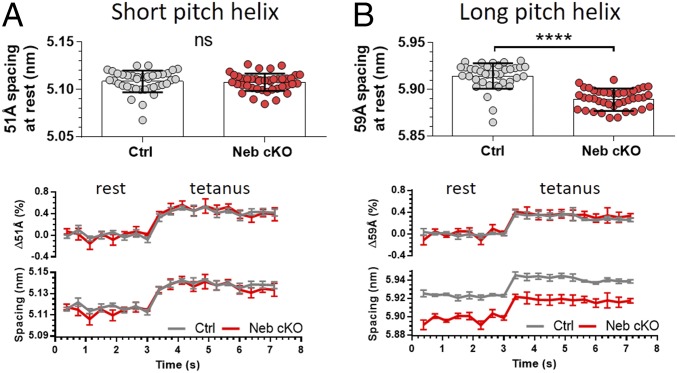
Effect of nebulin on thin filament helix and cross-bridge behavior. The 51 Å (A) and 59 Å (B) spacing in Ctrl and Neb cKO muscles. (A and B, Top) Values at rest. (A and B, Bottom) Graphs during the rest-to-tetanus transition, with the Upper graph demonstrating the relative spacing change normalized to the average spacing at rest. For each data point, 25 consecutive diffraction frames were averaged, resulting in 0.375 s time resolution. For each genotype, five time-resolved spacing traces were averaged. ns, not significant (P ≥ 0.05); ****P < 0.0001.
Fig. 4.
Fig. 4.
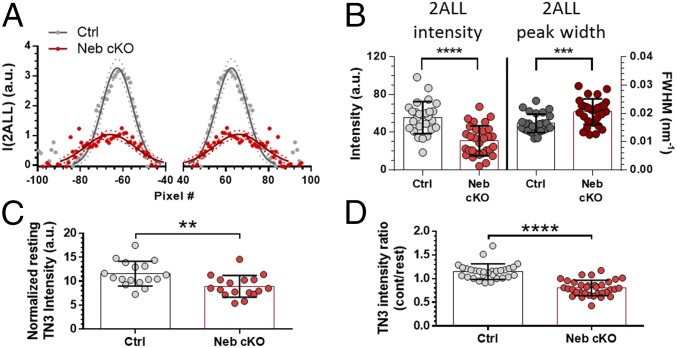
Tropomyosin and troponin movement on the thin filament. (A) Off-meridional tracing of the 2ALL of Ctrl and Neb cKO soleus. Continuous line indicates Gaussian fit; dotted lines indicate 95% CI of the Gaussian fit. I, intensity. (B) Integral intensity and width distribution of the 2ALL peaks of Ctrl and Neb cKO. FWHM, full width at half maximum, in reciprocal space. (C) Resting intensity of the TN3 meridional reflection in Ctrl and Neb cKO muscles normalized to the total volume of their thin filaments. (D) Relative intensity change of TN3 calculated as intensity of TN3 with contraction (cont) divided by intensity of TN3 at rest. **P < 0.01; ***P < 0.001; ****P < 0.0001.
Fig. 5.
Fig. 5.
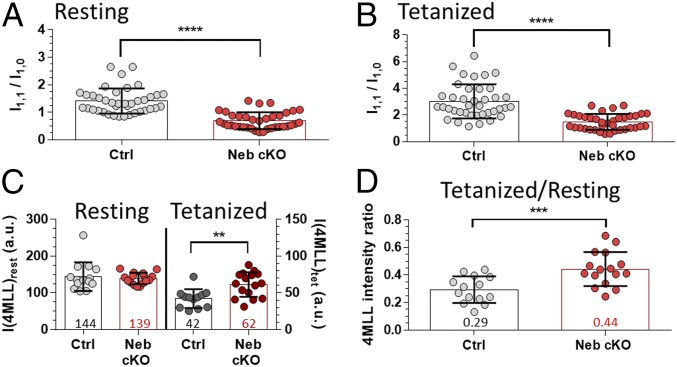
Effect of nebulin on cross-bridge behavior. (A and B) Equatorial I1,1/I1,0 intensity ratio of resting (A) and tetanic (B) Ctrl and Neb cKO muscles. (C) Intensity of the 4MLL in resting and tetanized Ctrl and Neb cKO soleus. (D) Ratio of tetanized to resting 4MLL intensities as a function of genotype. The numbers represent the group mean. **P < 0.01; ***P < 0.001; ****P < 0.0001.
Fig. 6.
Fig. 6.
Nebulin modulates force generation in skeletal muscle. (A) Ctrl muscle schematically showing nebulin and regulatory proteins (troponin and tropomyosin) on the thin filament. (B) Nebulin deficiency causes impaired tropomyosin/troponin movement, thereby interfering with cross-bridge formation and reducing the tetanic force. See text for details.

References

    1. Labeit S, et al. Evidence that nebulin is a protein-ruler in muscle thin filaments. FEBS Lett. 1991;282:313–316. - PubMed
    1. Labeit S, Kolmerer B. The complete primary structure of human nebulin and its correlation to muscle structure. J Mol Biol. 1995;248:308–315. - PubMed
    1. Pappas CT, Bliss KT, Zieseniss A, Gregorio CC. The nebulin family: An actin support group. Trends Cell Biol. 2011;21:29–37. - PMC - PubMed
    1. Wang K, Wright J. Architecture of the sarcomere matrix of skeletal muscle: Immunoelectron microscopic evidence that suggests a set of parallel inextensible nebulin filaments anchored at the Z line. J Cell Biol. 1988;107:2199–2212. - PMC - PubMed
    1. Wright J, Huang QQ, Wang K. Nebulin is a full-length template of actin filaments in the skeletal muscle sarcomere: An immunoelectron microscopic study of its orientation and span with site-specific monoclonal antibodies. J Muscle Res Cell Motil. 1993;14:476–483. - PubMed

Publication types

LinkOut - more resources