


Prevalence of Congenital Anomalies in the Japan Environment and Children's Study
- PMID: 30249945
- PMCID: PMC6556438
- DOI: 10.2188/jea.JE20180014
Prevalence of Congenital Anomalies in the Japan Environment and Children's Study
Abstract
Background: The aims of the present report were to estimate the prevalence of congenital anomalies (CAs) among infants in Japan using data from the Japan Environment and Children's Study (JECS) and to evaluate the validity of CA classification within JECS.
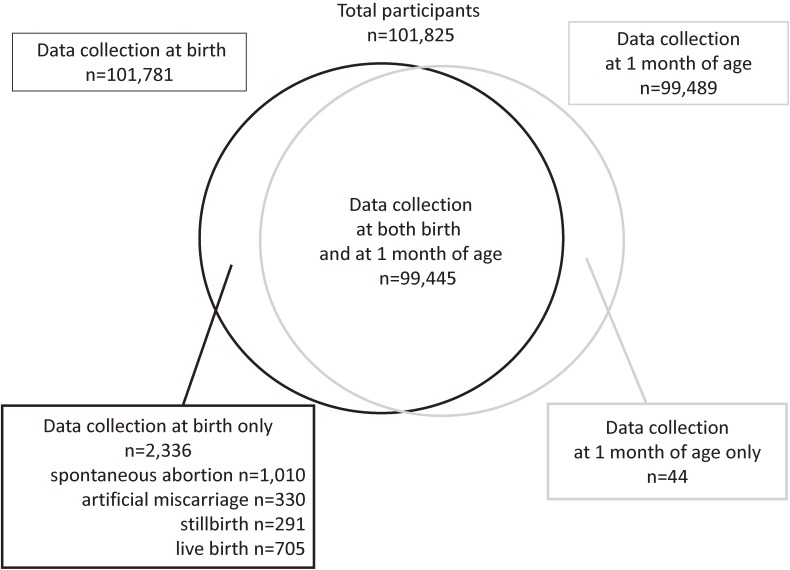
Methods: Data on CAs were collected at delivery and at age 1 month from the medical records of 101,825 infants at 15 regional centers. The analyses focused on 61 CAs, selected on the basis of reported associations with environmental exposure. Prevalence per 10,000 pregnancies (including miscarriages, stillbirths, and live births) was stratified according to four reporting patterns (at delivery, at age 1 month, at either, and at both). To evaluate the accuracy of observed CA prevalence, the medical records of 179 cases from a single JECS regional center underwent independent, retrospective re-evaluation.
Results: The prevalence of major CAs in four reporting patterns (at delivery, at age 1 month, at either, and at both) was 2.4, 2.6, 3.5, and 1.4 for myelomeningocele/spina bifida; 4.3, 4.2, 5.3, and 3.2 for cleft palate; 18.1, 17.4, 19.5, and 15.1 for cleft lip with or without cleft palate; 73.4, 100.3, 120.8, and 52.8 for congenital heart disease; and 10.5, 14.1, 15.0, and 9.6 for Down's syndrome, respectively. In the subsample re-evaluation, CA diagnoses were confirmed for 92.7%, 93.3%, 90.5%, and 97.8% of cases in the four reporting patterns (at delivery, at age 1 month, at either, and at both), respectively.
Conclusions: The present report generated reliable data concerning the prevalence of major CAs in JECS.
Keywords: JECS; Japan Environment and Children’s Study; birth cohort; congenital anomalies; prevalence.
Figures
References
-
- Congenital anomalies fact sheet [homepage on the Internet]. Available from: http://www.who.int/mediacentre/factsheets/fs370/en/.
MeSH terms
LinkOut - more resources
Full Text Sources
Other Literature Sources
Medical
