


Prevention of atherothrombotic events in patients with diabetes mellitus: from antithrombotic therapies to new-generation glucose-lowering drugs
- PMID: 30250166
- PMCID: PMC7136162
- DOI: 10.1038/s41569-018-0080-2
Prevention of atherothrombotic events in patients with diabetes mellitus: from antithrombotic therapies to new-generation glucose-lowering drugs
Abstract
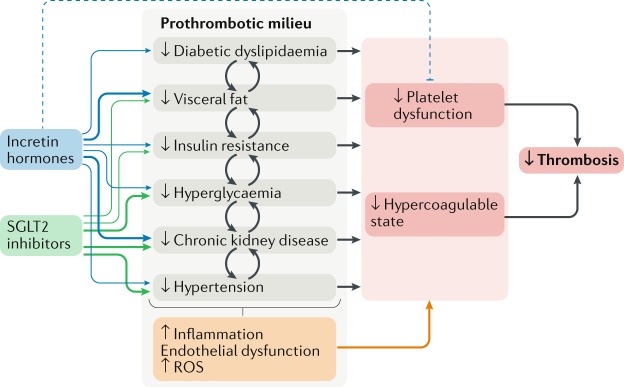
Diabetes mellitus is an important risk factor for a first cardiovascular event and for worse outcomes after a cardiovascular event has occurred. This situation might be caused, at least in part, by the prothrombotic status observed in patients with diabetes. Therefore, contemporary antithrombotic strategies, including more potent agents or drug combinations, might provide greater clinical benefit in patients with diabetes than in those without diabetes. In this Consensus Statement, our Working Group explores the mechanisms of platelet and coagulation activity, the current debate on antiplatelet therapy in primary cardiovascular disease prevention, and the benefit of various antithrombotic approaches in secondary prevention of cardiovascular disease in patients with diabetes. While acknowledging that current data are often derived from underpowered, observational studies or subgroup analyses of larger trials, we propose antithrombotic strategies for patients with diabetes in various cardiovascular settings (primary prevention, stable coronary artery disease, acute coronary syndromes, ischaemic stroke and transient ischaemic attack, peripheral artery disease, atrial fibrillation, and venous thromboembolism). Finally, we summarize the improvements in cardiovascular outcomes observed with the latest glucose-lowering drugs, and on the basis of the available evidence, we expand and integrate current guideline recommendations on antithrombotic strategies in patients with diabetes for both primary and secondary prevention of cardiovascular disease.
Conflict of interest statement
G.P. is a speaker, consultant, and/or advisory board member for Amgen, AstraZeneca, Bayer, BMS-Pfizer, Boehringer Ingelheim, Daiichi Sankyo, Malesci, MSD, PIAM, Sanofi, and Sigma-Tau. F.A. is a speaker, consultant, and/or advisory board member for Actelion, Amgen, Bayer, BMS-Pfizer, Boehringer Ingelheim, Daiichi Sankyo, International Menarini Foundation, and Medscape. E.M. has received speaker fees from Merck-Serono and grant support from AstraZeneca and Lilly. D.P. is a speaker or has received consultant and/or advisory fees from Bayer, BMS-Pfizer, Boehringer Ingelheim, and Daiichi Sankyo. G.R. has received consultant and speaker fees from Bayer, Boehringer Ingelheim, and Daiichi Sankyo. R.D.C. has received fees from AstraZeneca, Bayer, BMS-Pfizer, Boehringer Ingelheim, Daiichi Sankyo, Lilly, Novartis, and Sanofi-Aventis and has received grant support from AstraZeneca, Bayer, BMS-Pfizer, Boehringer Ingelheim, and Daiichi Sankyo. The other authors declare no competing interests.
Figures
References
-
- Colwell JA, Lopes-Virella M, Halushka PV. Pathogenesis of atherosclerosis in diabetes mellitus. Diabetes Care. 1981;4:121–133. - PubMed
-
- American Diabetes Association 9. Cardiovascular disease and risk management: standards of medical care in diabetes-2018. Diabetes Care. 2018;41:S86–S104. - PubMed
-
- Authors/Task Force Members et al. ESC Guidelines on diabetes, pre-diabetes, and cardiovascular diseases developed in collaboration with the EASD: the Task Force on diabetes, pre-diabetes, and cardiovascular diseases of the European Society of Cardiology (ESC) and developed in collaboration with the European Association for the Study of Diabetes (EASD) Eur. Heart J. 2013;34:3035–3087. - PubMed
-
- Ferreiro JL, Angiolillo DJ. Diabetes and antiplatelet therapy in acute coronary syndrome. Circulation. 2011;123:798–813. - PubMed
Publication types
MeSH terms
Substances
LinkOut - more resources
Full Text Sources
Other Literature Sources
Medical
