. 2018 Sep 25;16(9):e2005281.
doi: 10.1371/journal.pbio.2005281. eCollection 2018 Sep.

The neurodevelopmental precursors of altruistic behavior in infancy

Affiliations

The neurodevelopmental precursors of altruistic behavior in infancy

Tobias Grossmann et al. PLoS Biol. .

Abstract

Altruistic behavior is considered a key feature of the human cooperative makeup, with deep ontogenetic roots. The tendency to engage in altruistic behavior varies between individuals and has been linked to differences in responding to fearful faces. The current study tests the hypothesis that this link exists from early in human ontogeny. Using eye tracking, we examined whether attentional responses to fear in others at 7 months of age predict altruistic behavior at 14 months of age. Our analysis revealed that altruistic behavior in toddlerhood was predicted by infants' attention to fearful faces but not happy or angry faces. Specifically, infants who showed heightened initial attention to (i.e., prolonged first look) followed by greater disengagement (i.e., reduced attentional bias over 15 seconds) from fearful faces at 7 months displayed greater prosocial behavior at 14 months of age. Our data further show that infants' attentional bias to fearful faces and their altruistic behavior was predicted by brain responses in the dorsolateral prefrontal cortex (dlPFC), measured through functional near-infrared spectroscopy (fNIRS). This suggests that, from early in ontogeny, variability in altruistic helping behavior is linked to our responsiveness to seeing others in distress and brain processes implicated in attentional control. These findings critically advance our understanding of the emergence of altruism in humans by identifying responsiveness to fear in others as an early precursor contributing to variability in prosocial behavior.


Conflict of interest statement

The authors have declared that no competing interests exist.

Figures
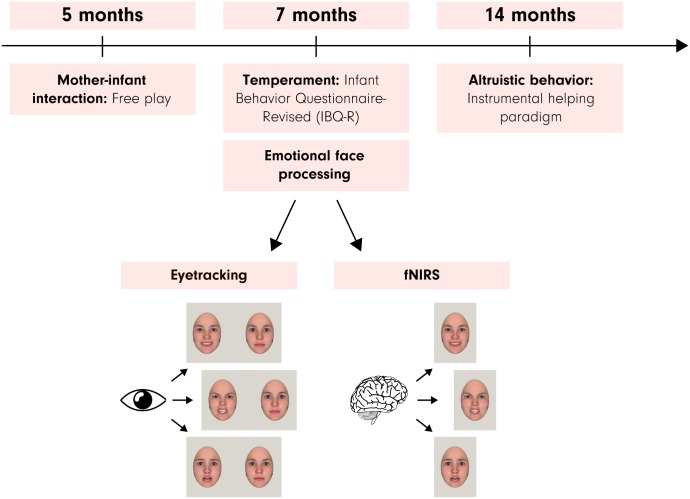
Fig 1
Fig 1. This figure shows an overview of the study design and the methods used with respect to the age of the infant.
Please note that infants viewed photographic images of real faces (see Materials and methods) and that the facial images shown here were computer generated with the FaceGen software (https://facegen.com) for illustrative purposes. fNIRS, functional near-infrared spectroscopy.
Fig 2
Fig 2
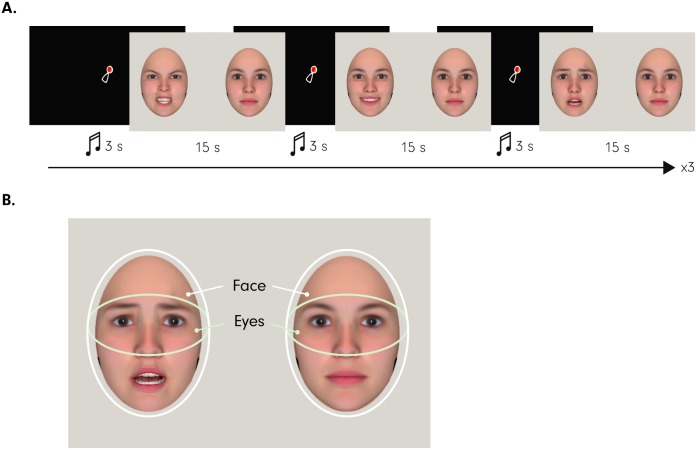
A: This illustrates the eye tracking paradigm employed in the current study at age 7 months. Note that the eye tracking experiment followed the fNIRS experiment. As shown here, infants were presented with experimental trials consisting of a side-by-side presentation of a neutral face and an emotional (happy, angry, or fearful) face. Note that in the actual experiment, the side on which an emotional face and neutral face were presented was counterbalanced, and the face identity changes were pseudorandomized (see Materials and methods for details). B: This illustrates the 2 areas of interest (face and eyes) that were used in the analysis of the eye tracking data. Please note that infants viewed photographic images of real faces (see Materials and methods) and that the facial images shown here were computer generated with the FaceGen software (https://facegen.com) for illustrative purposes. fNIRS, functional near-infrared spectroscopy.
Fig 3
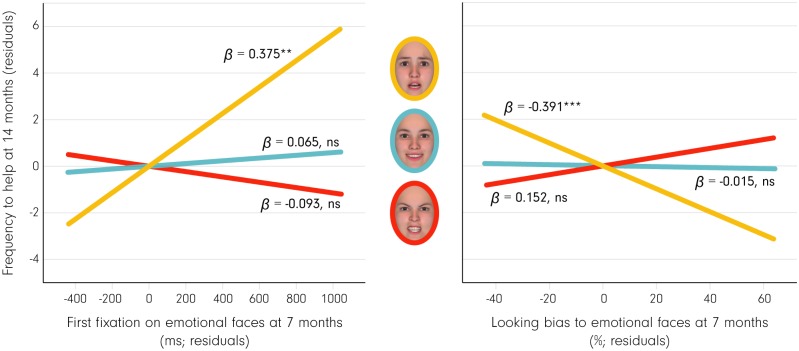
Fig 3. Attention to fearful faces, but not happy or angry faces, predicts altruistic behavior.
This shows partial regression plots from a multiple regression illustrating the specific impact of duration of first fixation on a fearful face when compared to the other facial expressions presented in the experiment (left) and looking bias to fearful faces when compared to the other facial expressions presented in the experiment (right) in predicting altruistic behavior measured as frequency of helping at 14 months (plotted on the y-axis; residuals). Please note that infants viewed photographic images of real faces (see Materials and methods) and that the facial images shown here were computer generated with the FaceGen software (https://facegen.com) for illustrative purposes. Underlying data are available through the Open Science Framework (https://osf.io/znjr7/). ns, not significant.
Fig 4
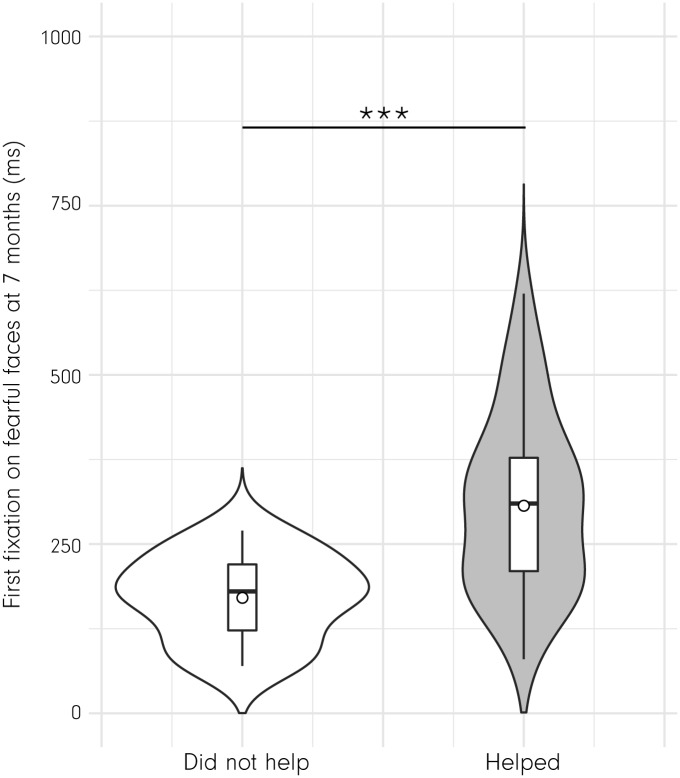
Fig 4. This combined violin–box plot shows that the duration of the first fixation on fearful faces at 7 months of age was significantly longer in infants who helped at age 14 months compared to infants who did not help (using altruistic behavior as a binary measure).
Note that the duration of the first fixation on fearful faces at 7 months significantly predicts altruistic behavior at 14 months in a logistical regression (see Results and Table 2). *** p < 0.001. Underlying data are available through the Open Science Framework, https://osf.io/znjr7/.
Fig 5
Fig 5
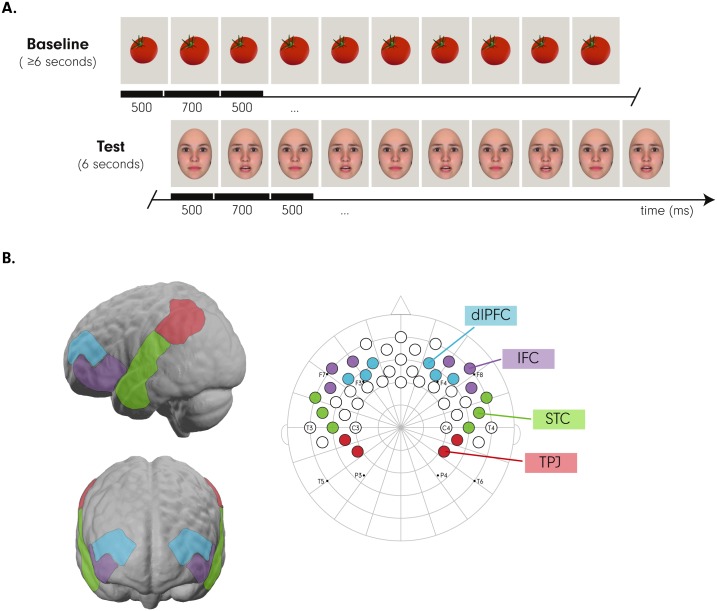
A: This illustrates the fNIRS paradigm employed in the current study at age 7 months. Note that the fNIRS experiment preceded the eye tracking experiment. Infants viewed at least 6 seconds of nonsocial (inanimate) baseline stimuli followed by 6 seconds of emotional (happy, angry, and fearful) test stimuli. Dynamically changing stimuli were administered by presenting neutral faces that rapidly and repeatedly changed to one of the 3 emotions. B: This shows the fNIRS channel layout (right) with the nose plotted up and the 3 ROIs marked by different colors (dlPFC = blue; IFC = violet; STC = green; TPJ = red) on the left with reference to the 10–20 system commonly used in EEG research. On the left, these ROIs are also shown when projected onto the cortical surface of a frontal-view (bottom) and lateral-view brain (top). Please note that infants viewed photographic images of real faces (see Materials and methods) and that the facial images shown here were computer generated with the FaceGen software (https://facegen.com) for illustrative purposes. EEG, electro-encephalography; fNIRS, functional near-infrared spectroscopy; IFC, inferior frontal cortex; ROI, region of interest; STC, superior temporal cortex; TPJ, temporo-parietal junction.

References

    1. Fehr E, Fischbacher U. The nature of human altruism. Nature. 2003;425(6960):785–91. 10.1038/nature02043 - DOI - PubMed
    1. Warneken F, Tomasello M. Helping and cooperation at 14 months of age. Infancy. 2007;11:271–94. - PubMed
    1. Warneken F, Hare B, Melis AP, Hanus D, Tomasello M. Spontaneous altruism by chimpanzees and young children. PLoS Biology. 2007;5:e184 10.1371/journal.pbio.0050184 - DOI - PMC - PubMed
    1. Hare B. Survial of the friendliest: Homo sapiens evoled via selection for prosociality. Annual Review of Psychology. 2017;68:155–86. 10.1146/annurev-psych-010416-044201 - DOI - PubMed
    1. Tomasello M. The ultra-social animal. European Journal of Social Psychology. 2014;44:187–94. 10.1002/ejsp.2015 - DOI - PMC - PubMed

LinkOut - more resources