


Low prevalence of depressive symptoms among stable patients on antiretroviral therapy in Johannesburg, South Africa
- PMID: 30252844
- PMCID: PMC6155448
- DOI: 10.1371/journal.pone.0203797
Low prevalence of depressive symptoms among stable patients on antiretroviral therapy in Johannesburg, South Africa
Abstract
Background: Depression is a leading cause of disability and may be associated with decreased adherence to ART. We sought to describe the prevalence of depressive symptoms and outcomes one year after screening among patients receiving ART at a large HIV Clinic in Johannesburg, South Africa.
Methods: Adult (≥18) patients who had been on first-line ART between 6-18 months who could communicate in English were eligible. Depressive symptoms were evaluated using the Patient Health Questionnaire (PHQ)-9 and a score ≥10 indicated depression.
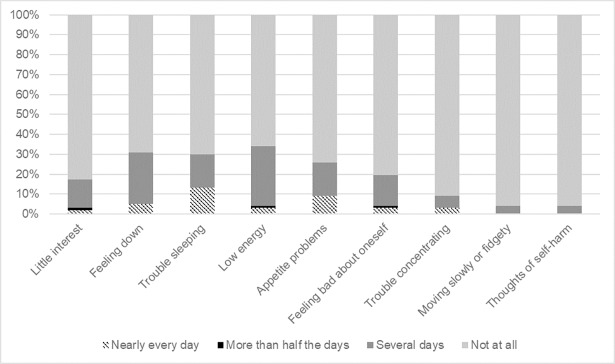
Results: 97 patients enrolled. Patients had been on ART for a median (IQR) of 8 (7-10) months, 61% were female, the median (IQR) age at enrollment was 38 (33-42) years, and the median (IQR) CD4 count at ART initiation was 154.5 (65-263) cells/mm3. 7 (7%) patients were found to have symptoms of depression; 4 (4%) had symptoms of moderate depression (PHQ score of 10-14) and 3 (3%) had symptoms of moderate/severe depression (PHQ score of 15-19). Women (10%) were more likely to have symptoms of depression than men (3%; prevalence difference [PD]: 7.5%; 95% confidence interval [CI]:-1.7%-16.8%); as were patients under the age of 30 (14%) compared to those 30-39 (4%; PD: -10.2; 95% CI: -29.4-9.0%) or ≥40 (9%; PD: -5.5%; -26.1%-15.2%), those with lower CD4 counts at ART initiation (<200 cells/mm3 vs ≥200 cells/mm3: 8% vs 3%; PD: 4.8%; 95% CI: -4.5%-14.0%), and those with high viral loads (>1000 copies/mL vs. <400 copies/mL: 40% vs. 5%; PD: 34.6%; 95% CI: -8.6%-77.6%). No relationship between depressive symptoms and retention in HIV care one year after screening was observed.
Conclusions: We found a lower prevalence of depressive symptoms compared to findings from other HIV-positive populations in South Africa but more than one-third of patients with an elevated viral load had evidence of depression. Further research on the relationship between depression, adherence, and viral failure is warranted as this may present an opportunity for early interventions to improve treatment outcomes and reduce the need for second-line treatment.
Conflict of interest statement
The authors have declared that no competing interests exist.
Figures
References
-
- World Health Organization. Depression [Internet]. [cited 2016 Oct 30]. Available from: http://www.who.int/topics/depression/en/
-
- GBD 2016 Disease and Injury Incidence and Prevalence Collaborators. Global, regional, and national incidence, prevalence, and years lived with disability for 328 diseases and injuries for 195 countries, 1990–2016: a systematic analysis for the Global Burden of Disease Study 2016. Lancet. 2017;390(10100):1211–59. 10.1016/S0140-6736(17)32154-2 - DOI - PMC - PubMed
-
- Institute for Health Metrics and Evaluation. South Africa [Internet]. [cited 2017 Dec 27]. Available from: http://www.healthdata.org/south-africa
-
- Brandt R. The mental health of people living with HIV/AIDS in Africa: a systematic review. African J AIDS Res. 2009. June 1;8(2):123–33. - PubMed
Publication types
MeSH terms
Substances
Grants and funding
LinkOut - more resources
Full Text Sources
Other Literature Sources
Medical
Research Materials
