


Implications of the variation in biological 18 O natural abundance in body water to inform use of Bayesian methods for modelling total energy expenditure when using doubly labelled water
- PMID: 30252964
- PMCID: PMC6283043
- DOI: 10.1002/rcm.8291
Implications of the variation in biological 18 O natural abundance in body water to inform use of Bayesian methods for modelling total energy expenditure when using doubly labelled water
Abstract
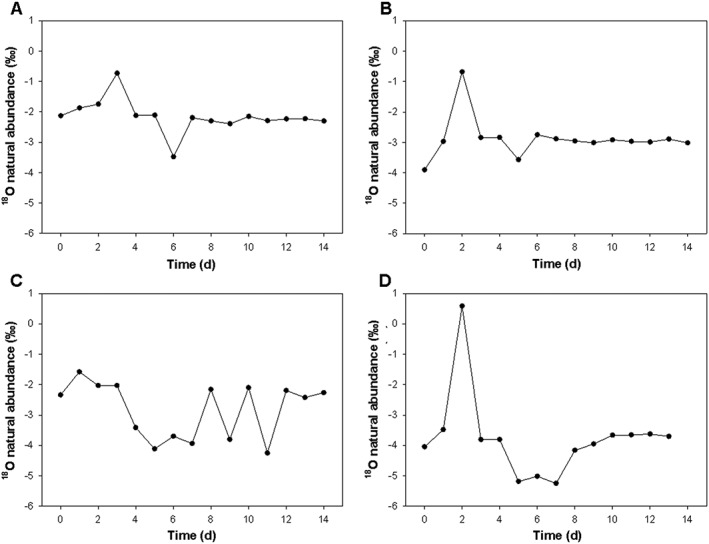
Rationale: Variation in 18 O natural abundance can lead to errors in the calculation of total energy expenditure (TEE) when using the doubly labelled water (DLW) method. The use of Bayesian statistics allows a distribution to be assigned to 18 O natural abundance, thus allowing a best-fit value to be used in the calculation. The aim of this study was to calculate within-subject variation in 18 O natural abundance and apply this to our original working model for TEE calculation.
Methods: Urine samples from a cohort of 99 women, dosed with 50 g of 20% 2 H2 O, undertaking a 14-day breast milk intake protocol, were analysed for 18 O. The within-subject variance was calculated and applied to a Bayesian model for the calculation of TEE in a separate cohort of 36 women. This cohort of 36 women had taken part in a DLW study and had been dosed with 80 mg/kg body weight 2 H2 O and 150 mg/kg body weight H2 18 O.
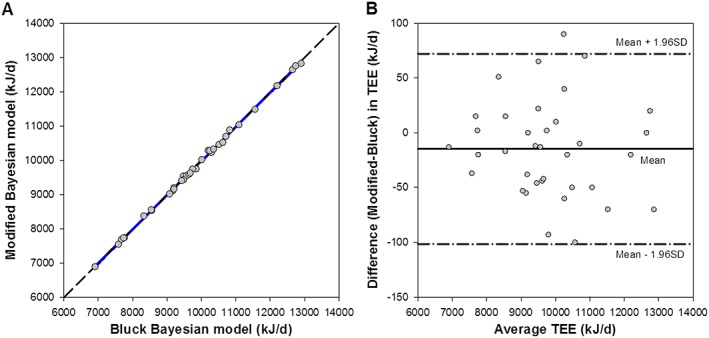
Results: The average change in the δ18 O value from the 99 women was 1.14‰ (0.77) [0.99, 1.29], with the average within-subject 18 O natural abundance variance being 0.13‰2 (0.25) [0.08, 0.18]. There were no significant differences in TEE (9745 (1414), 9804 (1460) and 9789 (1455) kJ/day, non-Bayesian, Bluck Bayesian and modified Bayesian models, respectively) between methods.
Conclusions: Our findings demonstrate that using a reduced natural variation in 18 O as calculated from a population does not impact significantly on the calculation of TEE in our model. It may therefore be more conservative to allow a larger variance to account for individual extremes.
© 2018 The Authors. Rapid Communications in Mass Spectrometry Published by John Wiley & Sons Ltd.
Figures
References
-
- Lifson N, Gordon GB, McClintock R. Measurement of total carbon dioxide production by means of D2 18O. J Appl Physiol. 1955;7(6):704‐710. - PubMed
-
- Schoeller DA, van Santen E. Measurement of energy expenditure in humans by doubly labeled water method. J Appl Physiol Respir Environ Exerc Physiol. 1982;53(4):955‐959. - PubMed
-
- Black AE, Prentice AM, Coward WA. Use of food quotients to predict respiratory quotients for the doubly‐labelled water method of measuring energy expenditure. Hum Nutr Clin Nutr. 1986;40(5):381‐391. - PubMed
-
- Elia M, Livesey G. Theory and validity of indirect calorimetry during net lipid synthesis. Am J Clin Nutr. 1988;47(4):591‐607. - PubMed
-
- Lifson N, McClintock R. Theory and use of the turnover rates of body water for measuring energy and material balance. J Theoret Biol. 1966;12(1):46‐74. - PubMed
MeSH terms
Substances
Grants and funding
LinkOut - more resources
Full Text Sources
Other Literature Sources
Research Materials