


Healthcare transition from childhood to adulthood in Tuberous Sclerosis Complex
- PMID: 30253036
- PMCID: PMC6635672
- DOI: 10.1002/ajmg.c.31653
Healthcare transition from childhood to adulthood in Tuberous Sclerosis Complex
Abstract
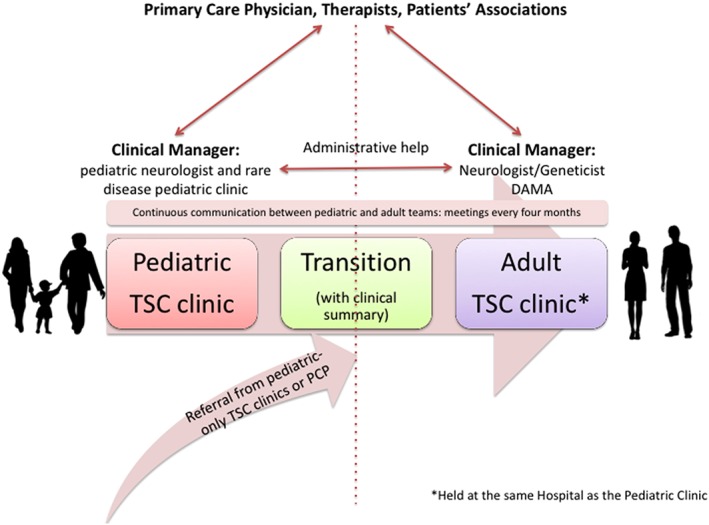
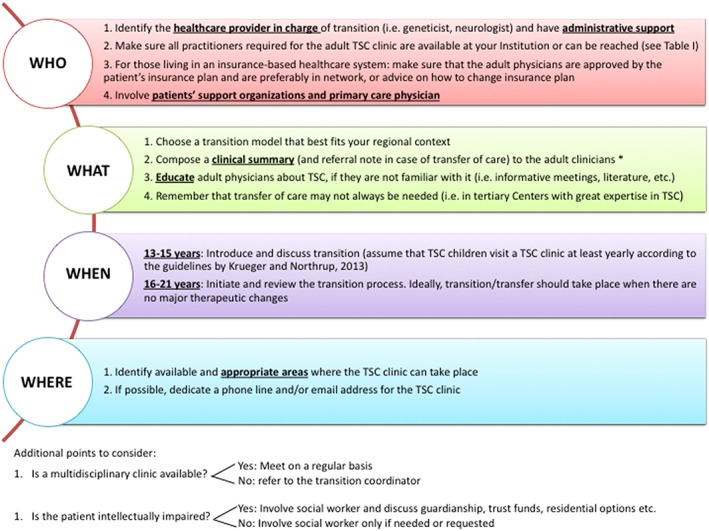
Healthcare transition from childhood to adulthood is required to ensure continuity of care of an increasing number of individuals with chronic conditions surviving into adulthood. The transition for patients with tuberous sclerosis complex (TSC) is complicated by the multisystemic nature of this condition, age-dependent manifestations, and high clinical variability and by the presence of intellectual disability in at least half of the individuals. In this article, we address the medical needs regarding each TSC-related manifestation in adulthood, and the services and support required. We review existing models of transition in different chronic conditions, discuss our experience in transitioning from the pediatric to the adult TSC Clinic at our Institution, and propose general rules to follow when establishing a transition program for TSC. Although a generalizable transition model for TSC is likely not feasible for all Institutions, a multidisciplinary TSC clinic is probably the best model, developed in accordance with the resources available and country-specific healthcare systems. Coordination of care and education of the adult team should be always sought regardless of the transition model.
Keywords: TSC; adult care; adult manifestations; healthcare needs; pediatric care; transition; transitional program; tuberous sclerosis complex.
© 2018 Wiley Periodicals, Inc.
Conflict of interest statement
None.
Figures
References
-
- American Academy of Pediatrics, American Academy of Family Physicians, & American College of Physicians‐American Society of Internal Medicine . (2002). A consensus statement on health care transitions for young adults with special health care needs. Pediatrics, 110(6), 1304–1306. - PubMed
-
- American Academy of Pediatrics, American Academy of Family Physicians, American College of Physicians, Transitions Authoring Group , Cooley, W. C. , & Sagerman, P. J. (2011). Clinical report—Supporting the health care transition from adolescence to adulthood in the medical home. Pediatrics, 128(1), 182–200. 10.1542/peds.2011-0969 - DOI - PubMed
-
- Avila, N. A. , Dwyer, A. J. , Rabel, A. , Darling, T. , Hong, C. H. , & Moss, J. (2010). CT of sclerotic bone lesions: Imaging features differentiating tuberous sclerosis complex with lymphangioleiomyomatosis from sporadic lymphangioleiomymatosis. Radiology, 254(3), 851–857. 10.1148/radiol.09090227 - DOI - PMC - PubMed
-
- Bissler, J. J. , Kingswood, J. C. , Radzikowska, E. , Zonnenberg, B. A. , Belousova, E. , Frost, M. D. , … Budde, K. (2017). Everolimus long‐term use in patients with tuberous sclerosis complex: Four‐year update of the EXIST‐2 study. PLoS One, 12(8), e0180939 10.1371/journal.pone.0180939 - DOI - PMC - PubMed
Publication types
MeSH terms
Grants and funding
LinkOut - more resources
Full Text Sources
Other Literature Sources
Medical
