


Predicting in-hospital mortality and unanticipated admissions to the intensive care unit using routinely collected blood tests and vital signs: Development and validation of a multivariable model
- PMID: 30253229
- PMCID: PMC6562198
- DOI: 10.1016/j.resuscitation.2018.09.021
Predicting in-hospital mortality and unanticipated admissions to the intensive care unit using routinely collected blood tests and vital signs: Development and validation of a multivariable model
Abstract
Aim: The National Early Warning System (NEWS) is based on vital signs; the Laboratory Decision Tree Early Warning Score (LDT-EWS) on laboratory test results. We aimed to develop and validate a new EWS (the LDTEWS:NEWS risk index) by combining the two and evaluating the discrimination of the primary outcome of unanticipated intensive care unit (ICU) admission or in-hospital mortality, within 24 h.
Methods: We studied emergency medical admissions, aged 16 years or over, admitted to Oxford University Hospitals (OUH) and Portsmouth Hospitals (PH). Each admission had vital signs and laboratory tests measured within their hospital stay. We combined LDT-EWS and NEWS values using a linear time-decay weighting function imposed on the most recent blood tests. The LDTEWS:NEWS risk index was developed using data from 5 years of admissions to PH, and validated on a year of data from both PH and OUH. We tested the risk index's ability to discriminate the primary outcome using the c-statistic.
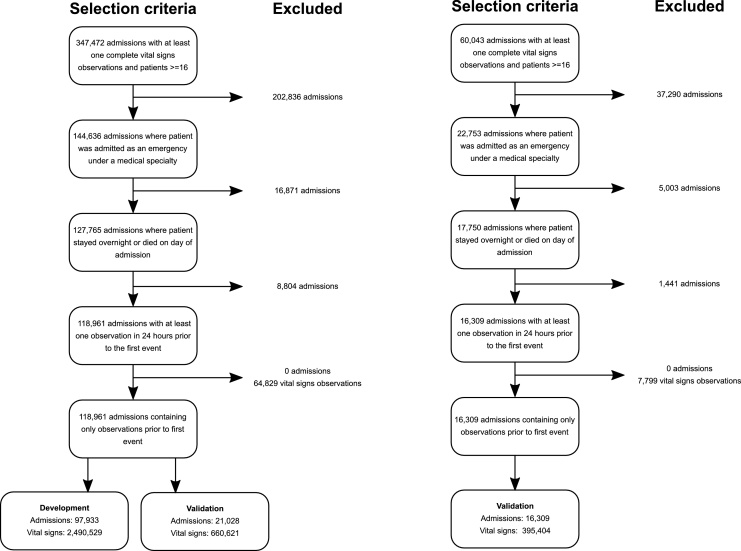
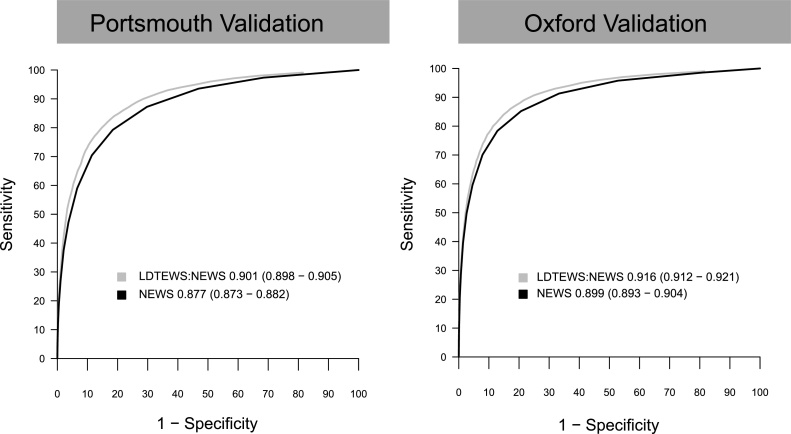
Results: The development cohort contained 97,933 admissions (median age = 73 years) of which 4723 (4.8%) resulted inhospital death and 1078 (1.1%) in unanticipated ICU admission. We validated the risk index using data from PH (n = 21,028) and OUH (n = 16,383). The risk index showed a higher discrimination in the validation sets (c-statistic value (95% CI)) (PH, 0.901 (0.898-0.905); OUH, 0.916 (0.911-0.921)), than NEWS alone (PH, 0.877 (0.873-0.882); OUH, 0.898 (0.893-0.904)).
Conclusions: The LDTEWS:NEWS risk index increases the ability to identify patients at risk of deterioration, compared to NEWS alone.
Keywords: Early warning score; Laboratory test results; Physiological monitoring; Vital signs.
Crown Copyright © 2018. Published by Elsevier B.V. All rights reserved.
Figures
References
-
- National Patient Safety Agency . The fifth report from the Patient Safety Observatory. 2007. Safer care for the acutely ill patient: learning from serious incidents; pp. 1–48.
-
- Cullinane M., Findlay G., Hargraves C., Lucas S. NCEPOD; London: 2005. An acute problem? A report of the national confidential enquiry into patient outcome and death. - PubMed
-
- Smith G.B., Prytherch D.R., Meredith P., Schmidt P.E., Featherstone P.I. The ability of the National Early Warning Score (NEWS) to discriminate patients at risk of early cardiac arrest, unanticipated intensive care unit admission, and death. Resuscitation. 2013;84:465–470. - PubMed
-
- Royal College of Physicians (London) 2012. National Early Warning Score (NEWS): standardising the assessment of acute illness severity in the NHS. Report of a working party. London.
-
- National Institute for Health and Care Excellence . 2016. Sepsis: recognition, diagnosis and early management. NICE guideline (51) - PubMed
Publication types
MeSH terms
Grants and funding
LinkOut - more resources
Full Text Sources
Other Literature Sources
Medical
