


Complications related to induced abortion: a combined retrospective and longitudinal follow-up study
- PMID: 30253769
- PMCID: PMC6156848
- DOI: 10.1186/s12905-018-0645-6
Complications related to induced abortion: a combined retrospective and longitudinal follow-up study
Abstract
Background: Induced abortion is one of the most common gynecological procedures in Sweden, but there is still little knowledge about the adverse effects. The aims of this study are to provide an overview of complications of medical and surgical abortions and to evaluate the impact of bacterial screening to prevent postabortal infections.
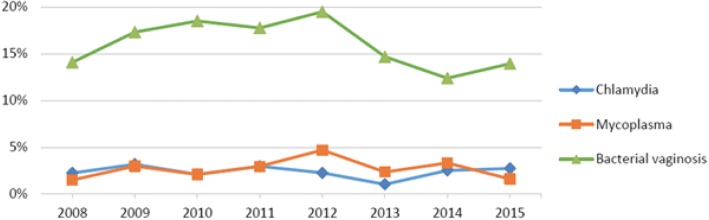
Methods: All women who underwent induced abortion at Skaraborg Hospital between 2008 and 2015 are included in the study. Bacterial screening for chlamydia, gonorrhea, mycoplasma, and bacterial vaginosis was performed prior to the abortions. Abortion complications, categorized as bleeding, infection, or incomplete abortion were assessed in women who came in contact with the gynecological clinic within 30 days after the procedure.
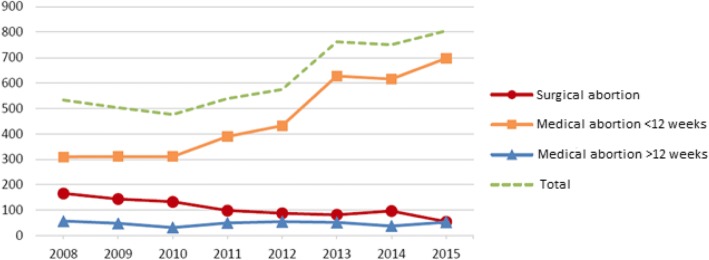
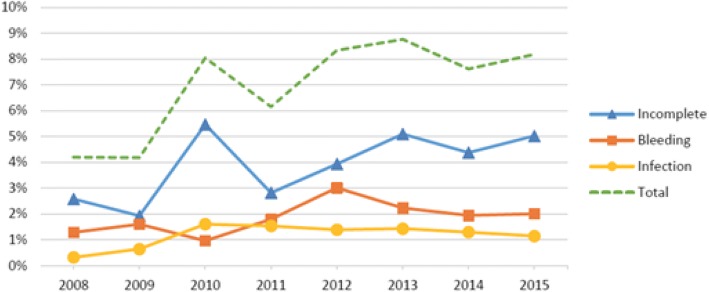
Results: A total of 4945 induced abortions were performed during the study period. Nearly all, 4945 (99.7%) were eligible for inclusion in the study. Medical abortions < 12 weeks were the most common procedure (74.7%), followed by surgical abortions (17.5%), and medical abortion > 12 weeks (7.8%). Complications were registered in 333 (6.7%) of all abortions. Among medical abortions < 12 weeks, the complication frequency increased significantly, from 4.2% in 2008 to 8.2% in 2015 (RR 1.49, 95% 1.04-2.15). An incomplete abortion was the most common complication related to medical abortions < 12 weeks. Of all women who tested positive for one or several bacteria at the screening and therefore received antibiotics, 1.4% developed a postabortal infection. Among those who tested negative at the screening, 1.7% developed infectious complications.
Conclusions: The share of complications related to medical abortions < 12 weeks increased significantly during 2008-2015 without any evident cause. Women who tested positive for one or several bacteria upon screening and received antibiotics experienced almost an equal proportion of postabortal infections compared to women who tested negative upon screening. The screening process seems to fulfill its purpose of reducing the risk of infectious complications.
Keywords: Endometritis; Induced abortion; Pregnancy; Sexually transmitted diseases; Vacuum curettage.
Conflict of interest statement
Ethics approval and consent to participate
Ethical approval by the regional ethical review board (EPN) in Gothenburg was given in 2010, number 658–09, for an extra screening of Mycoplasma genitalium in order to lower the amount of post abortion infections. All therapeutic abortions in Sweden are reported to the National Board of Health and Welfare. No consent was therefore needed to collect information about gestational age, the number of previous abortions, abortion method or the age of patients. At our hospital, we register all given antibiotics and the reason for treatment as a quality control and for statistical purposes. Therefore, there is no need for consent to collect data from the bacterial screening process. No consent was needed for the prospective part. Follow up appointments 1 month after the abortions were standard procedures even before we started collecting data for this study.
Consent for publication
Consent for publication was not applicable.
Competing interests
The authors declare that they have no competing interests.
Publisher’s Note
Springer Nature remains neutral with regard to jurisdictional claims in published maps and institutional affiliations.
Figures
References
-
- Socialstyrelsen. Abortstatistik 2014 – Statistics on induced abortions 2014 2015. [Available from: https://www.socialstyrelsen.se/publikationer2015/2015-9-4. Accessed 25 Jan 2016.
-
- Skånberg T. Motion 1992/93:So435 Abortpillret Mifegyne 1993. Available from: http://www.riksdagen.se/sv/Dokument-Lagar/Forslag/Motioner/Abortpillret-.... Accessed 9 Feb 2016.
Publication types
MeSH terms
Substances
LinkOut - more resources
Full Text Sources
Other Literature Sources
Medical
