Comment
doi: 10.1126/scisignal.aav1646.
Arrestins and G proteins in cellular signaling: The coin has two sides
Affiliations
- PMID: 30254054
- PMCID: PMC6390952
- DOI: 10.1126/scisignal.aav1646
Item in Clipboard
Comment
Arrestins and G proteins in cellular signaling: The coin has two sides
Sci Signal.
.
Abstract
Several studies have suggested that arrestin-mediated signaling by GPCRs requires G protein activation; however, in this issue of Science Signaling, Luttrell et al. documented arrestin-dependent activation of ERK1/2 by a number of GPCRs. These studies do not contradict each other, but illustrate the complexity of cellular signaling that cannot and should not be reduced to simplistic models.
Copyright © 2018 The Authors, some rights reserved; exclusive licensee American Association for the Advancement of Science. No claim to original U.S. Government Works.
Figures
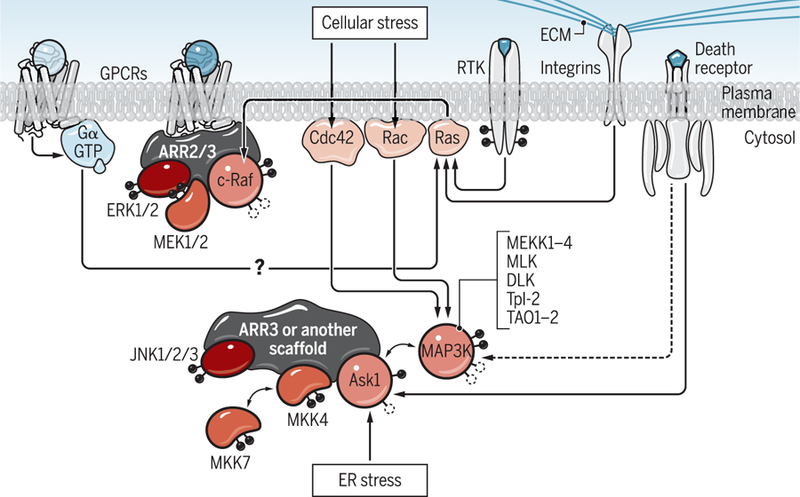
MAPK cascades consist of three kinases, MAP3K, MAP2K, and MAPK, which sequentially activate their downstream targets by phosphorylation. Arrestins have not been reported to participate in MAP3K activation, which initiates the signaling in MAPK cascades. G proteins can be activated by GPCR-dependent and GPCR-independent mechanisms. MAP3Ks are activated by RTKs, integrins, and several G protein–dependent mechanisms. Only after MAP3K activation can various scaffolds, including free and GPCR-bound arrestins, help to transform this first push into the activation of the most downstream MAPKs that are experimentally monitored in most studies of biased signaling. Note that JNK1/2/3 pathways are activated not only by ASK1 (which is not only scaffolded by arrestin-3) but also by other MAP3Ks, including MEKK1 to MEKK4, MLK, DLK, Tpl-2, and TAO1-2, with the help of other scaffolds. Note that c-Raf (cellular rapidly accelerated fibrosarcoma), ASK1 (apoptosis signal–regulated kinase 1), and MEKK1 to MEKK4, MLK, DLK, Tpl-2, and TAO1-2 are MAP3Ks; MEK1/2 and MKK4/7 are MAP2Ks; and Ras, Rac, and Cdc42 are small (single subunit) G proteins. Black circles indicate phosphorylation. Empty circles represent the dephosphorylation that is necessary for activation. ECM, extracellular matrix; PM, plasma membrane; ARR2/3, arrestin-2 or -3.
Comment on
-
Manifold roles of β-arrestins in GPCR signaling elucidated with siRNA and CRISPR/Cas9.Sci Signal. 2018 Sep 25;11(549):eaat7650. doi: 10.1126/scisignal.aat7650. Sci Signal. 2018. PMID: 30254056 Free PMC article.
References
-
- Luttrell LM, Wang J, Plouffe B, Smith JS,Yamani L, Kaur S, Jean-Charles P-Y, Gauthier C, Lee M-H, Pani B, Kim J, Ahn S, Rajagopal S,Reiter E, Bouvier M, Shenoy SK, Laporte SA,Rockman HA, Lefkowitz RJ, Manifold roles of β-arrestins in GPCR signaling elucidated with siRNA and CRISPR/Cas9. Sci. Signal 11, eaat7650 (2018). - PMC - PubMed
-
- Luttrell LM, ‘Location, location, location’: Activation and targeting of MAP kinases by G protein-coupled receptors. J. Mol. Endocrinol 30, 117–126 (2003). - PubMed
-
- DeWire SM, Ahn S, Lefkowitz RJ, Shenoy SK, β-arrestins and cell signaling. Annu. Rev. Physiol 69, 483–510 (2007). - PubMed
-
- Grundmann M, Merten N, Malfacini D, Inoue A, Preis P, Simon K, Rüttiger N, Ziegler N, Benkel T, Schmitt NK, Ishida S, Müller I, Reher R, Kawakami K, Inoue A, Rick U, Kühl T, Imhof D, Aoki J, König GM, Hoffmann C, Gomeza J, Wess J, Kostenis E, Lack of beta-arrestin signaling in the absence of active G proteins. Nat. Commun 9, 341 (2018). - PMC - PubMed
Publication types
MeSH terms
Substances
Grants and funding
LinkOut - more resources
Full Text Sources
Other Literature Sources
Miscellaneous