


First Genome-Wide Association Study of Latent Autoimmune Diabetes in Adults Reveals Novel Insights Linking Immune and Metabolic Diabetes
- PMID: 30254083
- PMCID: PMC6196829
- DOI: 10.2337/dc18-1032
First Genome-Wide Association Study of Latent Autoimmune Diabetes in Adults Reveals Novel Insights Linking Immune and Metabolic Diabetes
Abstract
Objective: Latent autoimmune diabetes in adults (LADA) shares clinical features with both type 1 and type 2 diabetes; however, there is ongoing debate regarding the precise definition of LADA. Understanding its genetic basis is one potential strategy to gain insight into appropriate classification of this diabetes subtype.
Research design and methods: We performed the first genome-wide association study of LADA in case subjects of European ancestry versus population control subjects (n = 2,634 vs. 5,947) and compared against both case subjects with type 1 diabetes (n = 2,454 vs. 968) and type 2 diabetes (n = 2,779 vs. 10,396).
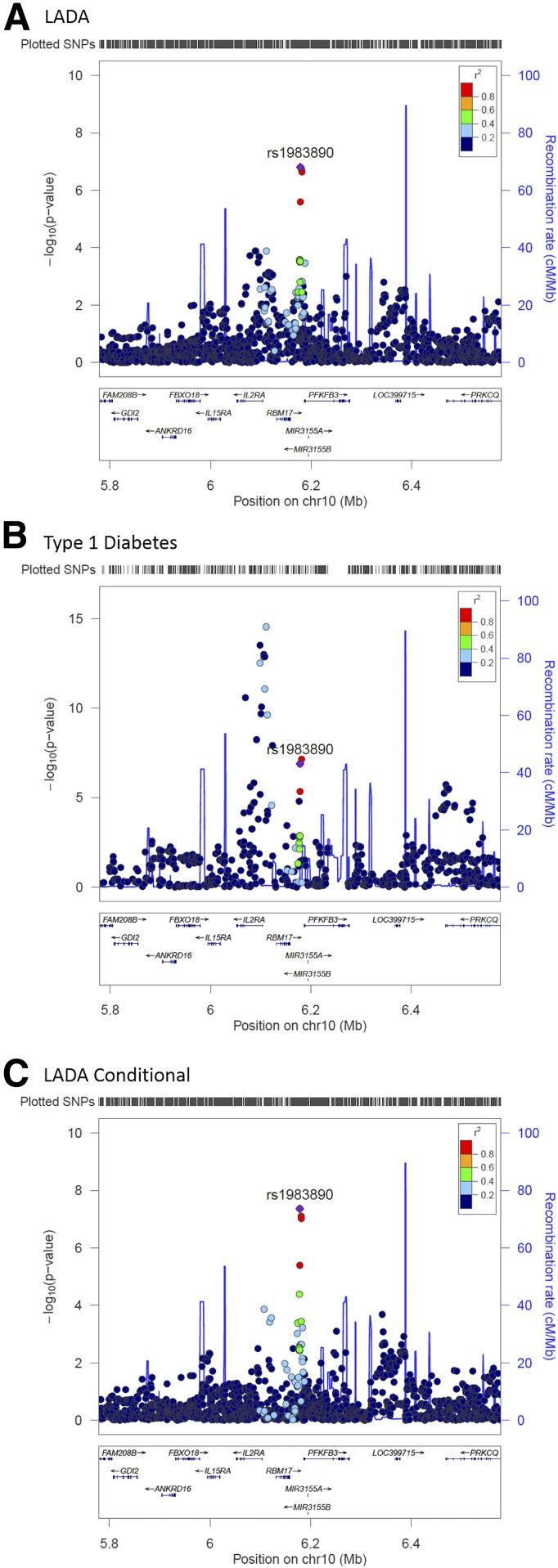
Results: The leading genetic signals were principally shared with type 1 diabetes, although we observed positive genetic correlations genome-wide with both type 1 and type 2 diabetes. Additionally, we observed a novel independent signal at the known type 1 diabetes locus harboring PFKFB3, encoding a regulator of glycolysis and insulin signaling in type 2 diabetes and inflammation and autophagy in autoimmune disease, as well as an attenuation of key type 1-associated HLA haplotype frequencies in LADA, suggesting that these are factors that distinguish childhood-onset type 1 diabetes from adult autoimmune diabetes.
Conclusions: Our results support the need for further investigations of the genetic factors that distinguish forms of autoimmune diabetes as well as more precise classification strategies.
© 2018 by the American Diabetes Association.
Figures
Comment in
-
Results of the First Genome-Wide Association Study of Latent Autoimmune Diabetes in Adults further highlight the need for a novel diabetes classification system.Ann Transl Med. 2018 Dec;6(Suppl 2):S102. doi: 10.21037/atm.2018.11.40. Ann Transl Med. 2018. PMID: 30740423 Free PMC article. No abstract available.
-
New genetic characteristics of latent autoimmune diabetes in adults (LADA).Ann Transl Med. 2019 Mar;7(5):81. doi: 10.21037/atm.2019.01.01. Ann Transl Med. 2019. PMID: 31019931 Free PMC article. No abstract available.
References
-
- Tuomi T, Santoro N, Caprio S, Cai M, Weng J, Groop L. The many faces of diabetes: a disease with increasing heterogeneity. Lancet 2014;383:1084–1094 - PubMed
-
- Ahlqvist E, Storm P, Käräjämäki A, et al. Novel subgroups of adult-onset diabetes and their association with outcomes: a data-driven cluster analysis of six variables. Lancet Diabetes Endocrinol 2018;6:361–369. - PubMed
Publication types
MeSH terms
Substances
Grants and funding
LinkOut - more resources
Full Text Sources
Other Literature Sources
Medical
Research Materials
