. 2018 Sep 15;16(3):A210-A216.
eCollection 2018 Summer.

Recording EMG Signals on a Computer Sound Card

Affiliations

Recording EMG Signals on a Computer Sound Card

Kevin M Crisp. J Undergrad Neurosci Educ. .

Abstract

For a few dollars and in a few minutes, a simple circuit can be built to permit a cheap external sound card and a laptop computer to be used as a portable data acquisition system for recording EMG. The circuit uses a common audio amplifier integrated circuit to increase the gain of the EMG signals recorded from EMG surface electrodes and to match the impedance of the electrode-skin interface with the input impedance of the sound card. Data can be recorded using open source sound editing software and analyzed offline using simple Python code. It is hoped that such activities provide opportunities to undergraduates to gain confidence as experimentalists and as innovators.

Keywords: lab activity; neuroscience; noise elimination; signal analysis; undergraduate.


Figures

Figure 1
Figure 1
A simple Visual Python simulation of an EMG burst using scaled Gaussian noise.
Figure 2
Figure 2
The LM386 integrated circuit is an easy to use audio amplifier that can be used to record EMG on a sound card.
Figure 3
Figure 3
Pin layout of a mono audio connector that plugs into the USB sound card. The tip is connected to the negative end of the electrolytic capacitor whose positive end is connected to in 5 of the LM386 chip. The sheath is connected to the blue rail.
Figure 4
Figure 4
Simplified diagram of the circuit.
Figure 5
Figure 5
Circuit constructed in a breadboard (prototyping board).
Figure 6
Figure 6
Schematic of the circuit shown in Figure 5.
Figure 7
Figure 7
Audacity user interface.
Figure 8
Figure 8
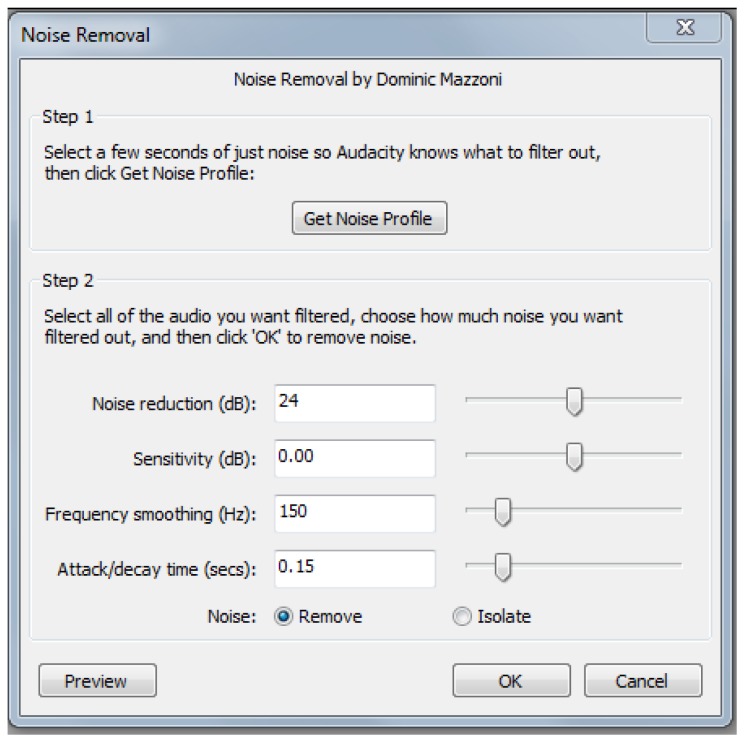
Audacity’s “Noise Removal” tool.
Figure 9
Figure 9
Noisy signal before (upper) and after (below) using Audacity’s “Noise Removal Tool.”
Figure 10
Figure 10
EMG signal recorded using the circuit in the breadboard shown in Figure 5.
Figure 11
Figure 11
EMG signal from Figure 10, rectified.
Figure 12
Figure 12
Envelope of rectified EMG signal shown in Figure 11.

References

    1. Crisp KM, Lin H, Prosper I. Breadboard amplifier: building and using simple electrophysiology equipment. J Undergrad Neurosci Educ. 2016;14:A124–A131. - PMC - PubMed
    1. Fish RM, Geddes LA. Conduction of electrical current to and through the human body: a review. Eplasty. 2009;9:e44. - PMC - PubMed
    1. Hamming RW. Digital filters. Mineola, NY: Dover Publications; 1997.
    1. Hayashi H, Furui A, Kurita Y, Tsuji T. A variance distribution model of surface EMG signals based on inverse gamma distribution. IEEE Trans Biomed Eng. 2017;64:2672–2681. - PubMed
    1. Heckman CJ, Enoka RM. Motor unit. Compr Physiol. 2012;2:2629–2682. - PubMed

LinkOut - more resources