. 2018 Sep 11:12:307.
doi: 10.3389/fncel.2018.00307. eCollection 2018.

HIV Neuroinfection and Alzheimer's Disease: Similarities and Potential Links?

Affiliations

HIV Neuroinfection and Alzheimer's Disease: Similarities and Potential Links?

Geoffrey Canet et al. Front Cell Neurosci. .

Abstract

Environmental factors such as chemicals, stress and pathogens are now widely believed to play important roles in the onset of some brain diseases, as they are associated with neuronal impairment and acute or chronic inflammation. Alzheimer's disease (AD) is characterized by progressive synaptic dysfunction and neurodegeneration that ultimately lead to dementia. Neuroinflammation also plays a prominent role in AD and possible links to viruses have been proposed. In particular, the human immunodeficiency virus (HIV) can pass the blood-brain barrier and cause neuronal dysfunction leading to cognitive dysfunctions called HIV-associated neurocognitive disorders (HAND). Similarities between HAND and HIV exist as numerous factors involved in AD such as members of the amyloid and Tau pathways, as well as stress-related pathways or blood brain barrier (BBB) regulators, seem to be modulated by HIV brain infection, leading to the accumulation of amyloid plaques or neurofibrillary tangles (NFT) in some patients. Here, we summarize findings regarding how HIV and some of its proteins such as Tat and gp120 modulate signaling and cellular pathways also impaired in AD, suggesting similarities and convergences of these two pathologies.

Keywords: Alzheimer’s disease; HIV-associated neurocognitive disorders; hypothalamo-pituitary-adrenal axis; neuroinflammation; viral neuroinfection.


Figures
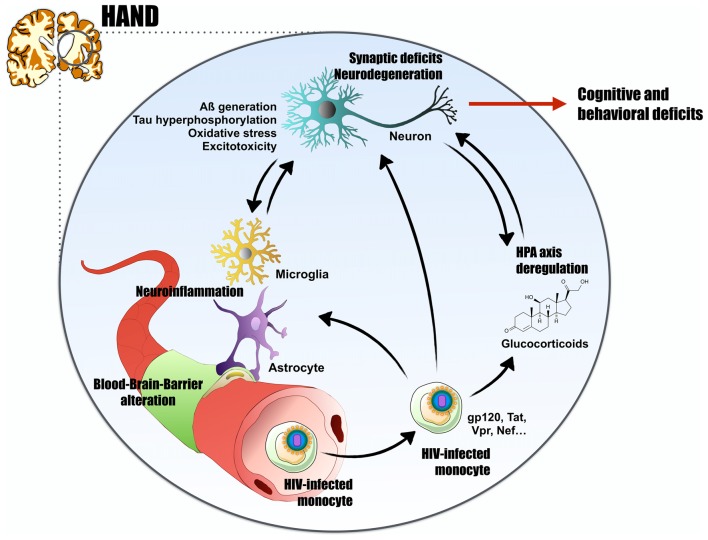
Figure 1
Figure 1
Proposed mechanism for human immunodeficiency virus (HIV)-associated neurocognitive disorders (HAND). HIV-1, through infected monocytes, can cross the blood brain barrier (BBB) by the Trojan horse mechanism. In the central nervous system (CNS), neuroinflammation triggered directly by viral replication or by HIV-viral proteins (glycoprotein 120 (gp120), transactivator of transcription (Tat), viral protein R (Vpr), negative regulatory factor (Nef)…) exert neurotoxic effects. They impact neurons integrity and lead to Alzheimer’s disease (AD)-like characteristics such as A generation, abnormal Tau phosphorylation, oxidative stress and excitotoxicity. The virus can induces neuroinflammation by several mechanisms: direct infection of astrocytes, BBB impairment and peripheral macrophages invasion, or massive gliosis and cytokines release. Finally, HIV+ patients present high glucocorticoids (cortisol) levels, characteristic of a hypothalamic–pituitary–adrenal (HPA) axis deregulation. Glucocorticoids and their receptors are highly involved in the etiology of AD. By these numerous pathways, HIV-1 induces synaptic deficits and neurodegeneration, thus leads to cognitive and behavioral deficits, and could explain the establishment of HAND in HIV+ patients and potentially the onset of AD.
Figure 2
Figure 2
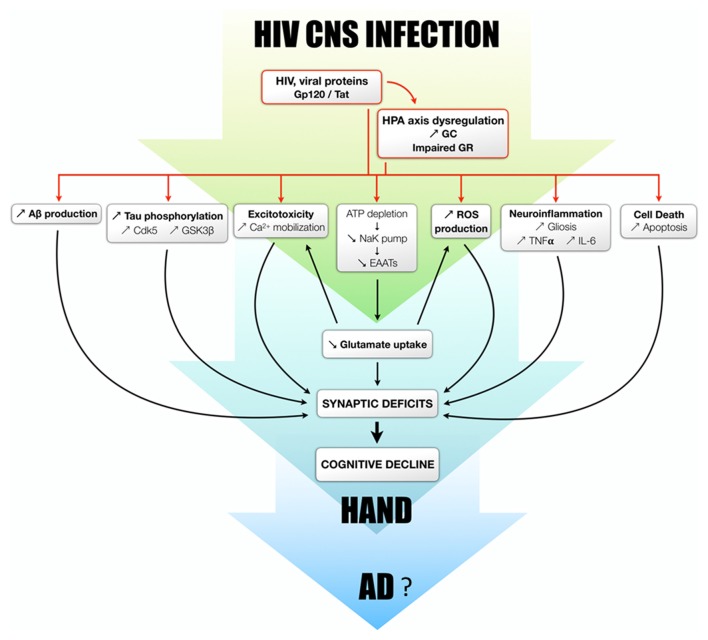
Proposed mechanisms by which glucocorticoids and their receptors modulate/potentiate the development of HAND and potentially AD. The dysregulation of the HPA axis is observed both in HIV patients and rodent models. GC overexposure, in combination with viral proteins or not, is able to induce the increase of Aβ production, Tau phosphorylation, excitotoxicity, oxidative stress, neuroinflammation and apoptosis. It should be also mentioned that Aβ itself can trigger Tau phosphorylation, excitotoxicity, oxidative stress, neuroinflammation and cell death. All these processes lead to neurodegeneration and synaptic deficits and potentially responsible for cognitive decline observed in HAND patients, all of which could progressively favor to the development of AD.

References

    1. Adle-Biassette H., Chrétien F., Wingertsmann L., Héry C., Ereau T., Scaravilli F., et al. (1999). Neuronal apoptosis does not correlate with dementia in HIV infection but is related to microglial activation and axonal damage. Neuropathol. Appl. Neurobiol. 25, 123–133. 10.1046/j.1365-2990.1999.00167.x - DOI - PubMed
    1. Aksenov M. Y., Aksenova M. V., Mactutus C. F., Booze R. M. (2010). HIV-1 protein-mediated amyloidogenesis in rat hippocampal cell cultures. Neurosci. Lett. 475, 174–178. 10.1016/j.neulet.2010.03.073 - DOI - PMC - PubMed
    1. Alfahad T., Nath A. (2013). Retroviruses and amyotrophic lateral sclerosis. Antiviral Res. 99, 180–187. 10.1016/j.antiviral.2013.05.006 - DOI - PMC - PubMed
    1. András I. E., Toborek M. (2013). Amyloid beta accumulation in HIV-1-infected brain: the role of the blood brain barrier. IUBMB Life 65, 43–49. 10.1002/iub.1106 - DOI - PMC - PubMed
    1. Anesten B., Yilmaz A., Hagberg L., Zetterberg H., Nilsson S., Brew B. J., et al. (2016). Blood-brain barrier integrity, intrathecal immunoactivation and neuronal injury in HIV. Neurol. Neuroimmunol. Neuroinflamm. 3:e300. 10.1212/nxi.0000000000000300 - DOI - PMC - PubMed