


Differential brain mechanisms for processing distracting information in task-relevant and -irrelevant dimensions in visual search
- PMID: 30256504
- PMCID: PMC8022275
- DOI: 10.1002/hbm.24358
Differential brain mechanisms for processing distracting information in task-relevant and -irrelevant dimensions in visual search
Abstract
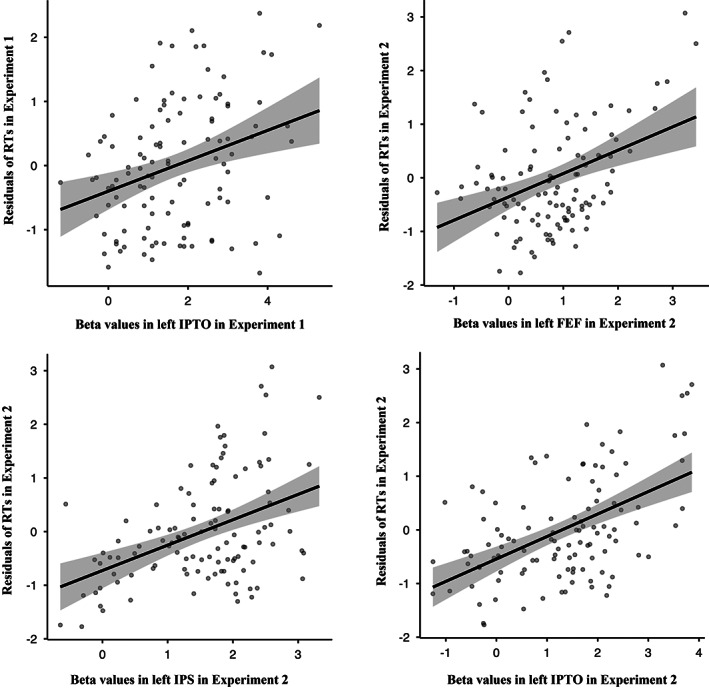
A crucial function of our goal-directed behavior is to select task-relevant targets among distractor stimuli, some of which may share properties with the target and thus compete for attentional selection. Here, by applying functional magnetic resonance imaging (fMRI) to a visual search task in which a target was embedded in an array of distractors that were homogeneous or heterogeneous along the task-relevant (orientation or form) and/or task-irrelevant (color) dimensions, we demonstrate that for both (orientation) feature search and (form) conjunction search, the fusiform gyrus is involved in processing the task-irrelevant color information, while the bilateral frontal eye fields (FEF), the cortex along the left intraparietal sulcus (IPS), and the left junction of intraparietal and transverse occipital sulci (IPTO) are involved in processing task-relevant distracting information, especially for target-absent trials. Moreover, in conjunction (but not in feature) search, activity in these frontoparietal regions is affected by stimulus heterogeneity along the task-irrelevant dimension: heterogeneity of the task-irrelevant information increases the activity in these regions only when the task-relevant information is homogeneous, not when it is heterogeneous. These findings suggest that differential neural mechanisms are involved in processing task-relevant and task-irrelevant dimensions of the searched-for objects. In addition, they show that the top-down task set plays a dominant role in determining whether or not task-irrelevant information can affect the processing of the task-relevant dimension in the frontoparietal regions.
Keywords: conjunction search; fMRI; feature search; task-irrelevant; task-relevant; visual search.
© 2018 Wiley Periodicals, Inc.
Conflict of interest statement
All authors declare no conflict of interests.
Figures


References
-
- Anderson, E. J. , Mannan, S. K. , Husain, M. , Rees, G. , Sumner, P. , Mort, D. J. , & Kennard, C. (2007). Involvement of prefrontal cortex in visual search. Experimental Brain Research, 180(2), 289–302. - PubMed
-
- Arguin, M. , Jeanette, Y. , & Cavanagh, P. (1993). Visual search for features and conjunction targets with an attention deficit. Journal of Cognitive Neuroscience, 5, 436–452. - PubMed
-
- Assad, J. A. (2003). Neural coding of behavioral relevance in parietal cortex. Current Opinion in Neurobiology, 13, 194–197. - PubMed
-
- Bartels, A. , & Zeki, S. (2000). The architecture of the colour centre in the human visual brain: New results and a review. European Journal of Neuroscience, 12, 172–193. - PubMed
Publication types
MeSH terms
Grants and funding
- 31470979/National Natural Science Foundation of China/International
- 31470980/National Natural Science Foundation of China/International
- 90920012/National Natural Science Foundation of China/International
- 2010CB833904/National Basic Research Program of China (973 Program)/International
- BAICIT-2016018/Beijing Advanced Innovation Center for Imaging Technology/International
LinkOut - more resources
Full Text Sources
Other Literature Sources
