


Common psychiatric and metabolic comorbidity of adult attention-deficit/hyperactivity disorder: A population-based cross-sectional study
- PMID: 30256837
- PMCID: PMC6157884
- DOI: 10.1371/journal.pone.0204516
Common psychiatric and metabolic comorbidity of adult attention-deficit/hyperactivity disorder: A population-based cross-sectional study
Abstract
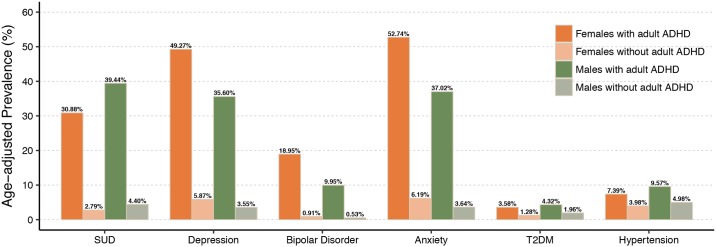
Attention-deficit/hyperactivity disorder (ADHD) is often comorbid with other psychiatric conditions in adults. Yet, less is known about its relationship with common metabolic disorders and how sex and ageing affect the overall comorbidity patterns of adult ADHD. We aimed to examine associations of adult ADHD with several common psychiatric and metabolic conditions. Through the linkage of multiple Swedish national registers, 5,551,807 adults aged 18 to 64 years and living in Sweden on December 31, 2013 were identified and assessed for clinical diagnoses of adult ADHD, substance use disorder (SUD), depression, bipolar disorder, anxiety, type 2 diabetes mellitus (T2DM), and hypertension. Logistic regression models and regression standardization method were employed to obtain estimates of prevalence, prevalence difference (PD), and prevalence ratio (PR). All comorbid conditions of interest were more prevalent in adults with ADHD (3.90% to 44.65%) than in those without (0.72% to 4.89%), with the estimated PRs being over nine for psychiatric conditions (p < 0.001) and around two for metabolic conditions (p < 0.001). Sex differences in the prevalence of comorbidities were observed among adults with ADHD. Effect modification by sex was detected on the additive scale and/or multiplicative scale for the associations of adult ADHD with all comorbidities. ADHD remained associated with all comorbidities in older adults aged 50 to 64 when all conditions were assessed from age 50 onwards. The comorbidity patterns of adult ADHD underscore the severity and clinical complexity of the disorder. Clinicians should remain vigilant for a wide range of psychiatric and metabolic problems in ADHD affected adults of all ages and both sexes.
Conflict of interest statement
In the past year, Dr. Faraone received income, potential income, travel expenses continuing education support and/or research support from Otsuka, Lundbeck, KenPharm, Rhodes, Arbor, Ironshore, Shire, Akili Interactive Labs, CogCubed, Alcobra, VAYA, Sunovion, Genomind and NeuroLifeSciences. With his institution, he has US patent US20130217707 A1 for the use of sodium-hydrogen exchange inhibitors in the treatment of ADHD. Dr. Larsson has served as a speaker for Eli-Lilly and has received research grants from Shire. Dr. Haavik has served as a speaker for Eli-Lilly, HB Pharma and Shire. The other authors declare no competing interests. This does not alter our adherence to PLOS ONE policies on sharing data and materials.
Figures
References
-
- van de Glind G, Konstenius M, Koeter MW, van Emmerik-van Oortmerssen K, Carpentier PJ, Kaye S, et al. Variability in the prevalence of adult ADHD in treatment seeking substance use disorder patients: results from an international multi-center study exploring DSM-IV and DSM-5 criteria. Drug Alcohol Depend. 2014;134:158–66. Epub 2013/10/26. 10.1016/j.drugalcdep.2013.09.026 . - DOI - PMC - PubMed
Publication types
MeSH terms
LinkOut - more resources
Full Text Sources
Other Literature Sources
Medical
Research Materials
