


Carcass Quality, Meat Quality and Sensory Properties of the Dual-Purpose Chicken Lohmann Dual
- PMID: 30257499
- PMCID: PMC6210674
- DOI: 10.3390/foods7100156
Carcass Quality, Meat Quality and Sensory Properties of the Dual-Purpose Chicken Lohmann Dual
Abstract
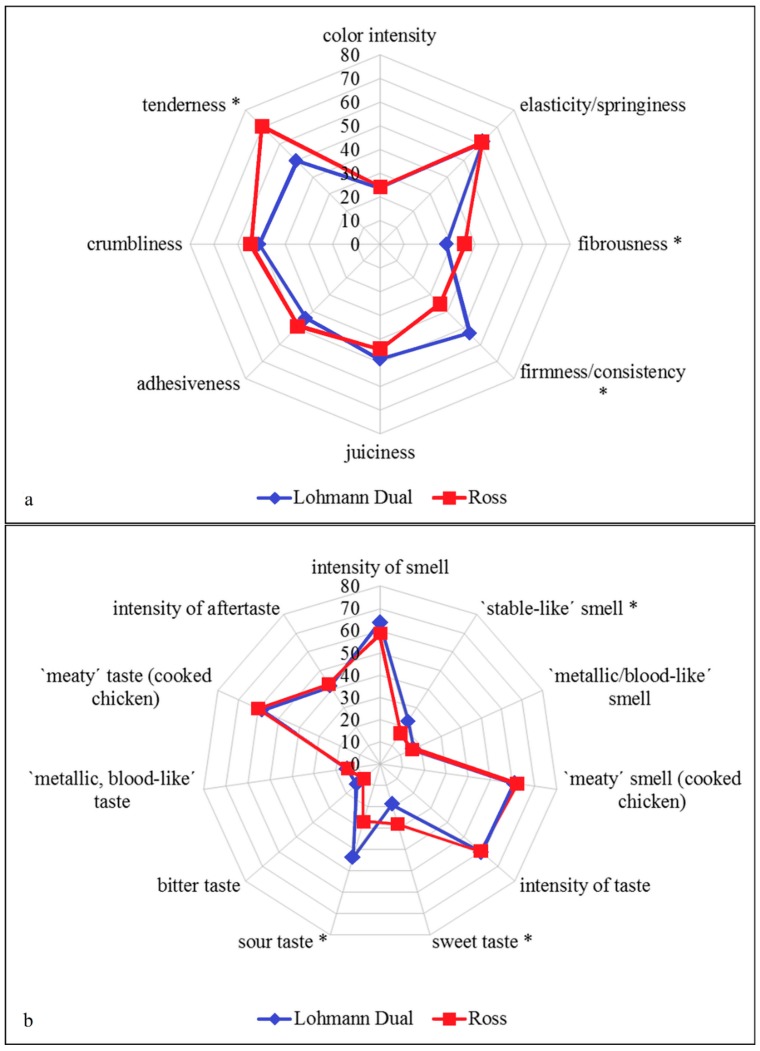
Over 40 million day-old layer line cockerels are culled in Germany each year, due to economic reasons, leading to a recently instigated research focus on the potential of dual-purpose breeds as an alternative to conventional poultry husbandry, especially the practice of culling. This paper aims to explore and assess the dual-purpose chicken breed "Lohmann Dual" (LD) performance (n = 30) and sensory characteristics (n = 48). Carcass and meat quality traits are evaluated, and descriptive sensory analysis of breast muscles is conducted. To define the scope of characteristics, a market sample of "Ross" Line (n = 35) is adducted. LD carcasses are characterized by higher leg than breast yield; carcass, breast and leg weights are higher in Ross. LD meat has a lower pH, differs in color, has higher drip and thawing losses, but lower cooking loss. LD breast muscles are firmer as indicated by shear force measurements, which is confirmed through the sensory analysis. Appearance, odor and flavor differ between the lines. Overall, distinguishable differences are found between both breeds. Further research should focus on the marketing aspect of the dual-purpose line, as some characteristics could draw consumers to this product. Animal welfare and ethical concerns should further be considered when considering dual-purpose breeds as a feasible alternative to culling.
Keywords: MORS-blade; animal welfare; descriptive sensory analysis; production performance.
Conflict of interest statement
The dual-purpose chicken Lohmann Dual was kindly provided by Lohmann Tierzucht, Cuxhaven. Arrangement of housing by Big Dutchman. Boehringer Ingelheim Vetmedica GmbH assisted with the arrangement of vaccination. The founding sponsors had no role in the design of the study; in the collection, analyses, or interpretation of data; in the writing of the manuscript, and in the decision to publish the results. There is no other conflict of interest declared by all other authors.
Figures
References
-
- Koenig M., Hahn G., Damme K., Schmutz M. Untersuchungen zur Mastleistung und Schlachtkörperzusammensetzung von Stubenküken aus Masthybriden und verschiedenen Legehybridherkünften. Züchtungskunde. 2012;84:511–522.
-
- Bruijnis M.R.N., Blok V., Stassen E.N., Gremmen H.G.J. Moral “lock-in” in responsible innovation, the ethical and social aspects of killing day-old chicks and its alternatives. J. Agric. Environ. Ethics. 2015;28:939–960. doi: 10.1007/s10806-015-9566-7. - DOI
-
- Damme K., Ristic M. Fattening performance, meat yield and economic aspects of meat and layer type hybrids. Worlds Poult. Sci. J. 2003;59:50–53.
-
- Gerken M., Jaenecke D., Kreuzer M. Growth, behaviour and carcass characteristics of egg-type cockerels compared to male broilers. Worlds Poult. Sci. J. 2003;59:46–49.
-
- Murawska D., Bochno R. Comparison of the slaughter quality of layer-type cockerels and broiler chickens. J. Poult. Sci. 2007;44:105–110. doi: 10.2141/jpsa.44.105. - DOI
LinkOut - more resources
Full Text Sources
Other Literature Sources
Research Materials
