The biofilm eradication activity of acetic acid in the management of periprosthetic joint infection
- PMID: 30258571
- PMCID: PMC6138806
- DOI: 10.1302/2046-3758.78.BJR-2018-0045.R1
The biofilm eradication activity of acetic acid in the management of periprosthetic joint infection
Abstract
Objectives: Periprosthetic joint infection following joint arthroplasty surgery is one of the most feared complications. The key to successful revision surgery for periprosthetic joint infections, regardless of treatment strategy, is a thorough deep debridement. In an attempt to limit antimicrobial and disinfectant use, there has been increasing interest in the use of acetic acid as an adjunct to debridement in the management of periprosthetic joint infections. However, its effectiveness in the eradication of established biofilms following clinically relevant treatment times has not been established. Using an in vitro biofilm model, this study aimed to establish the minimum biofilm eradication concentration (MBEC) of acetic acid following a clinically relevant treatment time.
Materials and methods: Using a methicillin-sensitive Staphylococcus aureus (MSSA) reference strain and the dissolvable bead assay, biofilms were challenged by 0% to 20% acetic acid (pH 4.7) for ten minutes, 20 minutes, 180 minutes, and 24 hours.
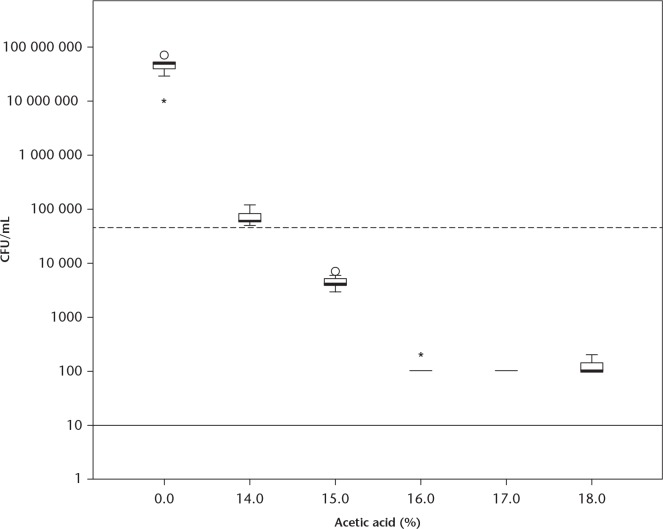
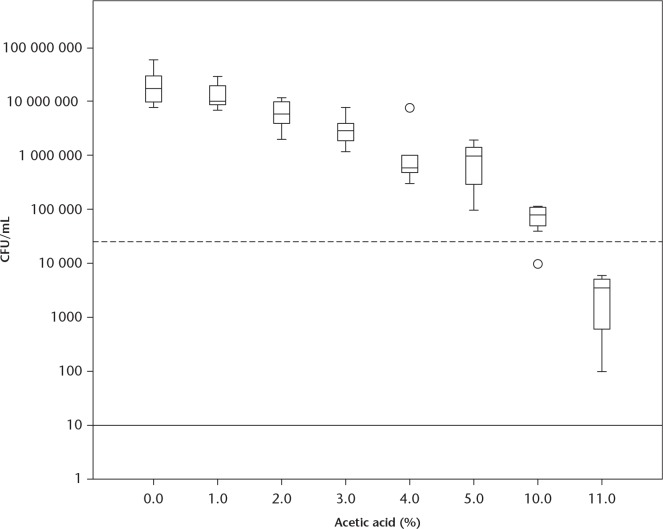
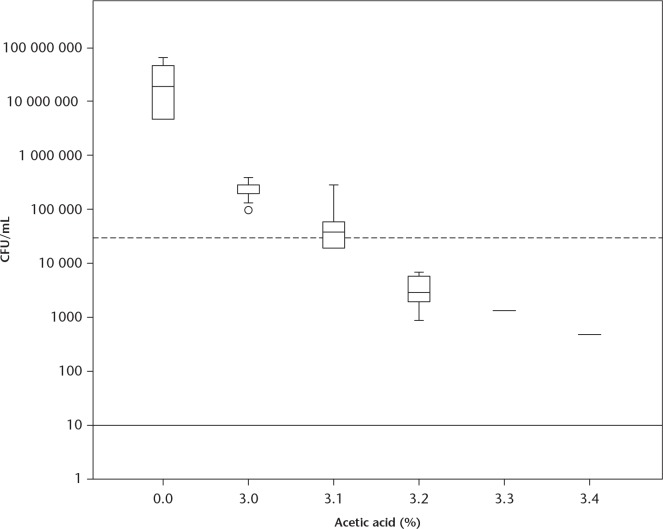
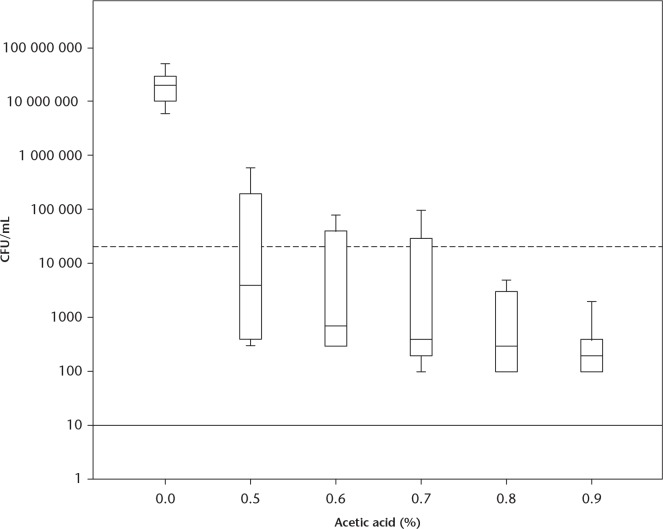
Results: The MBEC of acetic acid was found to be: 15%, 11%, 3.2%, and 0.8% following a ten-minute, 20-minute, 180-minute, and 24-hour treatment, respectively.
Conclusion: This study found that the MBEC of acetic acid following a 10- or 20-minute treatment time exceeded its safety threshold, making these concentrations unsuitable as a topical debridement adjunct. However, a clinically acceptable concentration (5%) was still found to eliminate 96.1% of biofilm-associated MSSA following a 20-minute treatment time.Cite this article: S. T. J. Tsang, P. J. Gwynne, M. P. Gallagher, A. H. R. W. Simpson. The biofilm eradication activity of acetic acid in the management of periprosthetic joint infection. Bone Joint Res 2018;7:517-523. DOI: 10.1302/2046-3758.78.BJR-2018-0045.R1.
Keywords: Acetic acid; Infection; Revision surgery.
Conflict of interest statement
Conflict of interest: The authors declare that there are no conflicts of interest.
Figures
References
-
- Zimmerli W, Trampuz A, Ochsner PE. Prosthetic-joint infections. N Engl J Med 2004;351:1645-1654. - PubMed
-
- Vanhegan IS, Malik AK, Jayakumar P, Ul Islam S, Haddad FS. A financial analysis of revision hip arthroplasty: the economic burden in relation to the national tariff. J Bone Joint Surg [Br] 2012;94-B:619-623. - PubMed
-
- British Orthopaedic Association. Getting It Right First Time. 2015. https://www.boa.ac.uk/pro-practice/getting-it-right-first-time/ (date last accessed 28 June 2017).
-
- Whitehouse JD, Friedman ND, Kirkland KB, Richardson WJ, Sexton DJ. The impact of surgical-site infections following orthopedic surgery at a community hospital and a university hospital: adverse quality of life, excess length of stay, and extra cost. Infect Control Hosp Epidemiol 2002;23:183-189. - PubMed
-
- Huotari K, Lyytikäinen O, Ollgren J, et al. Disease burden of prosthetic joint infections after hip and knee joint replacement in Finland during 1999-2004: capture-recapture estimation. J Hosp Infect 2010;75:205-208. - PubMed
LinkOut - more resources
Full Text Sources
Other Literature Sources