. 2018 Nov;25(33):33391-33401.
doi: 10.1007/s11356-018-3261-y. Epub 2018 Sep 27.

Seasonal and diurnal surveillance of treated and untreated wastewater for human enteric viruses

Affiliations

Seasonal and diurnal surveillance of treated and untreated wastewater for human enteric viruses

Kata Farkas et al. Environ Sci Pollut Res Int. 2018 Nov.

Abstract

Understanding the abundance and fate of human viral pathogens in wastewater is essential when assessing the public health risks associated with wastewater discharge to the environment. Typically, however, the microbiological monitoring of wastewater is undertaken on an infrequent basis and peak discharge events may be missed leading to the misrepresentation of risk levels. To evaluate diurnal patterns in wastewater viral loading, we undertook 3-day sampling campaigns with bi-hourly sample collection over three seasons at three wastewater treatment plants. Untreated influent was collected at Ganol and secondary-treated effluent was sampled at Llanrwst and Betws-y-Coed (North Wales, UK). Our results confirmed the presence of human adenovirus (AdV), norovirus genotypes I and II (NoVGI and NoVGII) in both influent and effluent samples while sapovirus GI (SaVGI) was only detected in influent water. The AdV titre was high and relatively constant in all samples, whereas the NoVGI, NoVGII and SaVGI showed high concentrations during autumn and winter and low counts during the summer. Diurnal patterns were detected in pH and turbidity for some sampling periods; however, no such changes in viral titres were observed apart from slight fluctuations in the influent samples. Our findings suggest that viral particle number in wastewater is not affected by daily chemical fluctuations. Hence, a grab sample taken at any point during the day may be sufficient to enumerate the viral load of wastewater effluent within an order of magnitude while four samples a day are recommended for testing wastewater influent samples.

Keywords: Activated sludge; Autosampler; Biofilter; Sampling method; Sewage treatment; Virus quantification; Water pollution.


Figures
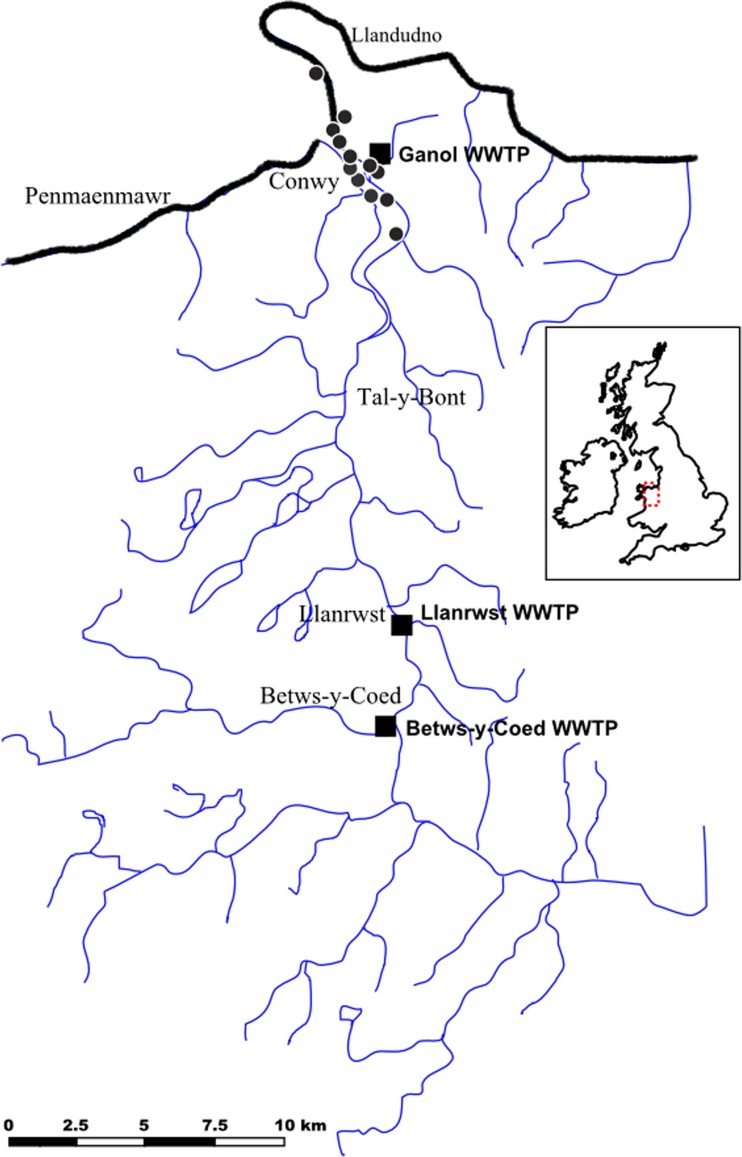
Fig. 1
Fig. 1
Map representing the Conwy catchment and estuary, North Wales, with the major wastewater treatment plants (squares) and combined sewer outflows (circles) of the Ganol wastewater treatment plant discharging to the river
Fig. 2
Fig. 2
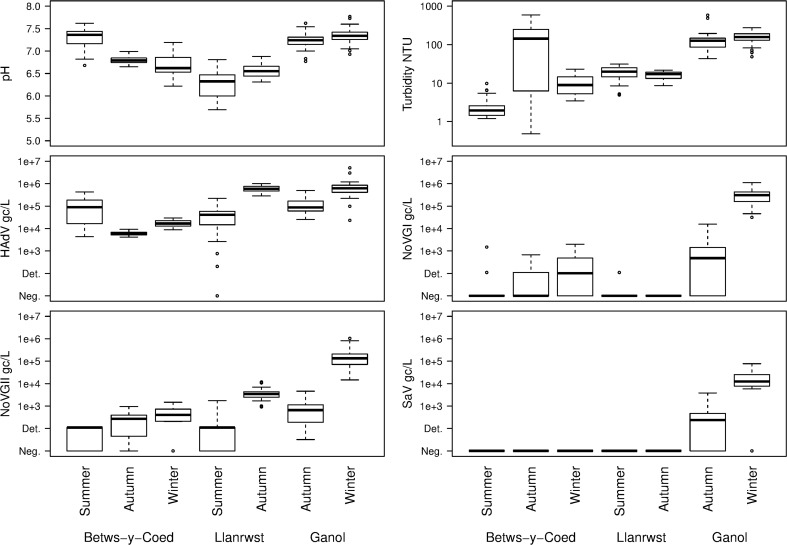
Boxplots of measured variables against sampling locations and times. Heavy bars show the median, boxes show the inter-quartile range, whiskers extend to data points no further than 1.5 times the distance between the median and the inter-quartile value. Data points beyond that range are shown individually
Fig. 3
Fig. 3
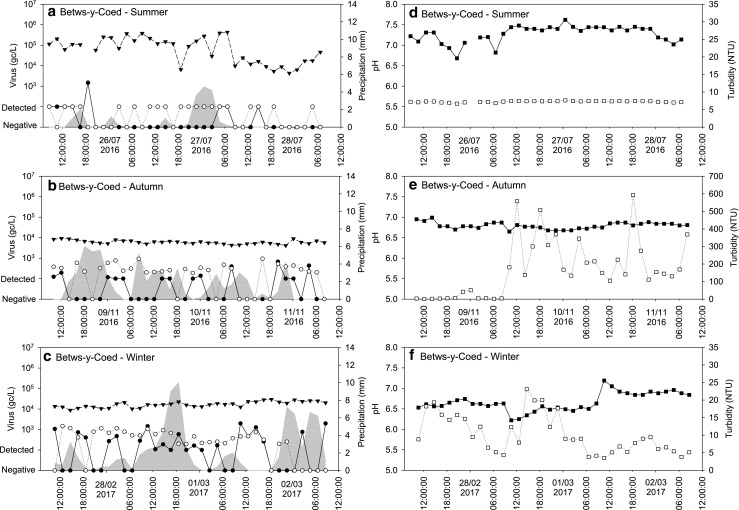
Observed NoVGI (○), NoVGII (●) and AdV (▼) concentrations and precipitation (grey area) during the summer sampling (a), autumn sampling (b) and winter sampling (c); pH (closed square) and turbidity (open square) values during the summer sampling (d), autumn sampling (e) and winter sampling (f) in wastewater effluent samples collected at Betws-y-Coed, North Wales. Grey circles, both NoVGI and NoVGII were detected
Fig. 4
Fig. 4
Observed NoVGI (○), NoVGII (●) and AdV (▼) concentrations and precipitation (grey area) during the summer sampling (a) and autumn sampling (b); pH (closed square) and turbidity (open square) values during the summer sampling (c) and autumn sampling (d) in the effluent samples collected at Llanrwst, North Wales. Grey circles, both NoVGI and NoVGII were detected
Fig. 5
Fig. 5
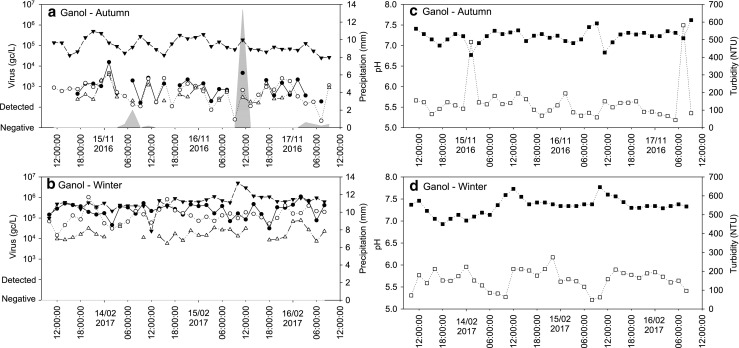
Observed NoVGI (○), NoVGII (●), AdV (▼) and SaVGI (△) concentrations and precipitation (grey area) during the autumn sampling (a) and winter sampling (b); pH (closed square) and turbidity (open square) values during the autumn sampling (c) and winter sampling (d) in influent samples collected at the Ganol WWTP, North Wales

References

    1. Adriaenssens E, Farkas K, Harrison C, et al. Viromic analysis of wastewater input to a river catchment reveals a diverse assemblage of RNA viruses. mSystems. 2018;3:e00025–e00018. doi: 10.1128/mSystems.00025-18. - DOI - PMC - PubMed
    1. Ashbolt NJ. Microbial contamination of drinking water and human health from community water systems. Curr Environ Health Rep. 2015;2:95–106. doi: 10.1007/s40572-014-0037-5. - DOI - PMC - PubMed
    1. Birks R, Hills S. Characterisation of indicator organisms and pathogens in domestic greywater for recycling. Environ Monit Assess. 2007;129:61–69. doi: 10.1007/s10661-006-9427-y. - DOI - PubMed
    1. Costantini V, Morantz EK, Browne H, Ettayebi K, Zeng XL, Atmar RL, Estes MK, Vinjé J. Human norovirus replication in human intestinal enteroids as model to evaluate virus inactivation. Emerg Infect Dis J. 2018;24:1453–1464. doi: 10.3201/eid2408.180126. - DOI - PMC - PubMed
    1. Eftim SE, Hong T, Soller J, Boehm A, Warren I, Ichida A, Nappier SP. Occurrence of norovirus in raw sewage – a systematic literature review and meta-analysis. Water Res. 2017;111:366–374. doi: 10.1016/j.watres.2017.01.017. - DOI - PubMed

LinkOut - more resources