Review
. 2019 Jan;12(1):125-147.
doi: 10.1111/1751-7915.13318. Epub 2018 Sep 26.

The art of vector engineering: towards the construction of next-generation genetic tools

Affiliations
Review

The art of vector engineering: towards the construction of next-generation genetic tools

Luísa Czamanski Nora et al. Microb Biotechnol. 2019 Jan.

Abstract

When recombinant DNA technology was developed more than 40 years ago, no one could have imagined the impact it would have on both society and the scientific community. In the field of genetic engineering, the most important tool developed was the plasmid vector. This technology has been continuously expanding and undergoing adaptations. Here, we provide a detailed view following the evolution of vectors built throughout the years destined to study microorganisms and their peculiarities, including those whose genomes can only be revealed through metagenomics. We remark how synthetic biology became a turning point in designing these genetic tools to create meaningful innovations. We have placed special focus on the tools for engineering bacteria and fungi (both yeast and filamentous fungi) and those available to construct metagenomic libraries. Based on this overview, future goals would include the development of modular vectors bearing standardized parts and orthogonally designed circuits, a task not fully addressed thus far. Finally, we present some challenges that should be overcome to enable the next generation of vector design and ways to address it.


Figures

Figure 1
Figure 1
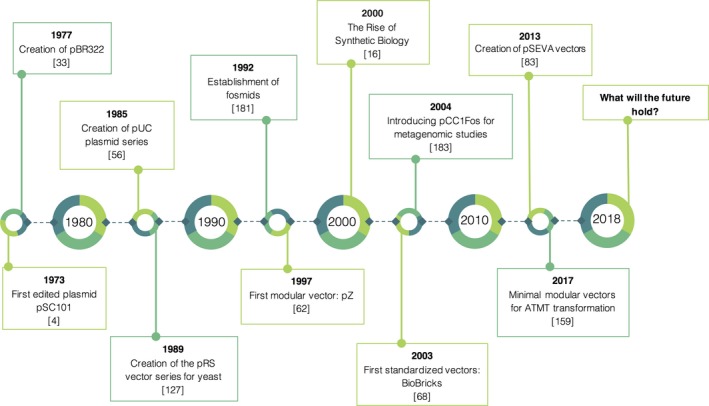
Timeline showing the most decisive breakthroughs regarding vector technology and design from 1970 until the present.
Figure 2
Figure 2
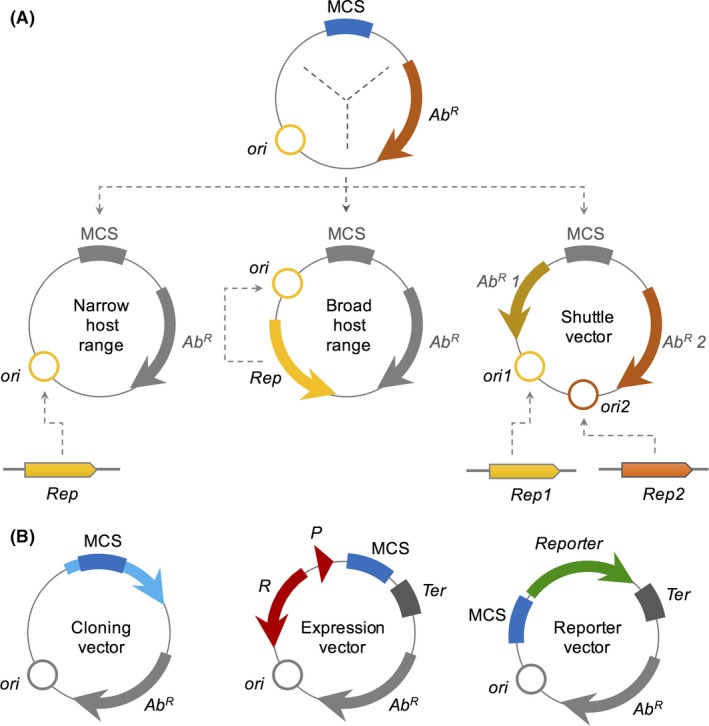
Most common bacterial plasmid architectures and categories.A. On the top, a minimal general architecture is formed by an origin of replication (ori), an antibiotic resistance marker (Ab R) and a multiple cloning site (MCS). From this general architecture, vectors can be categorized as narrow‐host‐range, broad‐host‐range and shuttle vectors. In the case of narrow‐host‐range, the ori relays on the replication machinery or a protein (Rep) provided by the host. In the case of broad‐host‐range vectors, the plasmid harbours its own Rep gene, which makes it mostly host‐independent. In the case of shuttle vectors, two ori regions (ori1 and ori2) are placed in the vector, each one being recognized by a specific Rep protein from different hosts (Rep1 and Rep2). In addition to that, two AbR (AbR 1 and AbR 2) are introduced to allow the selection in the appropriate host.B. Different functionalities of vectors. In cloning vectors, a MCS is usually located within a selection marker (such as the lacZα gene in pUC vectors) to allow the easy identification of plasmids with inserted fragments. In expression vectors, the MCS is preceded by an expression system (here shown as a regulated promoter P and its cognate regulator R) that allows the expression of the cloned fragment in response to a chemical inducer. Additionally, a strong terminator signal (Ter) is located after the MCS to ensure efficient transcriptional termination and increased plasmid stability. Finally, in a reporter vector, a reporter gene (such as a fluorescent protein, a luciferase coding gene or an enzyme‐coding gene such as lacZ) is flanked by an MCS and a strong terminator. In this system, the cloning of a promoter sequence in the MCS allows the investigation of promoter dynamics using the reporter gene of choice.
Figure 3
Figure 3
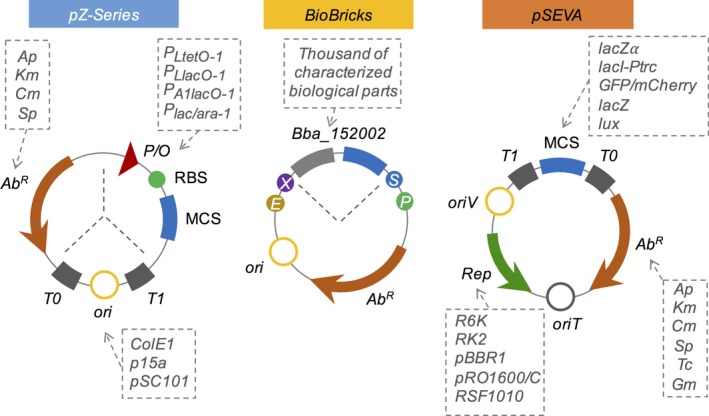
New generation of modular vectors. The pZ‐series represented remarkable progress in the new generation of vectors. In this set‐up, three modules are combined to generate a collection of vectors. In the original design, three narrow‐host‐range origins were combined with four antibiotic resistance markers and a few expression systems and reporters (Lutz and Bujard, 1997). In the BioBrick platform, a very interactive set‐up is used to assemble complex circuits by the joint of prefix and suffix fragments using only four restriction enzymes (Eco RI, XbaI, SpeI and PstI). This platform is merged with a collection of thousands of well‐characterized biological parts and is widely used by the iGEM community (Knight, 2003; Shetty et al., 2008). In the SEVA platform, broad‐host‐range origins of replication (represented by the oriV and Rep elements) are selected, allowing the replication of the plasmids in multiple Gram‐negative bacteria. This is combined with a number of antibiotic resistance markers and many functional systems at the MCS regions (some examples are shown in the figure). Another exclusive feature of this platform is the existence of a transference origin (oriT) to allow the mobilization of the plasmids to the target bacteria using conjugation (Silva‐Rocha et al., 2013).
Figure 4
Figure 4
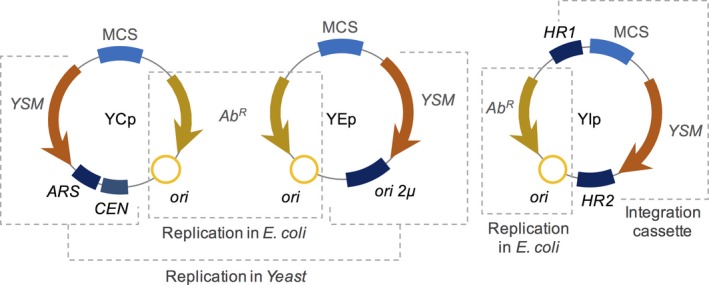
Modular vectors designed for yeast. The yeast centromeric plasmids (YCps) harbour the autonomously replicating sequences (ARS) and centromeric sequences (CEN), which allows the vectors to behave as mini‐chromosomes. The Yeast Episomal plasmids (YEps) are endowed with the 2μ origin of replication and are similar to plasmids in bacteria. In the case of Yeast Integrative plasmids (Yips), homologous regions (labelled as HR1 and HR2) to the host chromosome allow the integration of the target region through homologous recombination events. In all vectors, the yeast selection marker (YSM) represents a gene that allows the selection of transformants harbouring the vectors. In all cases, specific regions for replication of the bacterial host (usually E. coli) and the region required for replication or integration in yeast are highlighted.
Figure 5
Figure 5
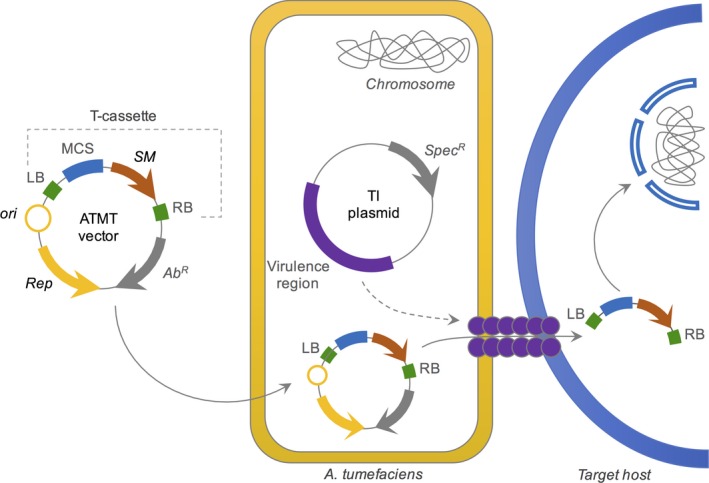
Minimal genetic tools based on Agrobacterium tumefacien‐mediated transformation (ATMT). ATMT vectors are based on broad‐host‐range plasmids and harbour a T‐cassette, which is composed of a MCS and a selection marker (SM) flanked by the left and right borders (LB and RB) required for the recognition of the A. tumefaciens machinery. Once inserted in the proper A. tumefaciens strain harbouring the TI plasmid (which expresses the components for T‐cassette mobilization), this vector can be used to introduce the T‐cassette into hosts such as fungi and plants.
Figure 6
Figure 6
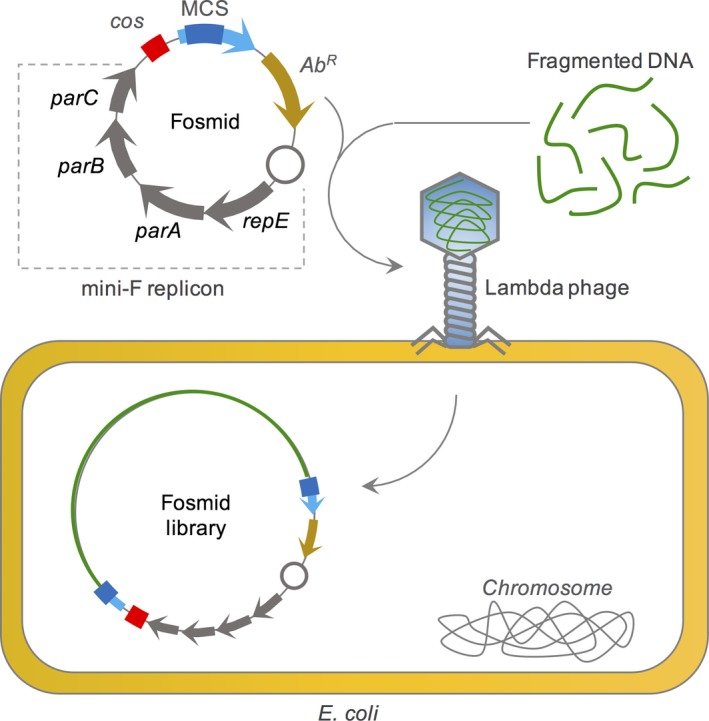
Tools based on minimal fosmids for cloning large DNA fragments. Fosmids are plasmid vectors based on the mini‐F origin of replication that harbour, in addition to MCS and AbR, a cos site for DNA packing in lambda phages. This allows the cloning of very long DNA fragments (up to 50 kb) by ligation and packing into empty lambda phages. The packed DNA is then used to infect E. coli host strains, resulting in the construction of genomic or metagenomic DNA libraries.
Figure 7
Figure 7
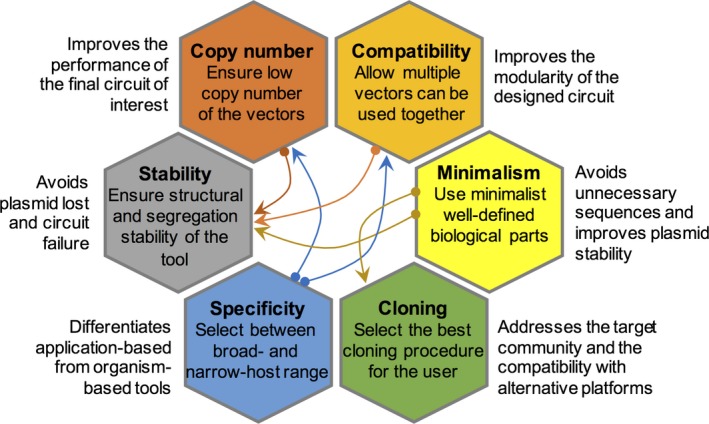
Critical features to consider for efficient vector engineering. In this schematic illustration, outside hexagons represent the main impact of each step on the effectiveness of the tool. Arrows connecting hexagons indicate which features significantly impact each other.

References

    1. Aakvik, T. , Degnes, K. F. , Dahlsrud, R. , Schmidt, F. , Dam, R. , Yu, L. , et al (2009) A plasmid RK2‐based broad‐host‐range cloning vector useful for transfer of metagenomic libraries to a variety of bacterial species. FEMS Microbiol Lett 296: 149–158. - PubMed
    1. Abe, A. , Elegado, E.B. , and Sone, T. (2006) Construction of pDESTR, a Gateway vector for gene disruption in filamentous fungi. Curr Microbiol 52: 210–215. - PubMed
    1. Alberti, S. , Gitler, A.D. , and Lindquist, S. (2007) A suite of Gateway cloning vectors for high‐throughput genetic analysis in Saccharomyces cerevisiae . Yeast 24: 913–919. - PMC - PubMed
    1. Alves, L.F. , Silva‐Rocha, R. , and Guazzaroni, M.‐E. (2017a) Enhancing metagenomic approaches through synthetic biology In Functional Metagenomics: Tools and Applications. Trevor C. Charles, Mark R. Liles. and Angela Sessitsch. (ed). Cham, Switzerland: Springer International Publishing, pp. 75–94.
    1. Alves, L.D.F. , Silva‐Rocha, R. , and Guazzaroni, M.‐E. (2017b) Enhancing metagenomic approaches through synthetic biology In Functional Metagenomics: Tools and Applications María‐Eugenia Guazzaroni. Charles T.C., Liles M.R., and Sessitsch A. (eds). Berlin, Germany: Springer International Publishing, pp. 1–14.