


Neurocognitive mechanisms of emotion-related impulsivity: The role of arousal
- PMID: 30259983
- PMCID: PMC6404980
- DOI: 10.1111/psyp.13293
Neurocognitive mechanisms of emotion-related impulsivity: The role of arousal
Abstract
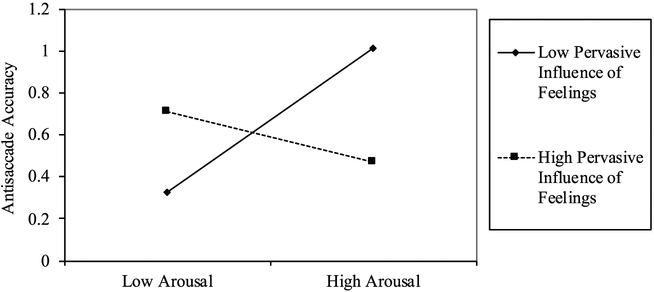
Prior research suggests that a traitlike tendency to experience impulsivity during states of high emotion is robustly associated with many forms of psychopathology. Several studies tie emotion-related impulsivity to response inhibition deficits, but these studies have not focused on the role of emotion or arousal within subjects. The present study tested whether arousal, measured by pupil dilation, amplifies deficits in response inhibition for those high in emotion-related impulsivity. Participants (N = 85) completed a measure of emotion-related impulsivity, underwent a positive mood induction procedure that reduced heterogeneity in mood states, and completed a response inhibition task. Pupil dilation was used to index arousal during the response inhibition task. Generalized linear mixed effect modeling yielded the hypothesized interaction between arousal (pupil dilation) and emotion-related impulsivity in predicting response inhibition performance at the trial level. Emotion-related impulsivity relates to more difficulties with response inhibition during moments of high arousal.
Keywords: cognitive control; emotion; impulsivity; pupillometry; response inhibition.
© 2018 Society for Psychophysiological Research.
Figures

References
-
- Adler NE, & Stewart JE (2007). Reaching for a healthier life: Facts on socioeconomic status and health in the U.S. San Francisco, CA: John D. & Catherine T. Macarthur Foundation Research Network on Socioeconomic Status and Health.
-
- Babiker A, Faye I, & Malik A (2013). Pupillary behavior in positive and negative emotions Paper Presented at the International Conference on Signal and Image Processing Applications, Banff, AB, Canada: 10.1109/ICSIPA.2013.6708037 - DOI
MeSH terms
Grants and funding
LinkOut - more resources
Full Text Sources
Other Literature Sources
Miscellaneous
