


Electrically Controllable Single-Point Covalent Functionalization of Spin-Cast Carbon-Nanotube Field-Effect Transistor Arrays
- PMID: 30260623
- PMCID: PMC6887518
- DOI: 10.1021/acsnano.8b03073
Electrically Controllable Single-Point Covalent Functionalization of Spin-Cast Carbon-Nanotube Field-Effect Transistor Arrays
Abstract
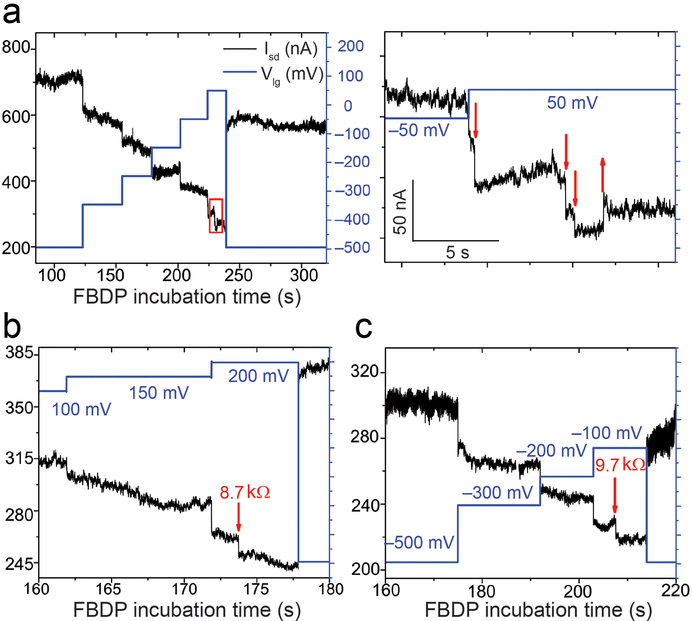
Single-point-functionalized carbon-nanotube field-effect transistors (CNTFETs) have been used to sense conformational changes and binding events in protein and nucleic acid structures from intrinsic molecular charge. The key to utilizing these devices as single-molecule sensors is the ability to attach a single probe molecule to an individual device. In contrast, with noncovalent attachment approaches such as those based on van der Waals interactions, covalent attachment approaches generally deliver higher stability but have traditionally been more difficult to control, resulting in low yield. Here, we present a single-point-functionalization method for CNTFET arrays based on electrochemical control of a diazonium reaction to create sp3 defects, combined with a scalable spin-casting method for fabricating large arrays of devices on arbitrary substrates. Attachment of probe DNA to the functionalized device enables single-molecule detection of DNA hybridization with complementary target, verifying the single-point functionalization. Overall, this method enables single-point defect generation with 80% yield.
Keywords: CNTFET array; DNA melting; carbon nanotube; diazonium; single-point defect; smFET; spin-cast; wafer scale.
Figures




References
-
- Thoma J; Burmann BM; Hiller S; Muller DJ Impact of Holdase Chaperones Skp and SurA on the Folding of Beta-Barrel Outer-Membrane Proteins. Nat. Struct. Mol. Biol 2015, 22, 795–802. - PubMed
Publication types
MeSH terms
Substances
Grants and funding
LinkOut - more resources
Full Text Sources
Other Literature Sources
Miscellaneous
