


Bacterial Diversity in an Alpine Debris-Free and Debris-Cover Accumulation Zone Glacier Ice, North Sikkim, India
- PMID: 30262957
- PMCID: PMC6141397
- DOI: 10.1007/s12088-018-0747-8
Bacterial Diversity in an Alpine Debris-Free and Debris-Cover Accumulation Zone Glacier Ice, North Sikkim, India
Abstract
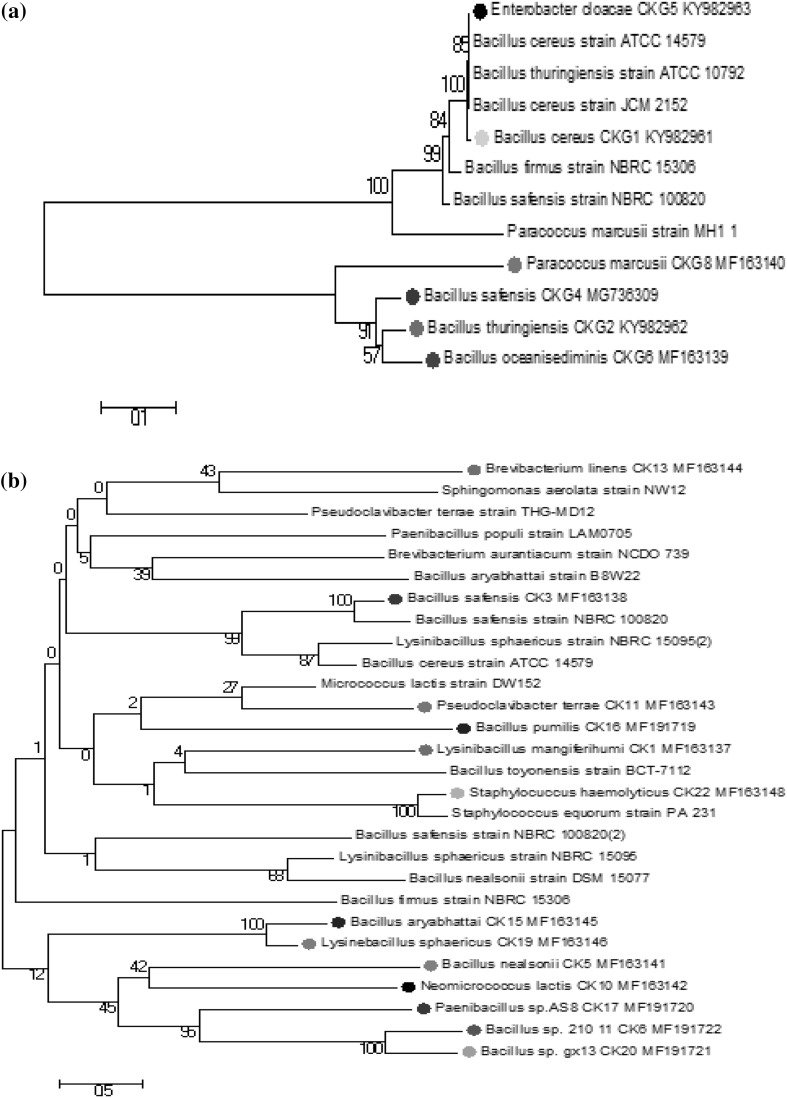
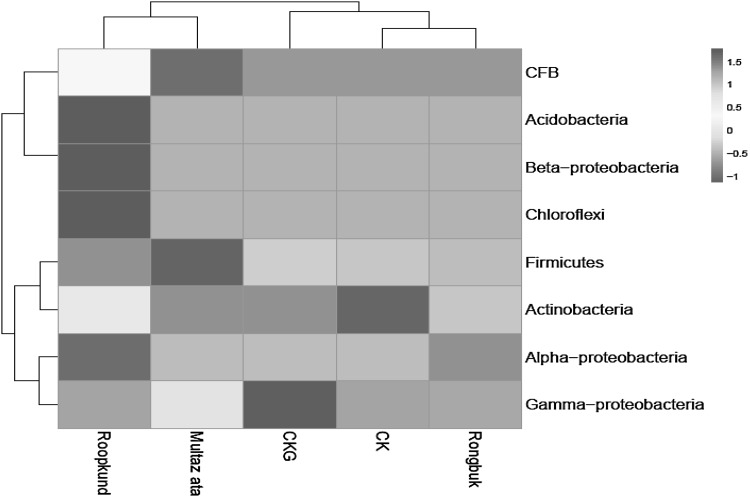
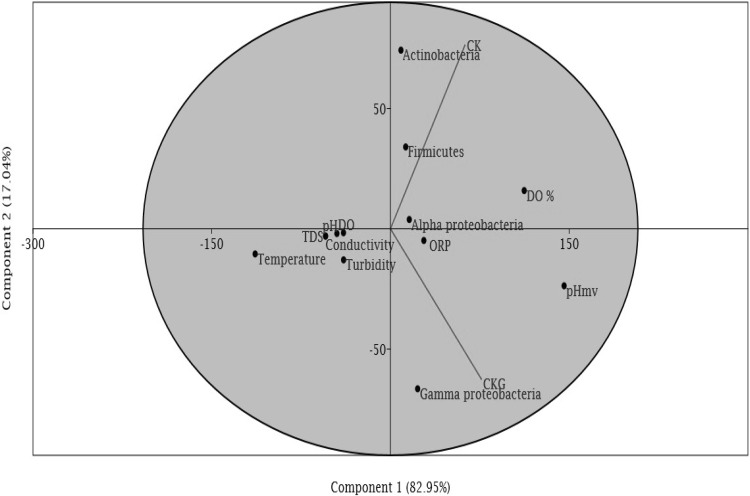
The Himalayas are water tower for billions of people; however in recent years due to climate change several glaciers of Himalaya are receding or getting extinct which can lead to water scarcity and political tensions. Thus, it requires immediate attention and necessary evaluation of all the environmental parameters which can lead to conservation of Himalayan glaciers. This study is the first attempt to investigate the bacterial diversity from debris-free Changme Khang (CKG) and debris-cover Changme Khangpu (CK) glacier, North Sikkim, India. The abundance of culturable bacteria in CKG glaciers was 1.5 × 10⁴ cells/mL and CK glacier 1.5 × 10⁵ cells/mL. A total of 50 isolates were isolated from both the glacier under aerobic growth condition. The majority of the isolates from both the glaciers were psychrotolerant according to their growth temperature. Optimum growth temperatures of the isolates were between 15 and 20 °C, pH 6-8 and NaCl 0-2%. The phylogenetic studies of 16S RNA gene sequence suggest that, these 21 isolates can be assigned within four phyla/class, i.e., Firmicutes, Beta-proteobacteria, Gamma-proteobacteria and Actinobacteria. The dominant phyla were Firmicutes 71.42% followed by Actinobacteria 14.28%, Alpha-proteobacteria 9.52% and Beta-proteobacteria 4.76%. The isolate Bacillus thuringiensis strain CKG2 showed the highest protease activity (2.24 unit/mL/min). Considering the fast rate at which Himalayan glaciers are melting and availability of limited number of research, there is urgent need to study the microbial communities confined in such environments.
Keywords: Changme Khang; Changme Khangpu; Glacier; Psychrophiles; Psychrotolerant.
Conflict of interest statement
Compliance with Ethical StandardsAuthors have no conflict of Interests.
Figures

References
-
- Byers A (2012) Committee on Himalayan Glaciers, hydrology, climate change, and implications for water security. The National Academies Press, Washington, pp 78–103. https://www.nap.edu/initiative/committee
-
- Jarraud M (2012) WMO statement on the status of the global climate in 2012. In: World meteorological organization, Geneva 2, Switzerland, pp 55–67. https://library.wmo.int/
-
- Petschel G (2007) Mitigation of climate change: contribution of working group III to the fourth assessment report of the Intergovernmental panel on climate change. In: Netherlands environmental assessment agency, Netherland. pp 71–76. https://www.ipcc.ch/pdf/assessment
-
- Gupta C, Prakash DG. Role of microbes in combating global warming. Int J Pharm Sci Lett. 2014;4:359–363.
LinkOut - more resources
Full Text Sources
Other Literature Sources
Research Materials