


Should Sex Be Considered an Effect Modifier in the Evaluation of Influenza Vaccine Effectiveness?
- PMID: 30263903
- PMCID: PMC6143149
- DOI: 10.1093/ofid/ofy211
Should Sex Be Considered an Effect Modifier in the Evaluation of Influenza Vaccine Effectiveness?
Abstract
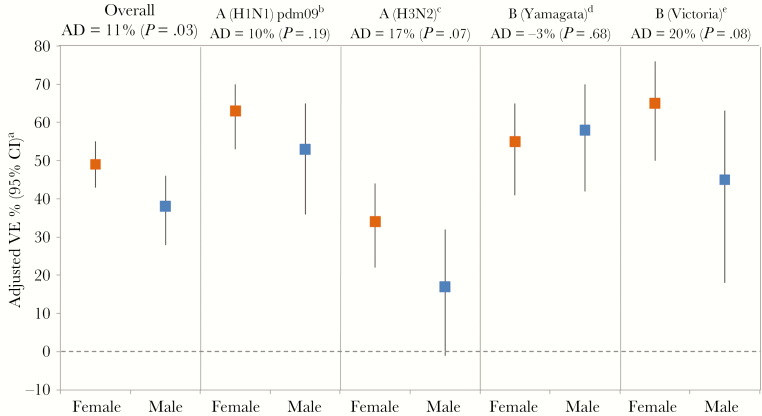
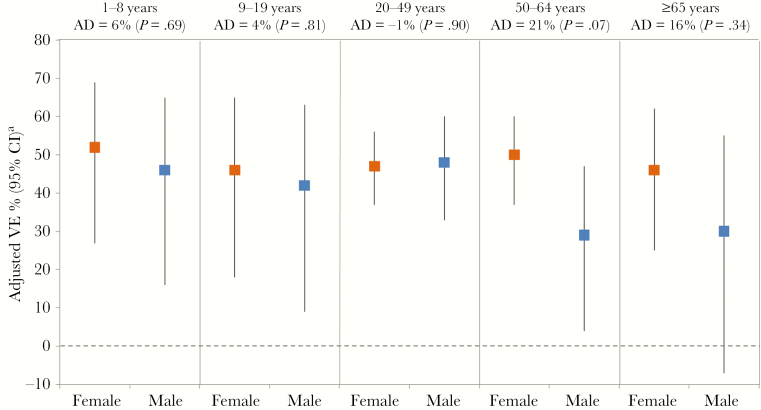
We investigated sex as a potential modifier of influenza vaccine effectiveness (VE) between 2010-2011 and 2016-2017 in Canada. Overall VE was 49% (95% confidence interval [CI], 43% to 55%) for females and 38% (95% CI, 28% to 46%) for males (absolute difference [AD], 11%; P = .03). Sex differences were greatest for influenza A(H3N2) (AD, 17%; P = .07) and B(Victoria) (AD, 20%; P = .08) compared with A(H1N1)pdm09 (AD, 10%; P = .19) or B(Yamagata) (AD, -3%; P = .68). They were also more pronounced in older adults ≥50 years (AD, 19%; P = .03) compared with those <20 years (AD, 4%; P = .74) or 20-49 years (AD, -1%; P = .90) but with variation by subtype/lineage. More definitive investigations of VE by sex and age are warranted to elucidate these potential interactions.
Keywords: effect modification; gender; influenza vaccine; influenza virus; sex; vaccine effectiveness.
Figures
References
-
- World Health Organization. Sex, Gender and Influenza. Geneva: World Health Organization; 2010. http://apps.who.int/iris/handle/10665/44401. Accessed 31 May 2018.
-
- Centers for Disease Control and Prevention. Flu vaccination coverge, United States, 2016–17 influenza seasonhttps://www.cdc.gov/flu/fluvaxview/coverage-1617estimates.htm. Accessed 3 May 2018.
-
- Sue K. The science behind “man flu.” BMJ 2017; 359:j5560. - PubMed
LinkOut - more resources
Full Text Sources
Other Literature Sources
