. 2018 Nov;7(11):5439-5447.
doi: 10.1002/cam4.1791. Epub 2018 Sep 27.

Analysis of solid tumor mutation profiles in liquid biopsy

Affiliations

Analysis of solid tumor mutation profiles in liquid biopsy

Sai A Balaji et al. Cancer Med. 2018 Nov.

Abstract

Liquid biopsy is increasingly gaining traction as an alternative to invasive solid tumor biopsies for prognosis, treatment decisions, and disease monitoring. Matched tumor-plasma samples were collected from 180 patients across different cancers with >90% of the samples below Stage IIIB. Tumors were profiled using next-generation sequencing (NGS) or quantitative PCR (qPCR), and the mutation status was queried in the matched plasma using digital platforms such as droplet digital PCR (ddCPR) or NGS for concordance. Tumor-plasma concordance of 82% and 32% was observed in advanced (Stage IIB and above) and early (Stage I to Stage IIA) stage samples, respectively. Interestingly, the overall survival outcomes correlated to presurgical/at-biopsy ctDNA levels. Baseline ctDNA stratified patients into three categories: (a) high ctDNA correlated with poor survival outcome, (b) undetectable ctDNA with good outcome, and (c) low ctDNA whose outcome was ambiguous. ctDNA could be a powerful tool for therapy decisions and patient management in a large number of cancers across a variety of stages.

Keywords: concordance; ctDNA; monitoring; prognosis; survival outcome.


Figures

Figure 1
Figure 1
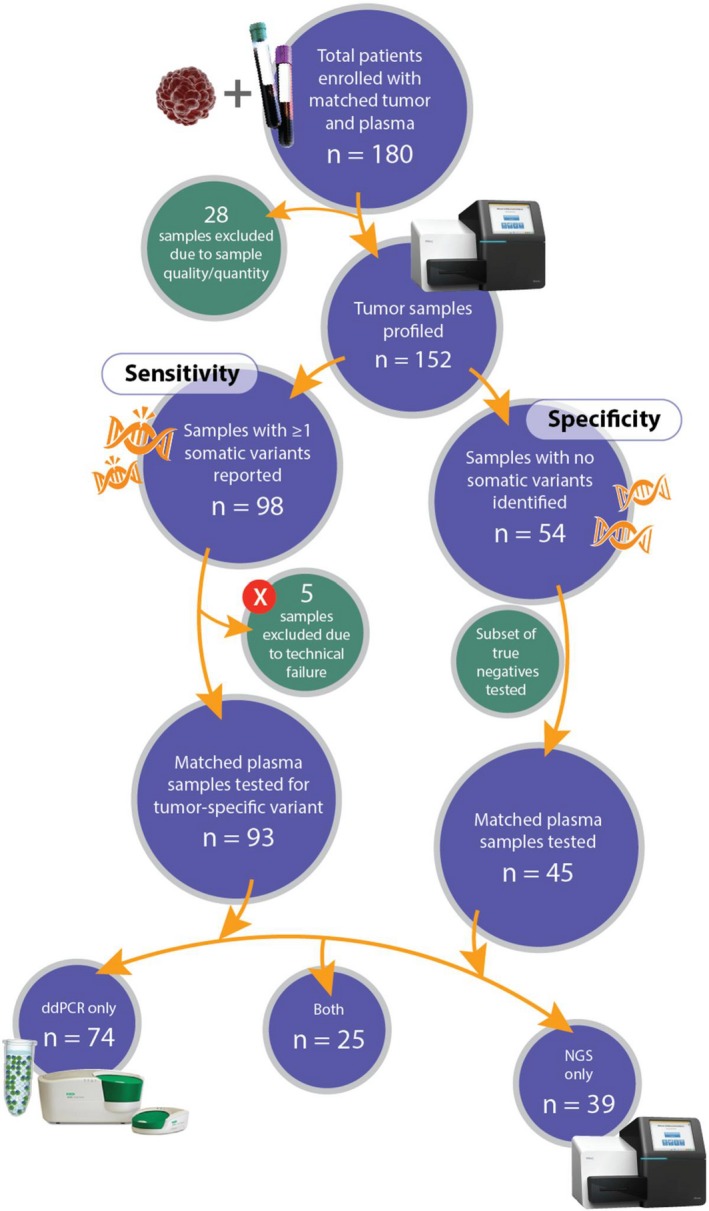
Study design. Matched tumor‐plasma samples were collected from a hundred and eighty cancer patients. Samples were excluded for quality or quantity insufficiency of either tumor or plasma, no reported mutations, or technical failures. The tumor DNA was profiled using targeted NGS sequencing or cobas® EGFR Mutation Test. The mutational status of the matched plasma samples were queried by either ddPCR or NGS or both for concordance
Figure 2
Figure 2
Mutation landscape of tumor samples. A heatmap of mutations across the ten most frequently mutated genes in the tumor samples is shown. Individual samples are depicted along the X‐axis while the mutation summary in the gens is indicated along the Y‐axis. Samples are colored by tissue types, as indicated by the strip along the X‐axis, while the mutations are distinguished by the variant types in the heatmap as indicated in the key. Frequency of mutations per gene is summarized by a histogram along the Y‐axis. The samples represented in the heatmap are sorted by their tissue type
Figure 3
Figure 3
Survival outcomes and baseline ctDNA levels. The Kaplan‐Meier curves indicate the difference in the overall survival of (A) the total cohort and (B) within the advanced stages (Stage IIB and greater). Patients were sorted into three groups: those with high ctDNA (red), low ctDNA (blue), and no detectable ctDNA (green) cp/mL plasma. The median survival of the groups in days is indicated by black dotted lines. The P‐values indicated in the graph are estimated using the log‐rank test. (C) Scatter plot indicating ctDNA (Y‐axis) versus cfDNA (X‐axis) cp/mL plasma. Each point represents one sample. The status of patients is indicated by the color and shape of the point: “Dead” by a red circle, “Progressed” by an orange triangle, and “Alive” by a blue square. The size of each point corresponds to the percent mutant allele frequency (MAF) of the mutation detected in the sample

References

    1. Siravegna G, Bardelli A. Genotyping cell‐free tumor DNA in the blood to detect residual disease and drug resistance. Genome Biol. 2014;15(8):449. - PMC - PubMed
    1. Murtaza M, Dawson SJ, Tsui DW, et al. Non‐invasive analysis of acquired resistance to cancer therapy by sequencing of plasma DNA. Nature. 2013;497(7447):108‐112. - PubMed
    1. Hsieh JS, Lin SR, Chang MY, et al. APC, K‐ras, and p53 gene mutations in colorectal cancer patients: correlation to clinicopathologic features and postoperative surveillance. Am Surg. 2005;71(4):336‐343. - PubMed
    1. Bettegowda C, Sausen M, Leary RJ, et al. Detection of circulating tumor DNA in early‐ and late‐stage human malignancies. Sci Transl Med. 2014;6:224ra24 - PMC - PubMed
    1. Lebofsky R, Decraene C, Bernard V, et al. Circulating tumor DNA as a non‐invasive substitute to metastasis biopsy for tumor genotyping and personalized medicine in a prospective trial across all tumor types. Mol Oncol. 2015;9(4):783‐790. - PMC - PubMed

Substances