. 2019 Feb 15;40(3):765-776.
doi: 10.1002/hbm.24410. Epub 2018 Sep 29.

White matter alterations and tract lateralization in children with dyslexia and isolated spelling deficits

Affiliations

White matter alterations and tract lateralization in children with dyslexia and isolated spelling deficits

Chiara Banfi et al. Hum Brain Mapp. .

Abstract

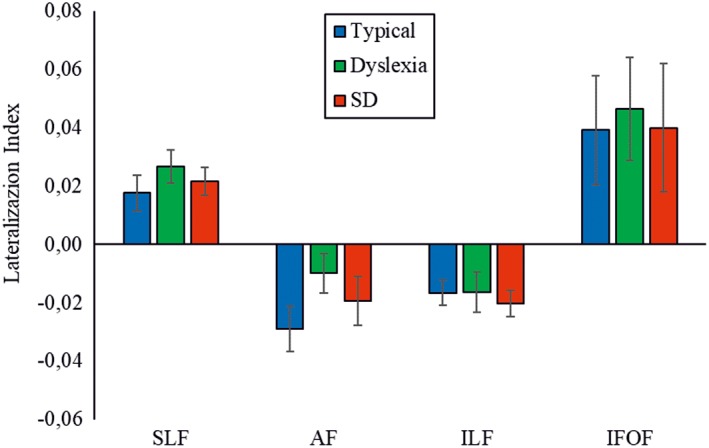
The present study investigated whether children with a typical dyslexia profile and children with isolated spelling deficits show a distinct pattern of white matter alteration compared with typically developing peers. Relevant studies on the topic are scarce, rely on small samples, and often suffer from the limitations of conventional tensor-based methods. The present Constrained Spherical Deconvolution study includes 27 children with typical reading and spelling skills, 21 children with dyslexia and 21 children with isolated spelling deficits. Group differences along major white matter tracts were quantified utilizing the Automated Fiber Quantification software and a lateralization index was calculated in order to investigate the structural asymmetry of the tracts. The two deficit groups mostly displayed different patterns of white matter alterations, located in the bilateral inferior longitudinal fasciculi, right superior longitudinal fasciculus, and cingulum for the group with dyslexia and in the left arcuate fasciculus for the group with isolated spelling deficits. The two deficit groups differed also with respect to structural asymmetry. Children with dyslexia did not show the typical leftward asymmetry of the arcuate fasciculus, whereas the group with isolated spelling deficits showed absent rightward asymmetry of the inferior fronto-occipital fasciculus. This study adds evidence to the notion that different profiles of combined or isolated reading and spelling deficits are associated with different neural signatures.

Keywords: AFQ; dyslexia; isolated spelling deficit; structural asymmetry; tractography.


Figures

Figure 1
Figure 1
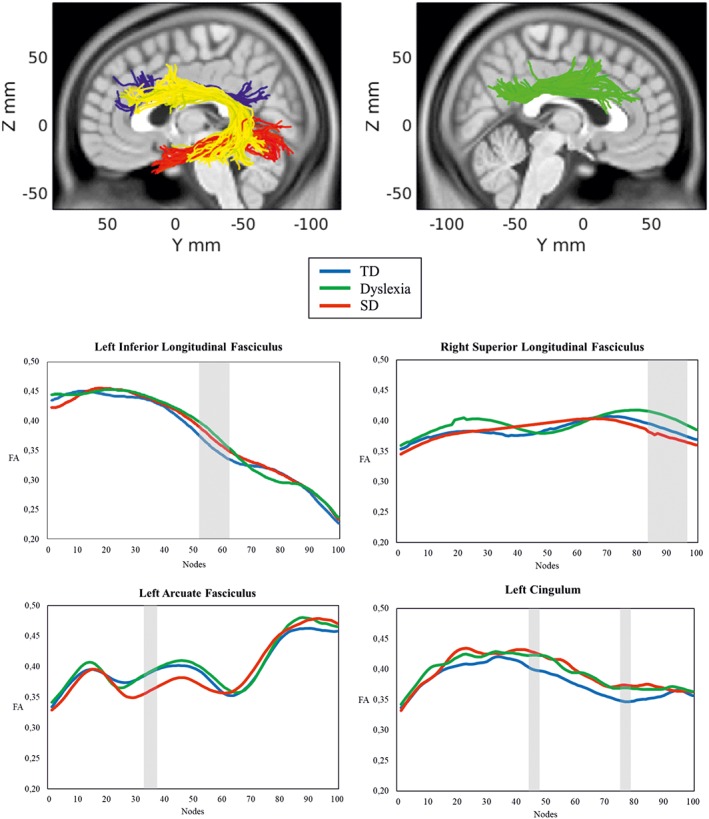
Panel above: Anatomical rendering of the left inferior longitudinal fasciculus (red), right superior longitudinal fasciculus (green), left arcuate fasciculus (yellow), and left cingulum (blue). Panels below: Tract profiles for the three groups (blue: Typical readers and spellers; green: Dyslexia group; red: SD group). The gray‐shadowed areas highlight regions on the tracts where groups differed. Nodes are ordered in the anterior–posterior direction for the left arcuate fasciculus, in the posterior–anterior direction for the inferior, superior longitudinal fasciculi and the cingulum [Color figure can be viewed at http://wileyonlinelibrary.com]
Figure 2
Figure 2
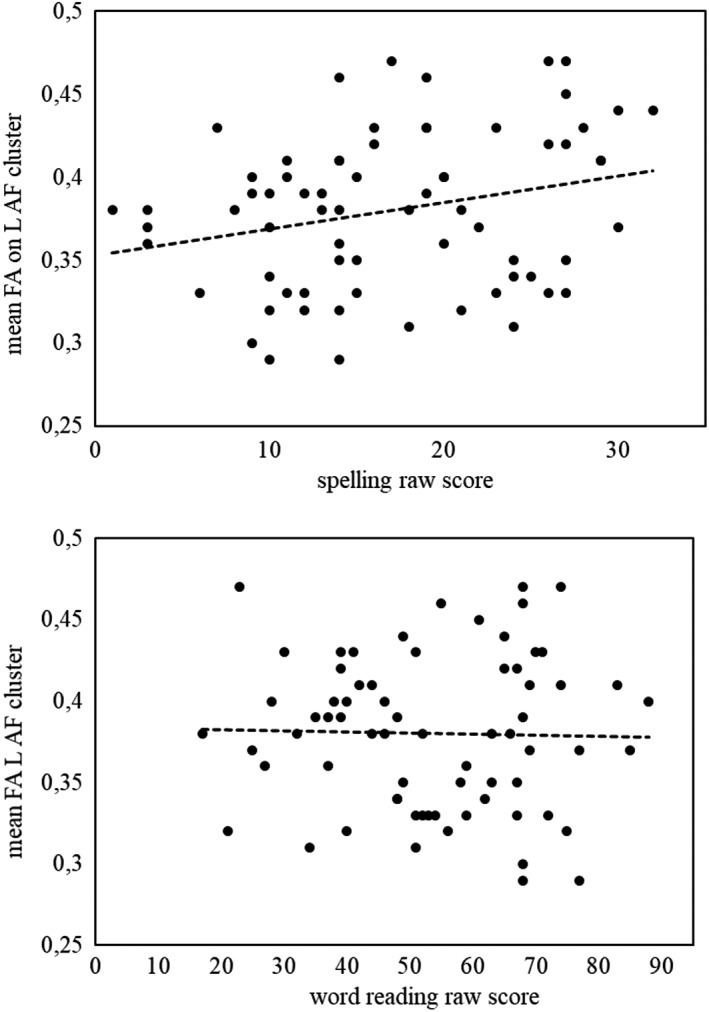
Panel above: Scatterplot presenting significant and positive correlation between FA on the left arcuate fasciculus and spelling. Panel below: Scatterplot presenting absent correlation between FA on the left arcuate fasciculus and word reading
Figure 3
Figure 3
Laterality index in the three groups. Bars represent standard errors. SLF, Superior longitudinal fasciculus; AF, Arcuate fasciculus; ILF, Inferior longitudinal fasciculus; IFOF, Inferior fronto‐occipital fasciculus [Color figure can be viewed at http://wileyonlinelibrary.com]

References

    1. Altarelli, I. , Monzalvo, K. , Fluss, J. , Billard, C. , Dehaene‐lambertz, G. , Galaburda, A. M. , & Ramus, F. (2014). Planum Temporale asymmetry in developmental dyslexia : Revisiting an old question. Human Brain Mapping, 35, 5717–5735. 10.1002/hbm.22579 - DOI - PMC - PubMed
    1. Beaulieu, C. , Plewes, C. , Paulson, L. A. , Roy, D. , Snook, L. , Concha, L. , & Phillips, L. (2005). Imaging brain connectivity in children with diverse reading ability. NeuroImage, 25, 1266–1271. 10.1016/j.neuroimage.2004.12.053 - DOI - PubMed
    1. Catani, M. , Allin, M. P. G. , Husain, M. , Pugliese, L. , Mesulam, M. M. , Murray, R. M. , & Jones, D. K. (2007). Symmetries in human brain language pathways correlate with verbal recall. Proceedings of the National Academy of Sciences, 104(43), 17163–17168. - PMC - PubMed
    1. Catani, M. , Jones, D. K. , & Ffytche, D. H. (2005). Perisylvian language networks of the human brain. Annals of Neurology, 57, 8–16. 10.1002/ana.20319 - DOI - PubMed
    1. Christodoulou, J. A. , Murtagh, J. , Cyr, A. , Perrachione, T. K. , Chang, P. , Halverson, K. , … Gabrieli, J. D. E. (2017). Relation of white‐matter microstructure to Reading ability and disability in beginning readers. Neuropsychology, 31(5), 508–515. 10.1037/neu0000243 - DOI - PubMed

Publication types

LinkOut - more resources