


Changing trends in suicide rates in South Korea from 1993 to 2016: a descriptive study
- PMID: 30269071
- PMCID: PMC6169778
- DOI: 10.1136/bmjopen-2018-023144
Changing trends in suicide rates in South Korea from 1993 to 2016: a descriptive study
Abstract
Objectives: The South Korean government has recently implemented policies to prevent suicide. However, there were few studies examining the recent changing trends in suicide rates. This study aims to examine the changing trends in suicide rates by time and age group.
Design: A descriptive study using nationwide mortality rates.
Setting: Data on the nationwide cause of death from 1993 to 2016 were obtained from Statistics Korea.
Participants: People living in South Korea.
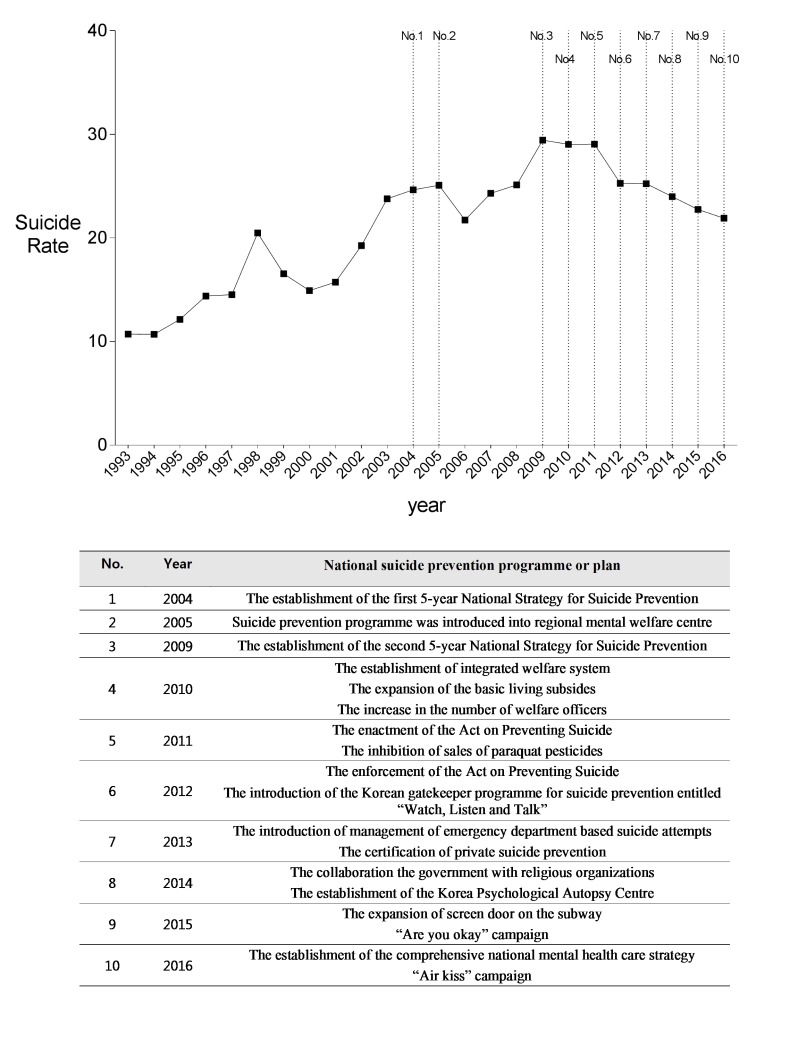
Interventions: Implementation of national suicide prevention policies (first: year 2004, second: year 2009).
Primary outcome measures: Suicide was defined as 'X60-X84' code according to the ICD-10 code. Age-standardised suicide rates were estimated, and a Joinpoint regression model was applied to describe the trends in suicide rate.
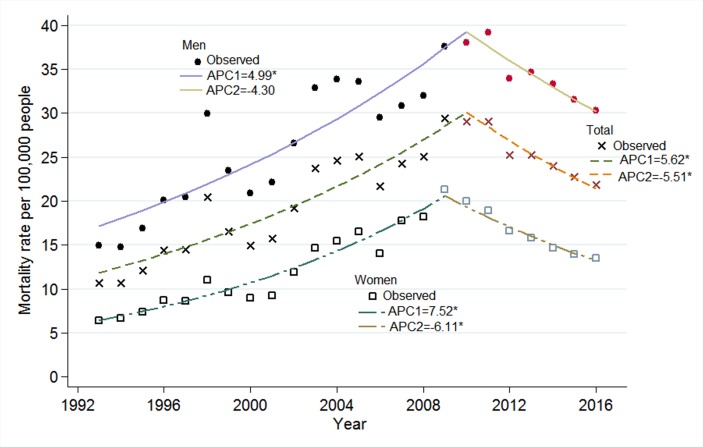
Results: From 2010 to 2016, the suicide rates in South Korea have been decreasing by 5.5% (95% CI -10.3% to -0.5%) annually. In terms of sex, the suicide rate for men had increased by 5.0% (95% CI 3.6% to 6.4%) annually from 1993 to 2010. However, there has been no statistically significant change from 2010 to 2016. For women, the suicide rate had increased by 7.5% (95% CI 6.3% to 8.7%) annually from 1993 to 2009, but since 2009, the suicide rate has been significantly decreasing by 6.1% (95% CI -9.1% to -3.0%) annually until 2016. In terms of the age group, the suicide rates among women of almost all age groups have been decreasing since 2010; however, the suicide rates of men aged between 30 and 49 years showed continuously increasing trends.
Conclusion: Our results showed that there were differences in the changing trends in suicide rate by sex and age groups. Our finding suggests that there was a possible relationship between implementation of second national suicide prevention policies and a decline in suicide rate.
Keywords: Republic Of Korea; mortality; prevention; social and political issues.
© Author(s) (or their employer(s)) 2018. Re-use permitted under CC BY-NC. No commercial re-use. See rights and permissions. Published by BMJ.
Conflict of interest statement
Competing interests: None declared.
Figures
References
-
- World Health Organisation. Suicide data. http://www.who.int/mental_health/prevention/suicide (accessed on 14 Sep 2017).
-
- World Health Organisation. Mental health action plan 2013−2020. http://www.who.int/mental_health/publications/action_plan/en/ (accessed on 14 Sep 2017).
-
- Hendin H, Phillips MR, Vijayakumar L, et al. Suicide and suicide prevention in Asia. Geneva: World Health Organization, 2018.
-
- Organization for Economic Co-operation and Development. OECD health data 2016. https://data.oecd.org/healthstat/suicide-rates.htm (accessed 14 Sep 2017).
-
- Statistics Korea. Cause-of-death statistics 2017. http://kosis.kr/en (accessed 14 Sep 2017).
Publication types
MeSH terms
LinkOut - more resources
Full Text Sources
Medical
