


A Pilot Study of "Peer Navigators" to Promote Uptake of HIV Testing, Care and Treatment Among Street-Connected Children and Youth in Eldoret, Kenya
- PMID: 30269232
- PMCID: PMC6458975
- DOI: 10.1007/s10461-018-2276-1
A Pilot Study of "Peer Navigators" to Promote Uptake of HIV Testing, Care and Treatment Among Street-Connected Children and Youth in Eldoret, Kenya
Abstract
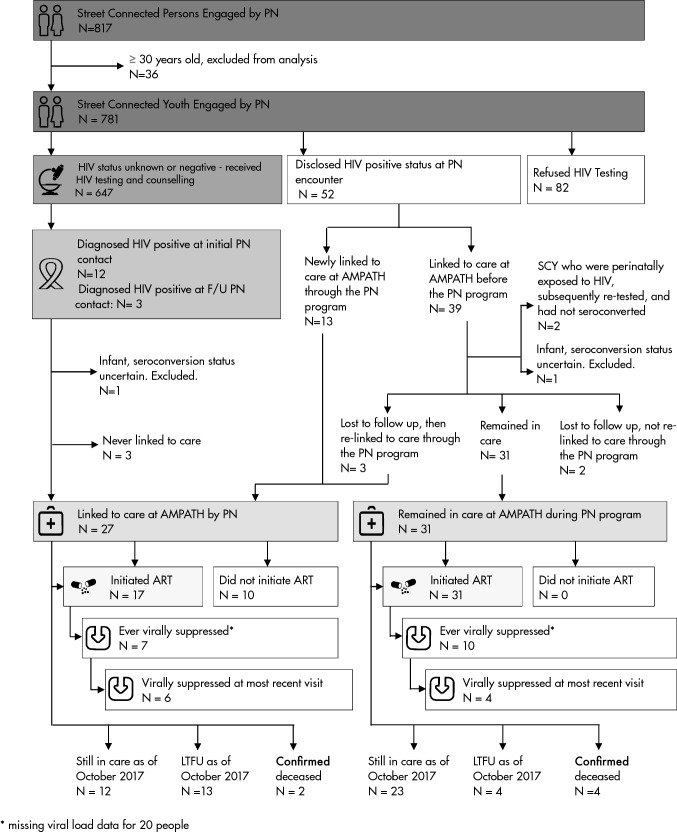
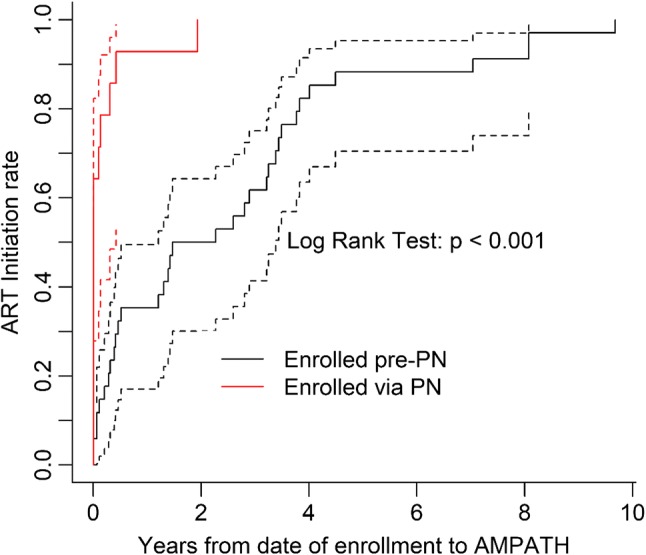
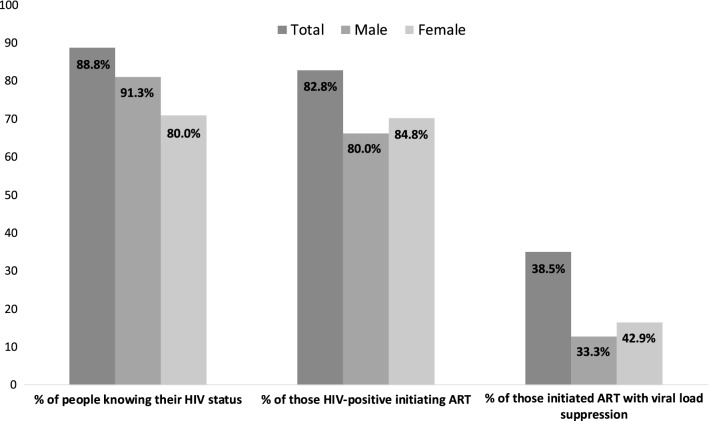
Research suggests a burden of HIV among street-connected youth (SCY) in Kenya. We piloted the use of peer navigators (PNs), individuals of mixed HIV serostatus and with direct experience of being street-connected, to link SCY to HIV testing and care. From January 2015 to October 2017, PNs engaged 781 SCY (585 male, 196 female), median age 16 (IQR 13-20). At initial encounter, 52 (6.6%) were known HIV-positive and 647 (88.8%) agreed to HIV testing. Overall, 63/781 (8.1%) SCY engaged in this program were HIV-positive; 4.6% males and 18.4% females (p < 0.001). Of those HIV-positive, 48 (82.8%) initiated ART. As of October 2017, 35 (60.3%) of the HIV-positive SCY were alive and in care. The pilot suggests that PNs were successful in promoting HIV testing, linkage to care and ART initiation. More research is needed to evaluate how to improve ART adherence, viral suppression and retention in care in this population.
Keywords: Africa; HIV; Homeless; Peer support; Youth.
Conflict of interest statement
Conflicts of interest
The authors have no conflicts of interest to disclose. All persons who made significant contributions to this study and the manuscript are included in the author list. The first draft of the manuscript was written by Pooja Shah, and no other honoraria, grants, or other forms of payment were given to anyone to produce the manuscript.
Research Involving Human and/or Animals Participants
This is a research study involving human participants. The study population includes children, adolescents and youth aged up to 30 years old who, as per self-report, spend the majority of their days and nights on the street or with other street youth in a shared shelter. All procedures performed in studies involving human participants were in accordance with the ethical standards of the institutional and/or national research committee and with the 1964 Helsinki declaration and its later amendments or comparable ethical standards.
Informed Consent
We sought and received institutional ethical approval to collect and disseminate de-identified data from Moi University/MTRH Institutional Research Ethics Committee, and the University of Toronto Research Ethics Board, which included a waiver of written consent and assent.
Figures
References
-
- World Health Organization. HIV and Adolescents. Guidance for HIV testing and counselling and care for adolescents living with HIV. Geneva, Switzerland: WHO; 2013.
-
- Joint United Nations Programme on HIV/AIDS . Global AIDS update 2016. Geneva: Switzerland; 2016.
-
- Joint United Nations Programme on HIV/AIDS . 90-90-90: an ambitious treatment target to help end the AIDS epidemic. Geneva: UNAIDS; 2014.
-
- UN Joint Programme on HIV/AIDS (UNAIDS). The gap report: UNAIDS; 2014. http://www.unaids.org/en/resources/campaigns/2014/2014gapreport/gapreport.
-
- National AIDS Control Council . Kenya’s fast-track plan to end HIV and AIDS among adolescents and young people. Nairobi: National AIDS Control Council; 2015.
MeSH terms
Substances
Grants and funding
LinkOut - more resources
Full Text Sources
Medical
Research Materials
