


Concise Review: Human Pluripotent Stem Cells for the Modeling of Pancreatic β-Cell Pathology
- PMID: 30270471
- PMCID: PMC7379656
- DOI: 10.1002/stem.2913
Concise Review: Human Pluripotent Stem Cells for the Modeling of Pancreatic β-Cell Pathology
Abstract
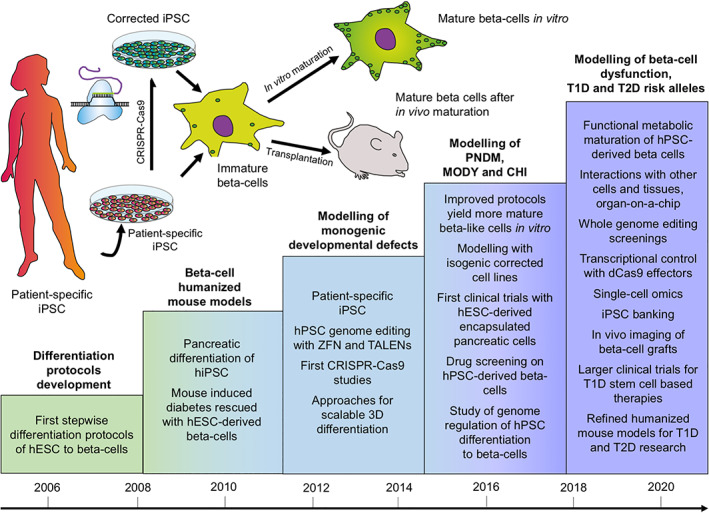
Pancreatic β-cells are the only source of insulin. Disturbances in β-cell development or function may thus result in insulin deficiency or excess, presenting as hyper- or hypoglycemia. It is increasingly evident that common forms of diabetes (types 1 and 2) are pathogenically heterogeneous. Development of efficient therapies is dependent on reliable disease models. Although animal models are remarkably useful research tools, they present limitations because of species differences. As an alternative, human pluripotent stem cell technologies offer multiple possibilities for the study of human diseases in vitro. In the last decade, advances in the derivation of induced pluripotent stem cells from diabetic patients, combined with β-cell differentiation protocols, have resulted in the generation of useful disease models for diabetes. First disease models have been focusing on monogenic diabetes. The development of genome editing technologies, more advanced differentiation protocols and humanized mouse models based on transplanted cells have opened new horizons for the modeling of more complex forms of β-cell dysfunction. We present here the incremental progress made in the modeling of diabetes using pluripotent stem cells. We discuss the current challenges and opportunities of these approaches to dissect β-cell pathology and devise new pharmacological and cell replacement therapies. Stem Cells 2019;37:33-41.
Keywords: CRISPR; Diabetes; Disease modeling; Genome editing; Pancreatic differentiation; Pluripotent stem cells; β-Cells.
© 2018 The Authors Stem Cells published by Wiley Periodicals, Inc. on behalf of AlphaMed Press.
Conflict of interest statement
The authors indicated no potential conflicts of interest.
Figures
References
-
- Ogurtsova K, da Rocha Fernandes JD, Huang Y et al. IDF diabetes atlas: Global estimates for the prevalence of diabetes for 2015 and 2040. Diabetes Res Clin Pract 2017;128:40–50. - PubMed
-
- Ahlqvist E, Storm P, Käräjämäki A et al. Novel subgroups of adult‐onset diabetes and their association with outcomes: A data‐driven cluster analysis of six variables. Lancet Diabetes Endocrinol 2018;6:361–369. - PubMed
Publication types
MeSH terms
LinkOut - more resources
Full Text Sources
Other Literature Sources
Research Materials
