. 2017 Jun 26;2(3):20.
doi: 10.3390/tropicalmed2030020.

Monitoring the Path to the Elimination of Infectious Diseases

Affiliations

Monitoring the Path to the Elimination of Infectious Diseases

John M Drake et al. Trop Med Infect Dis. .

Abstract

During the endgame of elimination programs, parasite populations may exhibit dynamical phenomena not typical of endemic disease. Particularly, monitoring programs for tracking infection prevalence may be hampered by overall rarity, the sporadic and unpredictable timing and location of outbreaks, and under-reporting. A particularly important problem for monitoring is determining the distance that must be covered to achieve the elimination threshold at an effective reproduction number less than one. In this perspective, we suggest that this problem may be overcome by measuring critical slowing down. Critical slowing down is a phenomenon exhibited by nonlinear dynamical systems in the vicinity of a critical threshold. In infectious disease dynamics, critical slowing down is expressed as an increase in the coefficient of variation and other properties of the fluctuations in the number of cases. In simulations, we show the coefficient of variation to be insensitive to under-reporting error and therefore a robust measurement of the approach to elimination. Additionally, we show that there is an inevitable delay between the time at which the effective reproduction number is reduced to below one and complete elimination is achieved. We urge that monitoring programs include dynamical properties such as critical slowing down in their metrics for measuring achievement and avoid withdrawing control activities prematurely.

Keywords: bifurcation delay; critical slowing down; elimination; endgame; smallpox.


Conflict of interest statement

The authors declare no conflict of interest. The founding sponsors had no role in the design of the study; in the collection, analyses, or interpretation of data; in the writing of the manuscript, and in the decision to publish the results.

Figures
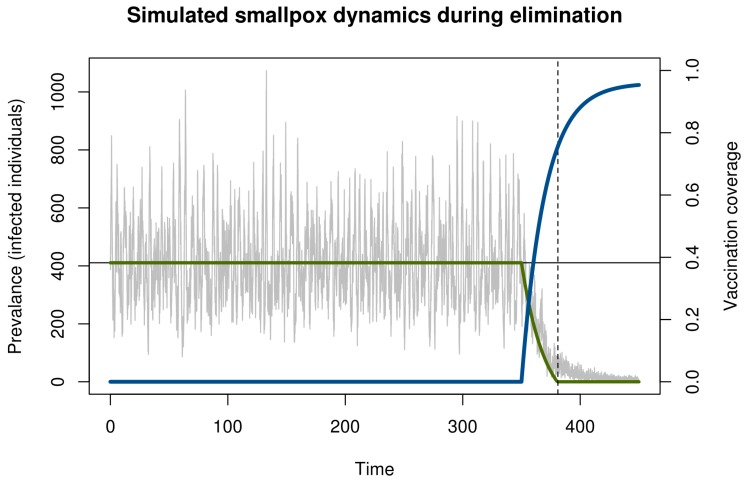
Figure 1
Figure 1
Simulation of smallpox elimination through vaccination. The gray line shows the number of infected individuals over time. The blue line shows vaccination coverage, which approaches a maximum at 0.96. The green line shows the deterministic equilibrium that would be achieved if the vaccination rate was held constant and the time-dependent value. Disease dynamics are given by a stochastic SIR model with states S, I, and R for the number of susceptible, infected, and immune persons, respectively; mean field equations dS/dt = μ(S + I + R)(1−ρ) − βSI/(S + I + R) – ξSμS, dI/dt = βSI/(S + I + R) + ξSμI − γI, and dR/dt = γI + μ(S + I + R)(ρ) − μR; and parameters for transmission β = R0(γ + μ) ≈ 121.7, recovery γ = 365/12 ≈ 30.4, demography μ = 1/60, externally acquired infection ξ = 0.001, speed of vaccination roll out σ = −0.05, maximum possible vaccination coverage a = 0.96, and time that vaccination begins s = 100. All rates are in units of years. The function ρ(t) = a(1 − exp[σ(ts)]) is the time-dependent vaccination rate. Total population size in this simulation was 100,000 individuals. Solutions were obtained using the adaptive tau-leaping algorithm [25]. Parameters follow Ferguson et al. [26].
Figure 2
Figure 2
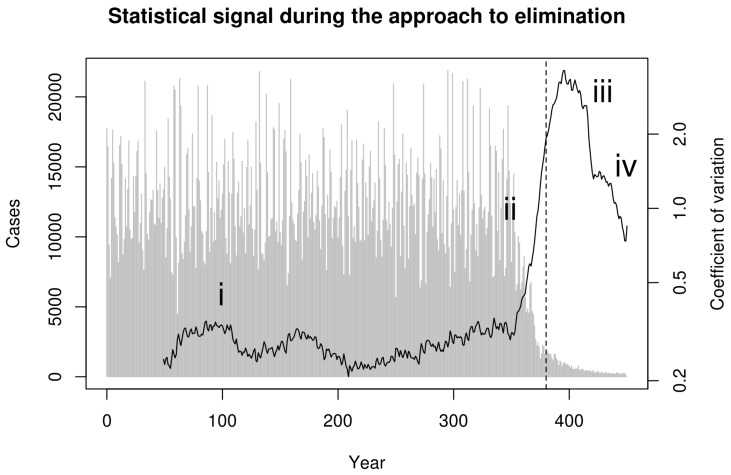
Statistical signal of the approach to the vaccination thresholds in simulated smallpox elimination. Contagion systems exhibit critical slowing down in the approach to a tipping point such as the vaccination threshold. The coefficient of variation in a moving window provides a measurement of the magnitude of this slowing down. We calculated this statistical signature by first detrending with a one-sided filter and then computing the coefficient of variation in a moving window of 30 observations. This figure shows this statistical signal to begin increasing with the onset of vaccination and to rise dramatically as the approach to the vaccination threshold (vertical dashed line) is approached.
Figure 3
Figure 3
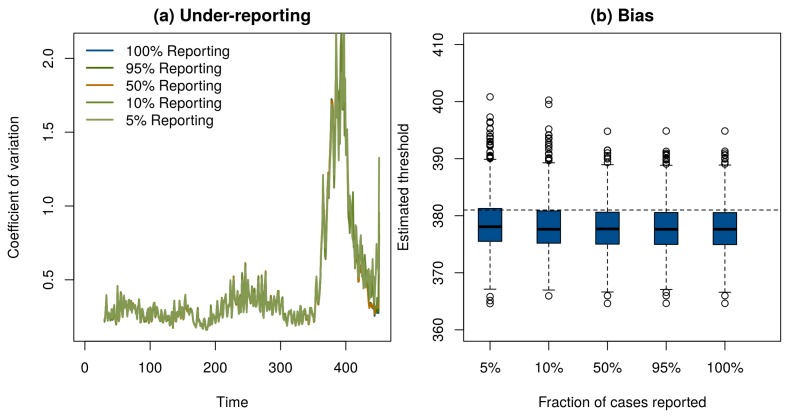
(a) Under-reporting had negligible effect on the ability of the moving window coefficient of variation to respond to the approach to the vaccination threshold. (b) A hyperbolic approximation was used to forecast the time the vaccination threshold would be reached. The estimated crossing time in 1000 simulations (boxplots) was on average slightly earlier than the true time of year 381 (horizontal dashed line). Under-reporting had little effect on the precision or bias of predictions.

References

    1. Hopkins D.R. Disease eradication. N. Engl. J. Med. 2013;368:54–63. doi: 10.1056/NEJMra1200391. - DOI - PubMed
    1. Fenner F., Henderson D.A., Arita I., Jecek Z., Ladnyi I.D. Smallpox and Its Eradication. History of International Public Health. World Health Organization; Geneva, Switzerland: 1998.
    1. Grassly N.C. The final stages of the global eradication of poliomyelitis. Philos. Trans. R. Soc. B. 2013;368:20120140. doi: 10.1098/rstb.2012.0140. - DOI - PMC - PubMed
    1. Biswas G., Sankara D.P., Agua-Agum J., Maiga A. Dracunculiasis (guinea worm disease): Eradication without a drug or a vaccine. Philos. Trans. R. Soc. B. 2013;368:20120146. doi: 10.1098/rstb.2012.0146. - DOI - PMC - PubMed
    1. Rinaldi A. Yaws eradication: Facing old problems, raising new hopes. PLoS Negl. Trop. Dis. 2012;6:e1837. doi: 10.1371/journal.pntd.0001837. - DOI - PMC - PubMed

LinkOut - more resources