. 2018 Feb:61:3-15.
doi: 10.1016/j.lmot.2017.03.009. Epub 2017 Apr 13.

Behavioral and Neural Subsystems of Rodent Exploration

Affiliations

Behavioral and Neural Subsystems of Rodent Exploration

Shannon M Thompson et al. Learn Motiv. 2018 Feb.

Abstract

Animals occupy territories in which resources such as food and shelter are often distributed unevenly. While studies of exploratory behavior have typically involved the laboratory rodent as an experimental subject, questions regarding what constitutes exploration have dominated. A recent line of research has utilized a descriptive approach to the study of rodent exploration, which has revealed that this behavior is organized into movement subsystems that can be readily quantified. The movements include home base behavior, which serves as a central point of attraction from which rats and mice organize exploratory trips into the remaining environment. In this review, we describe some of the features of this organized behavior pattern as well as its modulation by sensory cues and previous experience. We conclude the review by summarizing research investigating the neurobiological bases of exploration, which we hope will stimulate renewed interest and research on the neural systems mediating rodent exploratory behavior.

Keywords: grid cells; head direction cells; hippocampus; hyperactivity; locomotor; navigation; open-field; place cell; spatial behavior.


Figures
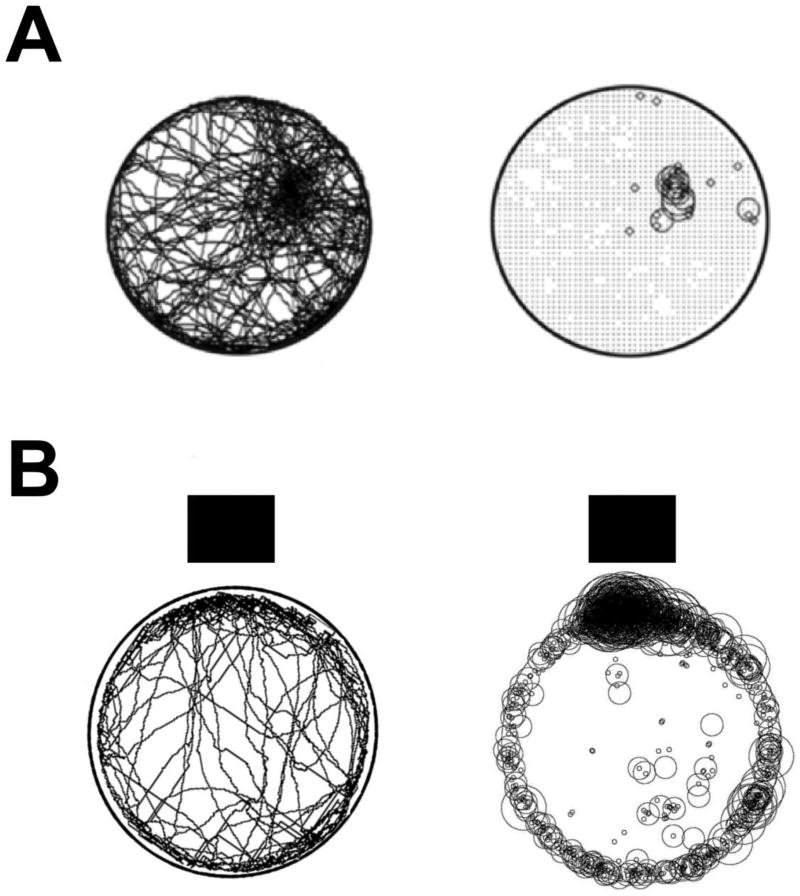
Figure 1
Figure 1
(A) Representative path (left) and stops (right) made by a rat (n = 1) during a 30 min exploration test in darkness. Stop duration is represented by the diameter of the circles (modified from Hines & Whishaw, 2005). (B) Composite of the paths (left) and stops (right) made by a group of rats (n = 6) tested in a 30min session in an open-field in lighted conditions (modified from Clark et al., 2005). The black square represents the location of a proximal visual cue placed next to the open-field. Note that rats display regional preferences in stopping behavior, but that the stops tend to cluster adjacent to the proximal cue when it is provided.
Figure 2
Figure 2
Representative paths (left) and stops (right) from a rat tested in the presence of a cue and a segment of a white wall (pictured is the location of the black visual cue and the white wall segment; note that the black cue was located a short distance from the open-field but the while wall was continuous with the open-field). Stops made by rats tended to cluster near the visual cue on Day 1, but stops clustered near the wall on Day 4 (modified from Lehmann et al., 2007).
Figure 3
Figure 3
Paths (top row), stops (middle row), and locomotor speed (bottom row) from representative mice tested in the presence of no cue, in darkness, with a single proximal cue, and with two proximal cues (black square = proximal cue) for 30 minutes (modified from Clark et al., 2006). Data from a different mouse is shown for each condition. Note that stops made by the mouse tended to cluster adjacent to the proximal cues, but do not display regional specificity in the absence of a proximal cue and in darkness. Locomotion speed is shown by color (green = 1– 20 cm/s, blue = 20–40 cm/s, red = 40+ cm/s). Note that higher locomotion speed (blue and red lines) occur in the dark and no cue conditions as well as in the center of the field in the cued conditions.
Figure 4
Figure 4
(A) Representative path (left) and stops (right) from a hippocampal lesioned rat tested in the presence of a cue and a segment of a white wall (modified from Lehmann et al., 2007). Note that the white wall was continuous with the open-field, but is separated in the illustration for display purposes. (B) Representative path (left) and stops (right) from a hippocampal lesioned rat tested in darkness (modified from Hines & Whishaw, 2005). Note that regional specificity in home base behavior is absent only in darkness.
Figure 5
Figure 5
Color-coded rate maps for a hippocampal place cell, a parahippocampal grid cell, and a border cell (Red = maximum firing rate; blue = minimum firing rate). The size of the testing arena is shown below each rate map. Polar plots of firing rate (spikes/sec) by direction are shown for an ensemble of head direction cells (P, peak firing rate in spikes/s). Place cell and head direction cells are from Berkowitz and Clark (unpublished), and grid and border cells are from Winter et al (2015a; 2015b).

References

    1. Alyan SH. Evidence for resetting the directional component of path integration in the house mouse. Ethology. 1996;102:629–638.
    1. Avni R, Elkan T, Dror AA, Shefer S, Eilam D, Avraham KB, Mintz M. Mice with vestibular deficiency display hyperactivity, disorientation, and signs of anxiety. Behav Brain Res. 2009;202:210–7. - PubMed
    1. Barnett SA. The Rat: A Study of Behavior. Aldine, Chicago: 1963.
    1. Barry C, Hayman R, Burgess N, Jeffery KJ. Experience-dependent rescaling of entorhinal grids. Nat Neurosci. 2007;10:682–4. - PubMed
    1. Berlyne DE. Conflict, arousal, and curiosity. New York, NY, US: McGraw-Hill Book Company; 1960.

LinkOut - more resources