


Interleukin 12/interleukin 23 pathway: Biological basis and therapeutic effect in patients with Crohn's disease
- PMID: 30271076
- PMCID: PMC6158482
- DOI: 10.3748/wjg.v24.i36.4093
Interleukin 12/interleukin 23 pathway: Biological basis and therapeutic effect in patients with Crohn's disease
Abstract
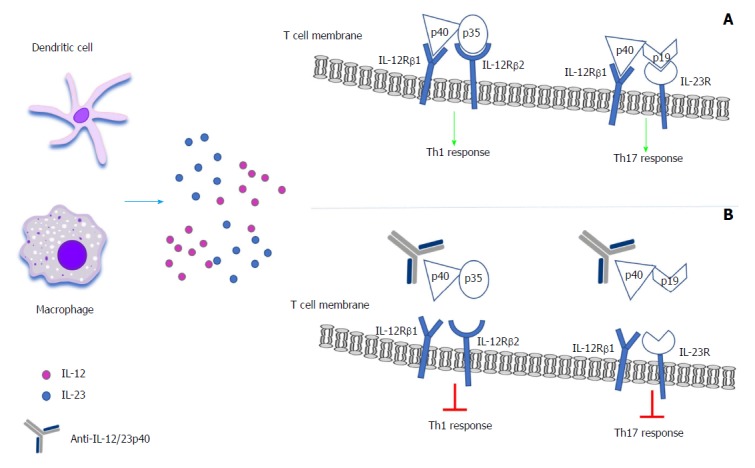
Considering that both innate and adaptive immune responses are involved in the pathogenesis of Crohn's disease (CD), novel therapeutic options have significantly been developed. Biological agents represent an important addition to the conventional treatments for immuno-inflammatory conditions, acting as antagonists of adhesion molecules or various inflammatory cytokines. The interleukin 12 (IL-12)/IL-23 common pathway has been found to play a determinant role in the induction of inflammation in adaptive immune responses. In particular, IL-23 promotes the differentiation of naïve T helper cells into Th17 phenotype with the concomitant secretion of several inflammatory cytokines such as IL-17 and IL-22, whereas IL-12 induces the Th1 polarization and production of critical cytokines such as interferon-γ and tumor necrosis factor. Nowadays, there is increased interest regarding the role of IL-23 as a therapeutic target of CD through the blockage of IL-23 mediated pathways. In this editorial, we focus on the role of IL-12/IL-23 pathway in the regulation of mucosal immunity and in the induction and maintenance of chronic inflammation. In parallel, we critically discuss the available data regarding the therapeutic effect of the IL-12/IL-23 inhibitors and especially of ustekinumab, a human monoclonal antibody which has been recently approved by the United States Food and Drug Administration for the management of moderate-to-severe CD and its potential to be used as first-line therapy in everyday clinical practice.
Keywords: Biological agents; Crohn’s disease; Interleukin 12; Interleukin 12/interleukin 23 blockade; Interleukin 23; Monoclonal antibodies; Ustekinumab.
Conflict of interest statement
Conflict-of-interest statement: Not related to this article.
Figures
References
Publication types
MeSH terms
Substances
LinkOut - more resources
Full Text Sources
Other Literature Sources
Medical
