


Klebsiella grimontii, a New Species Acquired Carbapenem Resistance
- PMID: 30271396
- PMCID: PMC6142883
- DOI: 10.3389/fmicb.2018.02170
Klebsiella grimontii, a New Species Acquired Carbapenem Resistance
Abstract
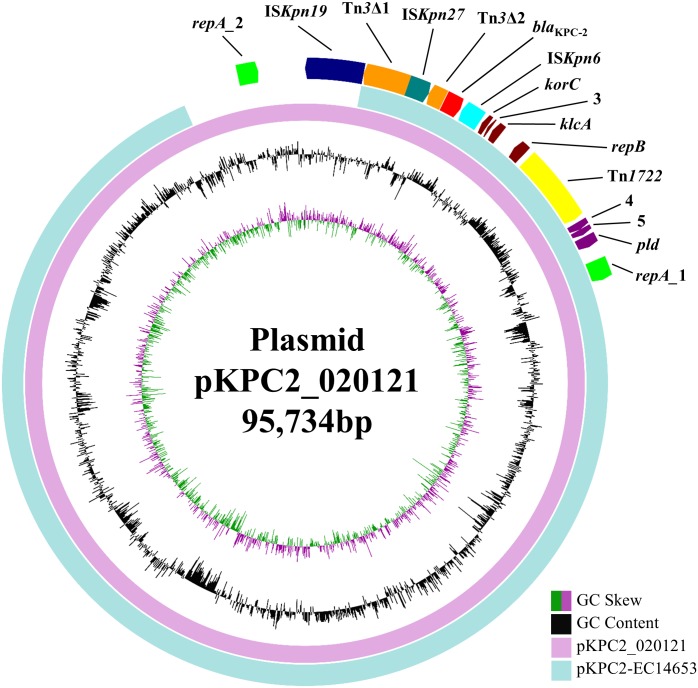
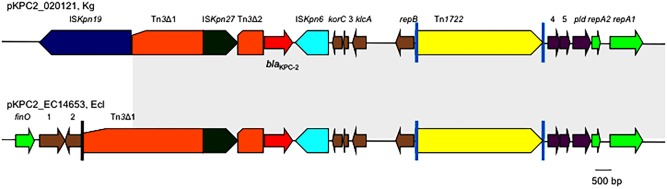
Klebsiella grimontii is a newly identified species closely related to Klebsiella oxytoca, but carbapenem resistance was not identified in the species before. We found a carbapenem-resistant K. oxytoca-like clinical strain, WCHKG020121. The strain was subjected to whole genome sequencing using Illumina HiSeq X10. The precise species identification was established based on average nucleotide identity (ANI) and in silico DNA-DNA hybridization (isDDH) between strain WCHKG020121 and type strains of Klebsiella species. Antimicrobial resistance genes were identified from the genome sequence. The sequence of the bla KPC-2-carrying plasmid was completed using PCR and Sanger sequencing. Conjugation experiments were performed to obtain the plasmid carrying bla KPC-2. All K. grimontii genomes were retrieved from GenBank and were analyzed for antimicrobial resistance genes. Strain WCHKG020121 was resistant to imipenem and meropenem (MIC for both, 32 μg/ml) but was susceptible to colistin (1 μg/ml). Strain WCHKG020121 was initially identified as K. oxytoca using Vitek II but it actually belongs to K. grimontii as it had a 98.81% ANI and 83.4% isDDH value with K. grimontii type strain. Strain WCHKG020121 had bla KPC-2; by contrast, none of other K. grimontii genomes carry any known carbapenemase genes. bla KPC-2 was carried by a 95,734-bp plasmid, designated pKPC2_020121, which contained two different FII(Y) replicons. pKPC2_020121 was closest (93% coverage, 99% identity) to bla KPC-2-carrying plasmids from Enterobacter hormaechei recovered in 2014 at the same hospital. pKPC2_020121 was not self-transmissible, which could be explained by the absence of a conjugation essential gene, traY. In conclusion, we reported the first K. grimontii strain that produced the KPC carbapenemase. Carbapenem resistant K. grimontii may represent a new threat.
Keywords: KPC-2; Klebsiella; Klebsiella grimontii; Klebsiella oxytoca; carbapenemase.
Figures
References
-
- Clinical and Laboratory Standards Institute [CLSI] (2017). Performance Standards for Antimicrobial Susceptibility Testing; Twenty-Seventh Informational Supplement. M100-S27. Wayne, PA: Clinical and Laboratory Standards Institute.
LinkOut - more resources
Full Text Sources
Molecular Biology Databases
