Dental anomalies and their treatment modalities/planning in orthodontic patients
- PMID: 30271761
- PMCID: PMC6144762
- DOI: 10.4103/jos.JOS_37_18
Dental anomalies and their treatment modalities/planning in orthodontic patients
Abstract
Objective: This study was carried to study the prevalence of dental anomalies and treatment modalities/planning among the orthodontic patients.
Materials and methods: A total of 370 orthodontic records including their pre-treatment orthopantomographs (OPG) and study models of orthodontic patients in permanent dentition who attended dental clinic were assessed for impaction, hypodontia, supernumerary, supraocclusion, infraocclusion, and any other anomalies excluding the third molars. The association of anomalies with gender status and racial status was analyzed using Pearson's Chi-square test. A P value of <0.05 is considered as significant. The confidence interval at 95% (CI) was set.
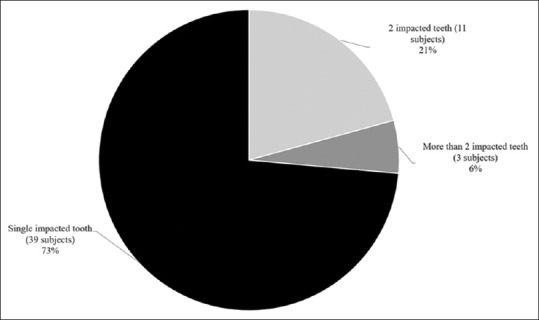
Results: Among the 370 subjects, 105 (28.4%) presented with at least one anomaly. Eighty-five (23%) demonstrated a single anomaly and 20 (5.4%) with more than one anomaly. The most prevalent anomaly was impaction (14.32%), followed by hypodontia (7.03%). The less common anomalies were microdontia (1.08%), dilacerations (0.27%), and generalised enamel hypoplasia (0.27%). Maxillary right lateral incisors and canines were the most common affected teeth and these are located on the maxillary right quadrant. It was evident that dental anomalies were statistically dependant on race (P = 0.025), but independent of gender. The most common treatment planned for these patients was fixed appliance.
Conclusions: Impaction was predominant among 28.4% subjects observed with anomaly and most patients with anomaly are treated with fixed appliances (49%).
Clinical relevance: These anomalies play a great role in occlusion and alignment in treatment planning and relapse for orthodontic treatment.
Keywords: Dental anomalies; hypodonia; impaction; infraocclusion; orthodontic; supernumerary.
Conflict of interest statement
There are no conflicts of interest.
Figures
References
-
- Berkovitz BK, Holland GR, Moxham BJ. Development of the dentitions. In: Berkovitz BK, Holland GR, Moxham BJ, editors. Oral anatomy, embryology, and histology. 4th ed. Edinburgh: Mosby; 2009. p. 358.
-
- Al-Jabaa AH, Aldrees AM. Prevalence of Dental Anomalies in Saudi Orthodontic Patients. J Contemp Dent Pract. 2013;14:724–30. - PubMed
-
- Uslu O, Akcam MO, Evirgen S, Cebeci I. Prevalence of dental anomalies in various malocclusions. Am J Orthod Dentofacial Orthop. 2009;135:328–35. - PubMed
-
- Gupta SK, Saxena P, Jain S, Jain D. Prevalence and distribution of selected developmental dental anomalies in an Indian population. J Oral Sci. 2011;53:231–8. - PubMed
-
- Thongudomporn U, Freer TJ. Prevalence of dental anomalies in orthodontic patients. Aust Dent J. 1998;43:395–8. - PubMed