. 2018 Jun 8:1:66.
doi: 10.1038/s42003-018-0076-9. eCollection 2018.

An automated Design-Build-Test-Learn pipeline for enhanced microbial production of fine chemicals

Affiliations

An automated Design-Build-Test-Learn pipeline for enhanced microbial production of fine chemicals

Pablo Carbonell et al. Commun Biol. .

Abstract

The microbial production of fine chemicals provides a promising biosustainable manufacturing solution that has led to the successful production of a growing catalog of natural products and high-value chemicals. However, development at industrial levels has been hindered by the large resource investments required. Here we present an integrated Design-Build-Test-Learn (DBTL) pipeline for the discovery and optimization of biosynthetic pathways, which is designed to be compound agnostic and automated throughout. We initially applied the pipeline for the production of the flavonoid (2S)-pinocembrin in Escherichia coli, to demonstrate rapid iterative DBTL cycling with automation at every stage. In this case, application of two DBTL cycles successfully established a production pathway improved by 500-fold, with competitive titers up to 88 mg L-1. The further application of the pipeline to optimize an alkaloids pathway demonstrates how it could facilitate the rapid optimization of microbial strains for production of any chemical compound of interest.


Conflict of interest statement

The authors declare no competing interests.

Figures
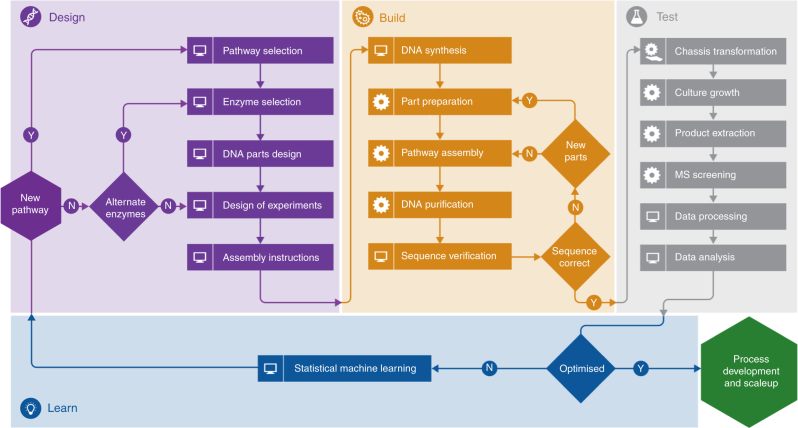
Fig. 1
Fig. 1
The SYNBIOCHEM Design/Build/Test/Learn pipeline for microbial production of fine and speciality chemicals. The pipeline starts at the Design stage (purple) with pathway (RetroPath) and enzyme (Selenzyme) selection tools. Selected DNA parts are sequence optimized (PartsGenie), combined into plasmid libraries through design of experiments (SBC-DoE), and automated assembly instructions are generated (DominoGenie). The Build stage (orange-yellow) prepares assembly parts from commercially synthesized DNA, and assembles them into plasmids via ligase cycling reaction, according to automatically generated worklists driving laboratory automation. Assembled plasmids are first checked by high-throughput restriction digest analysis using capillary electrophoresis, then by commercial Sanger-based sequencing. The Test stage (gray) encompasses high-throughput methods for the growth of microbial production cultures, automated product extraction, and screening via fast-liquid chromatography QqQ mass spectrometry. Data are processed and analyzed with open-source R scripts. Results are analyzed at the Learn stage (blue) through predictive models using statistical methods and machine learning to inform the next round of design. After a number of iterations of this DBTL cycle, successful prototypes are taken forward to process development and scale-up
Fig. 2
Fig. 2
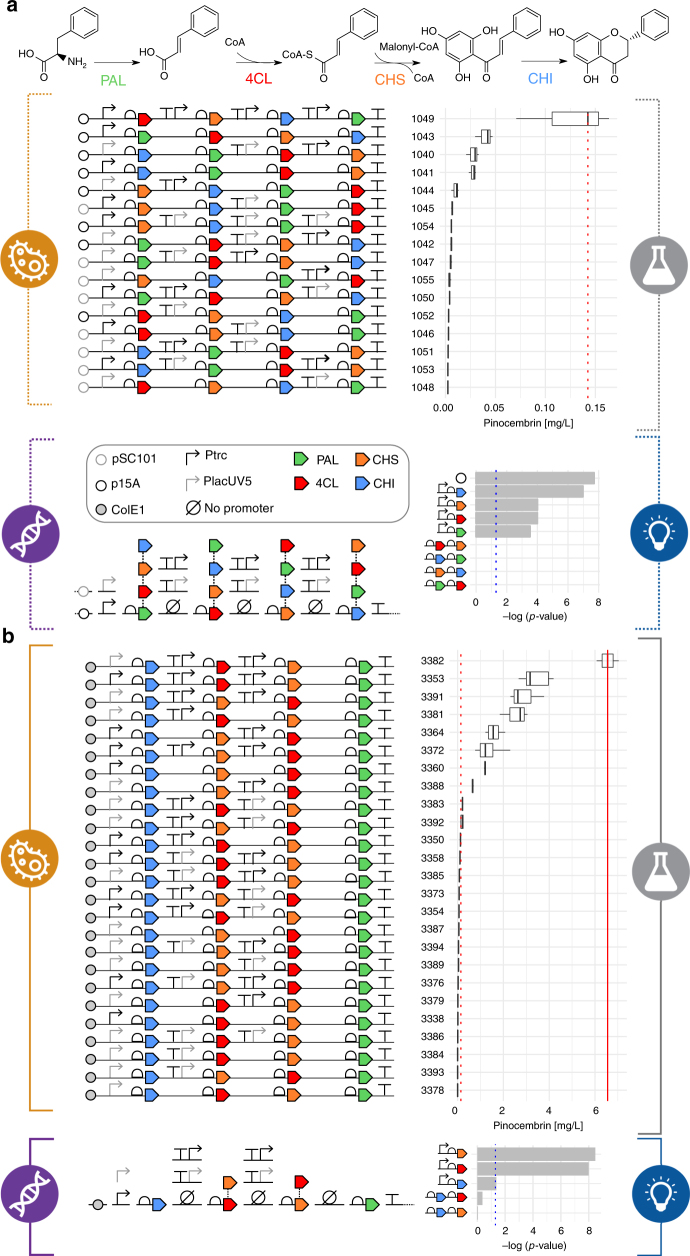
Combinatorial optimization of the (2S)-pinocembrin pathway through the Design/Build/Test/Learn cycle. a A biosynthetic pathway composed of four enzymes (PAL, 4CL, CHS, and CHI; see Supplementary Table 2) was initially selected. In the first DBTL cycle, a combinatorial library totaling 2592 pathway configurations was designed by varying the order of pathway genes, promoter parts (Ptrc and PlacUV5), and plasmid copy numbers (pSC101 and p15a). Through the application of statistical DoE, the designed library was reduced to 16 representative constructs. This pathway library was assembled and expressed in E. coli DH5α to test pinocembrin titers. Statistical analysis was then used to assess the relative effects of the different design factors tested. b In the second DBTL cycle, a new focused combinatorial library was designed, based on experimental factors from the first cycle which correlated with pinocembrin titer. For this second full-factorial library, PAL was fixed at the end of the pathway and CHI at the beginning, while CHS and 4CL were allowed to exchange positions with or without promoter parts
Fig. 3
Fig. 3
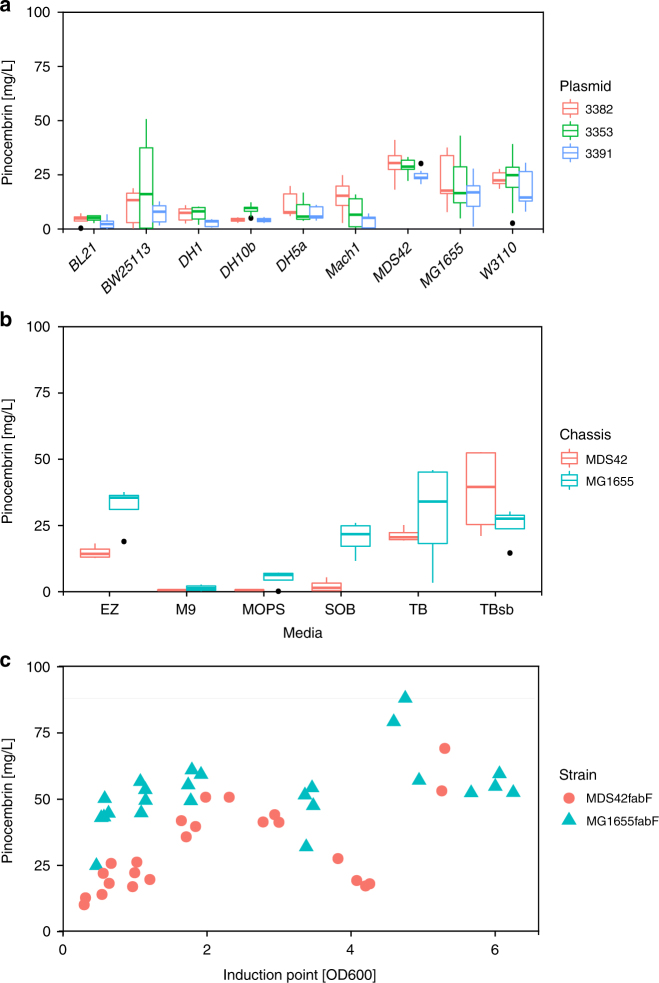
Process development and optimization of (2S)-pinocembrin production. a Chassis selection was performed by expressing the best-performing constructs from the second DBTL cycle (3382, 3353, and 3391; see Supplementary Table 1) in nine different E. coli strains (listed in Table 1) and the results are displayed as box-whisker plots, indicating median and interquartile range. b Media screening was performed by expressing the best construct (3382) in the two best chassis (MG1655 and MDS42) and monitoring pinocembrin in six different growth media (listed in Table 2). c Further optimization was investigated by screening fabF::kan mutants of the best chassis (MG1655 and MDS42) transformed with the best construct (3382), with pathway induction at different culture densities (OD600)
Fig. 4
Fig. 4
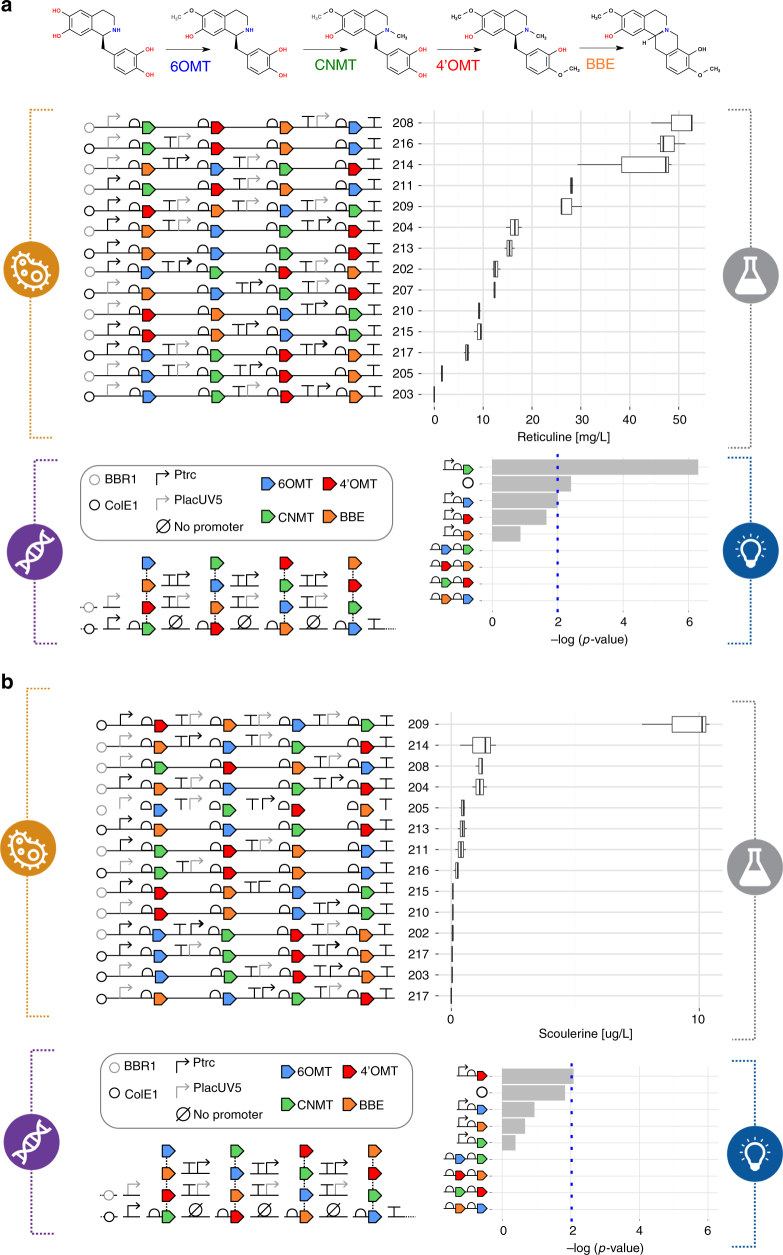
Combinatorial optimization of the (S)-reticuline/(S)-scoulerine pathway through the Design/Build/Test/Learn cycle. a A biosynthetic pathway composed of four enzymes from Coptis japonica (6OMT, CNMT, 4′OMT, and BBE; see Supplementary Table 10) was selected. For this DBTL cycle, a combinatorial library totaling 2592 pathway configurations was designed by varying the order of pathway genes, promoter parts (Ptrc and PlacUV5) and plasmid copy numbers (pBBR1 and ColE1 origins). Through the application of statistical DoE, the designed library was reduced to 16 representative constructs, of which 14 were successfully assembled and tested. This pathway library was expressed in E. coli DH5α and reticuline titers were quantified. Statistical analysis was then used to assess the relative effects of the different design factors tested. b Quantification of scoulerine titers observed for the same 14 constructs and statistical analysis of the relative effects of the different design factors

References

    1. Casini A, Storch M, Baldwin GS, Ellis T. Bricks and blueprints: methods and standards for DNA assembly. Nat. Rev. Mol. Cell Biol. 2015;16:568–576. doi: 10.1038/nrm4014. - DOI - PubMed
    1. Csörgő B, Nyerges Aacute, Pósfai G, Fehér T. System-level genome editing in microbes. Curr. Opin. Microbiol. 2016;33:113–122. doi: 10.1016/j.mib.2016.07.005. - DOI - PubMed
    1. Smanski MJ, et al. Functional optimization of gene clusters by combinatorial design and assembly. Nat. Biotechnol. 2014;32:1241–1249. doi: 10.1038/nbt.3063. - DOI - PubMed
    1. Rogers JK, Church GM. Multiplexed engineering in biology. Trends Biotechnol. 2016;34:198–206. doi: 10.1016/j.tibtech.2015.12.004. - DOI - PubMed
    1. Carbonell P, et al. Bioinformatics for the synthetic biology of natural products: integrating across the Design-Build-Test cycle. Nat. Prod. Rep. 2016;33:925–932. doi: 10.1039/C6NP00018E. - DOI - PMC - PubMed